

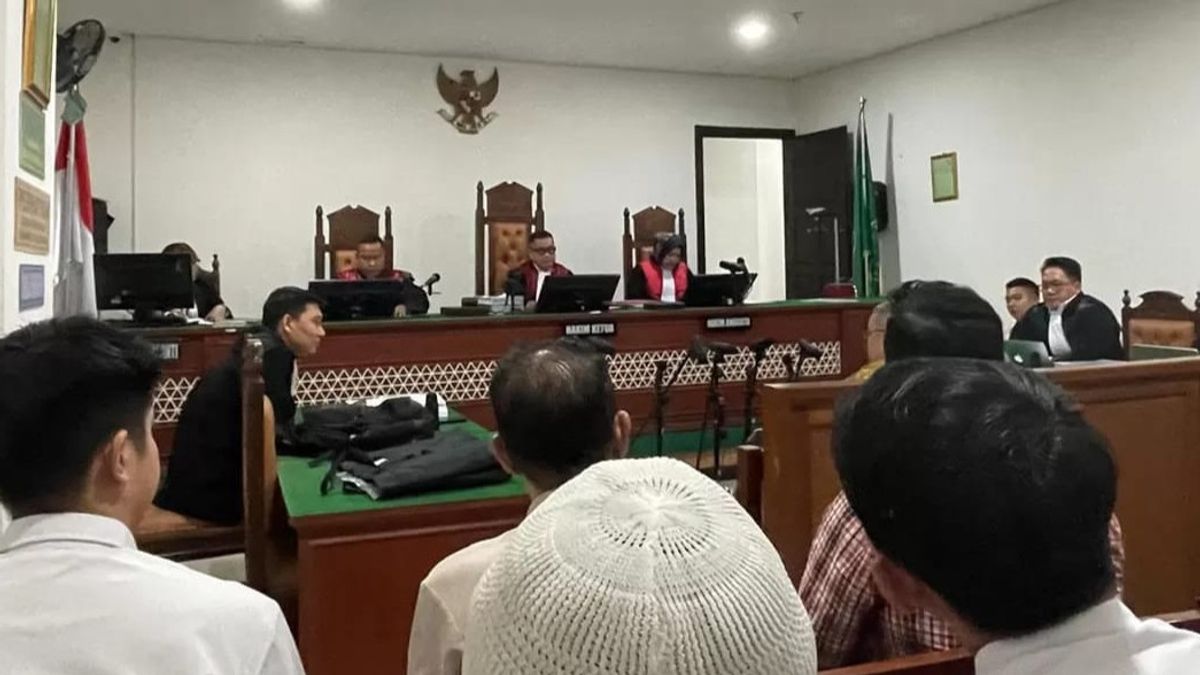


JAKARTA - The trial of alleged embezzlement at the Bekasi PN revealed new facts. Criminal experts said the defendant did not have a criminal element, but only a violation of corporate ethics.
The trial of the alleged embezzlement in office that ensnared the former staff of PT Bumi Alam Segar Calvin Cahya alias CC is rolling again at the Bekasi District Court.
The trial presented forensic criminal expert Dr. Robintan Sulaiman to dissect the legal construction alleged against the defendant.
The trial, which was led by Judge Uli Purnama, focused on the fact that the defendant's role in the company was actually very limited.
According to witnesses, as a staff who is looking for vendors of sugarcane and coconut sugar suppliers, the defendant does not have the authority to determine the price or choose vendors independently. All final decisions regarding the selection of business partners and contract amounts are entirely in the hands of the company's superiors, not in the authority of the defendant.
In the course of his case, CC was accused of embezzlement after an internal audit found a flow of funds from vendors to certain accounts as a form of "thank you".
However, the defense from the legal advisor, Dr. Yusof Ferdinand Wangania, revealed another veil behind the findings.
The lawyer emphasized that his client never abused his position because he did not have direct access to the company's finances.
Regarding the allegation of asking for money to third parties, Dr. Yusof Ferdinand Wangania gave a firm clarification based on evidence at the trial.
"CC did not ask vendors for money as a deposit in every purchase of raw materials as alleged, in the internal audit results it said that the auditor confirmed to 6 vendors, it turned out that in the trial only 1 vendor was confirmed by the auditor," said Dr. Yusof in a statement received, Wednesday, May 13, 2026.
More shocking, the lawyer revealed evidence of a recording of a conversation showing that the vendor denied having a deposit of money per kilogram of raw material from the defendant.
The facts of the trial revealed that the vendor was allegedly directed to provide incriminating testimony. In addition, CC's confession in the internal audit was allegedly made under pressure after being held captive for several dozen hours by certain parties.
Dr. Yusof again added details about the irregularities in the process of proving this.
"In the second recording evidence, the vendor admitted that the vendor had been instructed to make a confession to CC. In the trial, it was also proven that CC's confession in the internal audit was a forced confession because CC was detained for about 12 hours and forced to admit to an act that he did not commit," he said.
Another anomaly highlighted was the absence of a criminal expert from the prosecutor's side who had previously given testimony at the investigation stage.
This is considered by the lawyer to make the evidence invalid in form. In addition, the use of external auditor experts is also questioned because it only recalculates the conclusions of investigators after the CC is designated as a suspect, so that its value is considered subjective.
Dr. Yusof expressed his opinion regarding the position of the auditor in front of the panel of judges.
"The external auditor who was present only re-calculated what the investigators had concluded, this cannot also be judged by the panel of judges and must be set aside, because this expert was used by the investigators in addition to only re-calculating, it was also used after CC was named a suspect," he said.
Meanwhile, Dr. Robintan Sulaiman as a forensic criminal expert explained that the main condition for embezzlement in office is the existence of full authority and control over company funds.
"If the matter as conveyed by the judge that there are other people (vendors) who give money to someone who works in company A who is the place where the vendor supplies raw materials, without raising the price that has been agreed upon together and the price does not pass the price set by the person's boss, it is an absolute violation of ethics. committed by the person," he said.
Closing the trial that day, the legal advisor concluded that based on expert testimony, this case is more inclined towards internal disciplinary violations than the criminal realm. All material elements in the alleged article are considered irrelevant to the defendant's position.
"The main elements in Article 488 of the Criminal Code, which the defendant is charged with, are not met," said Dr. Yusof.
The English, Chinese, Japanese, Arabic, and French versions are automatically generated by the AI. So there may still be inaccuracies in translating, please always see Indonesian as our main language. (system supported by DigitalSiber.id)
Most Popular Tags
#Prabowo Subianto #donald trump #Febrie Adriansyah #8791 #giias 2026Popular


