



JAKARTA - The summer air in Beijing is starting to sting. Walking outside without a head covering feels dizzy, especially when the white fluff from the cotton tree flies in various corners of the city, disturbing the nose and eyes. This condition makes Beijing not a favorite choice for some people.
But for some others, Beijing remains one of the top destinations in China, no matter the season.
From January to May this year, a number of heads of state and government came to Beijing. They include British Prime Minister Keir Starmer, South Korean President Lee Jae-myung, Canadian Prime Minister Mark Carney, German Chancellor Friedrich Merz, President of Uruguay Luis Lacalle Pou, Spanish Prime Minister Pedro Sánchez, President of Tajikistan Emomali Rahmon, and of course the most awaited figure, President of the United States Donald Trump.
So what is the condition of Beijing ahead of Trump's arrival? Is it still hot and tight as usual?
As the capital of the country, Beijing has a stricter level of security than other cities, especially around Tiananmen Square, the Great Hall of the People and government buildings around it.
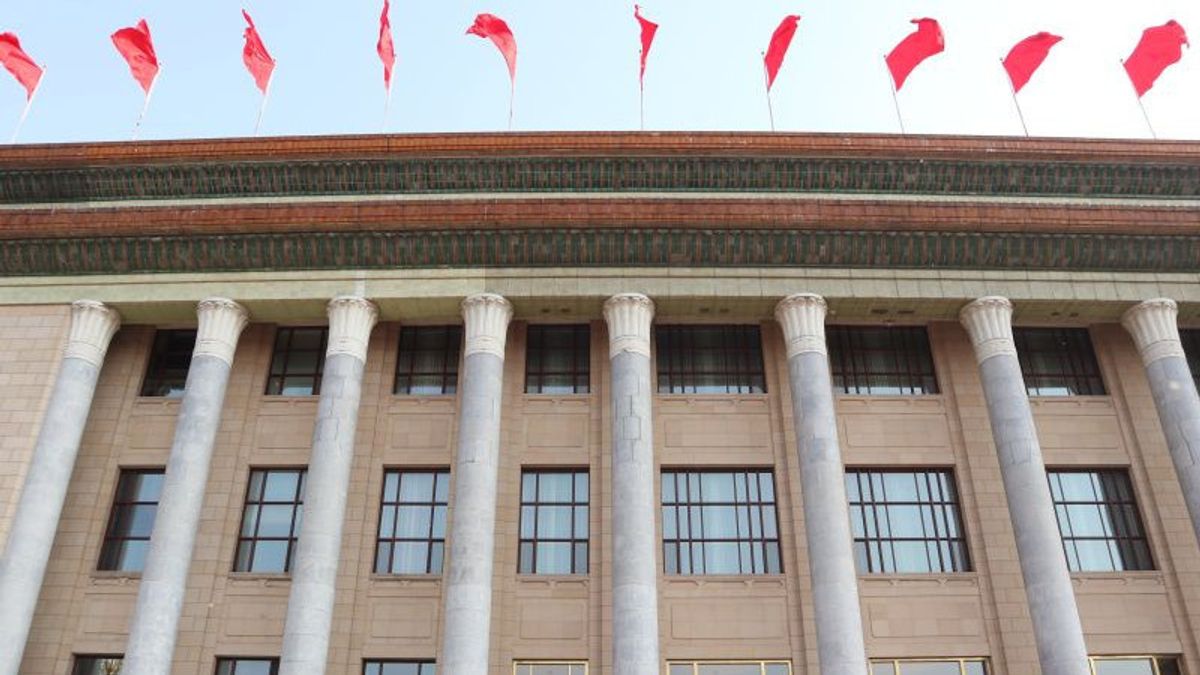
President Xi and Donald Trump themselves are planning to meet at the Great Hall of the People (人民大会堂 dibaca Rénmín Dàhuìtáng), the main symbol building of the People's Republic of China located on the west side of Tiananmen Square.
The Great People's Hall was established at the suggestion of the founder of the People's Republic of China, Mao Zedong, who wanted a large hall for people's meetings. The building was then officially established on September 24, 1959 as a gift for the 10th anniversary of the founding of the People's Republic of China.
As the name implies, "Da" or "Big", this building is indeed standing majestically on an area of 150,000 square meters with a building area of 171,800 square meters. Its main feature lies in the facade shaped like a mountain, with the middle part higher and the left-right side lower, symbolizing the stability of the country.
The building is also surrounded by 134 round pillars, 12 of which are 25-meter-high marble pillars at the east gate (main gate) with the RRC emblem on top.
However, the heads of state generally enter through the north door facing Chang'an Road, one of the main streets in Beijing. If the weather is not good or there are certain considerations, the large hall on the north side of the Great Hall of the People is chosen as the location of the welcoming ceremony, although the ceremony is usually held in the front yard of the East Gate.
On Tuesday (12/5), the hall was empty. A carpet of red carpet stretched under the light of the chandelier lights, while giant jars stood in the corners of the room.
On that day, President Xi received at least three official guests, namely the Crown Prince and Senior Minister at the Prime Minister's Office of Brunei Darussalam Al-Muhtadee Billah, Director General of UNESCO Khaled El-Enany and President of Tajikistan Emomali Rahmon consecutively from 16.00 - 18.00.
The entourage who took part in the three meetings was not too large, so the rooms used were small and medium-sized rooms with giant tables that gave the impression of "close but far away" during the meeting.
There was also no different decoration inside the Great Hall of the People. The Red Flag with Five Stars (五星红旗 or Wǔ Xīng Hóng Qí) was installed together with the red, white, green flag of Tajikistan, which was installed on a number of poles around Tiananmen Square, becoming the only marker of the head of state from Tajikistan visiting Beijing that day.
The Brunei flag was only displayed in the meeting room between Chinese President Xi Jinping and Prince Al-Muhtadee Billah. The prince did not receive a state welcome because he was not the head of state.
In terms of security, the number of police vehicles that are usually on standby around the Great Hall of the People seems to have increased. A number of intersections are also closed to pedestrians, while cyclists are required to show identification cards at several checkpoints around Tiananmen Square and the Great Hall of the People. Such checks are actually also often carried out on weekdays, even without the visit of the head of state.
The area is indeed always guarded more strictly than other areas in Beijing. In addition to being the location of the annual session of the Chinese parliament, party conferences, and meetings of heads of state, the place is also considered to have important symbolic meaning. China's first Prime Minister, Zhou Enlai, once said that the area represented the principle of "the people are the masters of the country", so its authority must be maintained.
In addition to the Great People's Hall, Trump is also scheduled to visit the Temple of Heaven or Tiāntán (天坛), a complex built in 1420 during the Ming Dynasty. The place was originally used as a place of worship to the god of the sky in winter and prayer for good harvests in the spring.
The main building in the complex is the Qinian Hall or Hall of Prayer for Good Harvests. The building is circular in shape as a symbol of the sky, while the courtyard and outer fence are square in shape, symbolizing the earth. The entire structure was built without iron nails, but using traditional Chinese wood-joining techniques. The arrangement of the three-story building also symbolizes the relationship between the sky, man, and earth.
Based on local media reports, the management of the Langit Temple has announced the temporary closure of the entire area on May 13-14. Even the Qinian Hall has been closed since May 12.
Indeed, a number of heads of state received special treatment from Chinese President Xi Jinping.
During his last visit in 2017, Trump was invited by Xi to visit the Forbidden City, which is right across Tiananmen Square. A similar treatment was also received by French President Emmanuel Macron who gained private access to the Forbidden City in December 2025 and accompanied Xi to Chengdu. Meanwhile, King Willem-Alexander of the Netherlands has several times received personal meetings with Xi and First Lady Peng Liyuan in Zhongnanhai, the official residence of the Chinese President, during visits in 2015 and 2018.
Meeting contents
Until the day before the meeting, the Chinese government has not explained in detail the agenda to be discussed by Chinese President Xi Jinping and US President Donald Trump in Beijing.
"During President Trump's visit to China, the two heads of state will have an in-depth exchange of views on major issues concerning China-US relations and world peace and development," Chinese Foreign Ministry spokesman Guo Jiakun said at a press conference in Beijing, Wednesday (13/5).
However, Guo Jiakun did not elaborate on what he meant by "major issues".
Before leaving for Beijing, Trump only mentioned the sale of US weapons to Taiwan and the fate of Hong Kong media entrepreneur Jimmy Lai who is in prison as part of the agenda for talks.
Trump is also reported to have brought dozens of CEOs and executives of major US companies. They include Larry Fink, Stephen Schwarzman, Kelly Ortberg, Brian Sikes, Jane Fraser, and Jim Anderson.
Also joining were Larry Culp, David Solomon, Jacob Thaysen, Michael Miebach, Dina Powell McCormick, and Sanjay Mehrotra.
Then Larry Culp (CEO of GE Aerospace), David Solomon (CEO of Goldman Sachs), Jacob Thaysen (CEO of Illumina), Michael Miebach (CEO of Mastercard), Dina Powell McCormick (President and Vice Chairman of Meta), Sanjay Mehrotra (CEO of Micron),
Other names are Cristiano Amon, Elon Musk, Ryan McInerney, and Jensen Huang who are said to have joined the Air Force One plane at the last moment during refueling in Alaska.
Xinhuanews on Wednesday (13/5) also published a long-term plan titled "China-US relations cannot go back to the past, but can have a better future".
The article said that China-US relations had experienced two phases of ebb and flow in the past decade. The first phase was the trade war against China launched by the US in 2018, while the second phase was concentrated in 2025.
"In just a few months, China-US relations have undergone a process from an atmosphere that was like a storm to returning to a stable trend," the article said.
Currently, the China-United States dialogue is said to take place in a more equal position, with more pragmatic communication and a clearer foundation.
China also stressed that it was not challenging or trying to replace the United States, even admitting that it was happy to see the US remain prosperous and develop. However, Beijing again emphasized that Taiwan was the most important and sensitive core issue in relations between the two countries.
Chinese President Xi Jinping has repeatedly told US President Donald Trump that Taiwan is part of China. Beijing, according to Xi, will continue to defend its sovereignty and territorial integrity and will never allow Taiwan to separate.
Therefore, the meeting in Beijing is expected to be able to encourage the two countries to choose to walk side by side. This step is considered not only beneficial for China and the US, but also for the future of the world.
The world is indeed looking forward to the meeting of the two leaders of the big countries who are conducting official negotiations in the "big building" and a private tour to the "Temple of Heaven"
The wait is reminiscent of a verse from the poem of Emperor Qianlong (1735-1796) when offering sacrifices at the Temple of Heaven: "There is autumn and happiness spreads to all corners of the country."
If China and the United States both get positive results from the meeting, hopefully the good impact can also be felt by other countries in the world.
The English, Chinese, Japanese, Arabic, and French versions are automatically generated by the AI. So there may still be inaccuracies in translating, please always see Indonesian as our main language. (system supported by DigitalSiber.id)
Most Popular Tags
#Prabowo Subianto #donald trump #firearm #8791 #giias 2026Popular


