

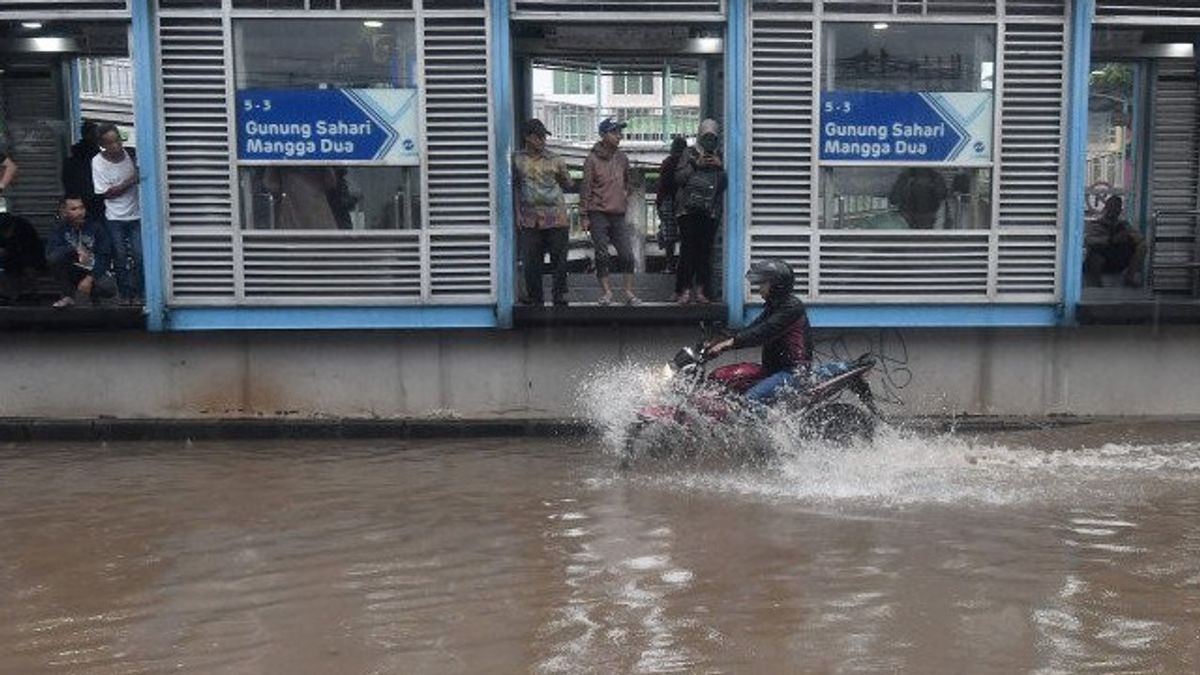


JAKARTA - Coordinating Minister for Infrastructure and Regional Development Agus Harimurti Yudhoyono (AHY) emphasized that handling floods in Jakarta and the buffer area cannot only rely on infrastructure development.
The government also needs community involvement to maintain river cleanliness and not throw garbage indiscriminately. This was conveyed by AHY when attending the National River Service Movement at the Inlet Sodetan Kali Ciliwung towards the East Flood Canal (KBT), Bidara Cina, East Jakarta, Thursday, May 7.
The activity was also attended by Deputy Minister of Public Works Diana Kusumastuti, the ranks of the Ministry of PUPR, the DKI Jakarta Provincial Government, environmental communities, and high school and junior high school students.
"The spirit of today's activities is certainly oriented towards efforts to maintain our rivers, this time with the people around the Ciliwung River, which we know is also part of preventing flooding, from dredging, from garbage, including water pollution which of course disturbs the raw water and clean water supply for public consumption," said AHY.
According to AHY, the problem of flooding and the availability of clean water are interrelated between the upstream, middle, and downstream areas. Therefore, the government is preparing a comprehensive approach ranging from dam construction, river normalization, to coastal area protection.
AHY explained that the current capacity of the Ciliwung River is still far from ideal. The government targets the widening and normalization of the river to be able to accommodate water discharge of up to 570 cubic meters per second, from the current condition of around 200 cubic meters per second.
"We must take effective steps, including infrastructure solutions. Dams, for example, including dry dams in Ciawi and in Sukamahi. Then we make sure that the river continues to be normalized so that there is no siltation," he said.
AHY also highlighted the misuse of spatial planning which led to a reduction in water catchment areas. According to him, this condition makes flooding easier to occur when extreme rain hits the Jabodetabek area.
In addition to threats from upstream, the coastal area of northern Java also faces pressure due to rising sea levels triggered by global warming. Therefore, the government continues to mature the Giant Sea Wall project or the North Java Coast sea wall.
"The second, the attention of the President regarding the Giant Sea Wall project, of course this is his priority," said AHY.
According to him, the Giant Sea Wall project is part of the National Priority Work Program in the infrastructure and disaster resilience sectors. The project covers five provinces, namely Banten, Jakarta, West Java, Central Java, and East Java, and involves 20 regencies and five cities.
AHY said the construction of the Giant Sea Wall would be carried out gradually through a combination of sea embankment construction and natural approaches such as mangrove rehabilitation. On the other hand, the government is also accelerating the normalization of the Ciliwung River.
AHY said that out of a total length of 33 kilometers, about 17 kilometers or 52% of the normalization had been completed. Meanwhile, the remaining 16 kilometers are targeted to be completed by 2029.
The English, Chinese, Japanese, Arabic, and French versions are automatically generated by the AI. So there may still be inaccuracies in translating, please always see Indonesian as our main language. (system supported by DigitalSiber.id)
Most Popular Tags
#Prabowo Subianto #donald trump #2026 World Cup #Febrie Adriansyah #8791Popular


