

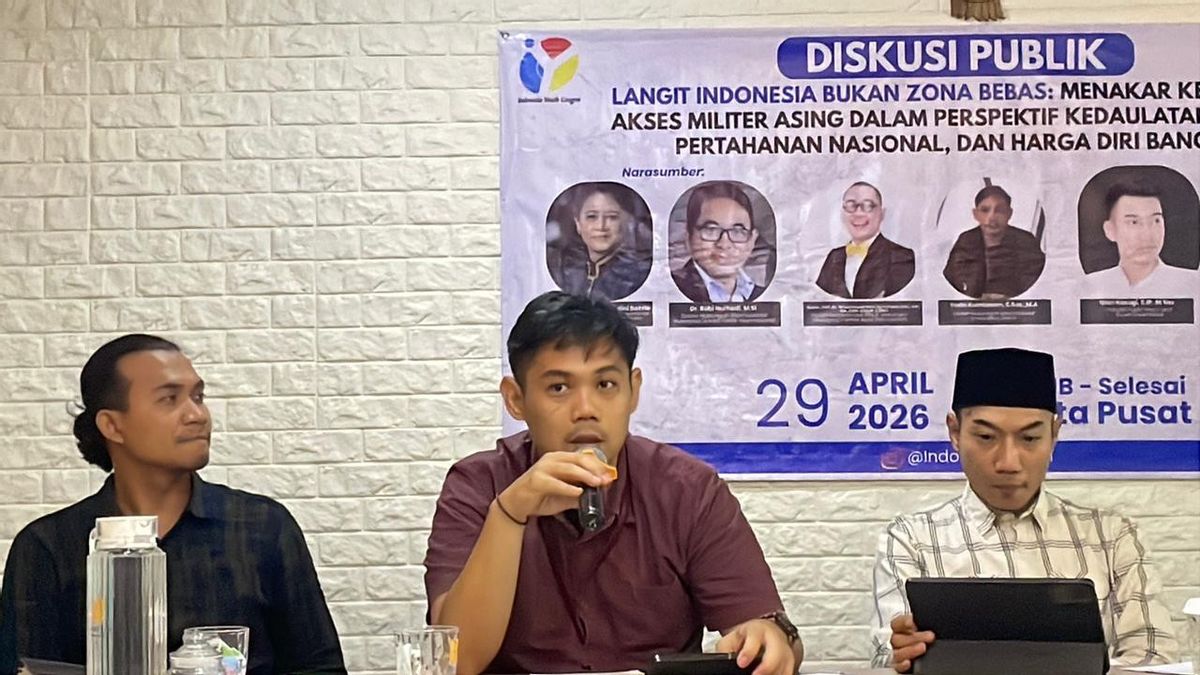


JAKARTA - The discussion on granting access to foreign military aircraft in Indonesian airspace has been criticized by academics and researchers. This issue emerged in a public discussion entitled "Indonesian Sky is not a Free Zone: Criticizing Foreign Military Access Policy in the Perspective of Air Sovereignty, National Defense Policy, and National Pride" which was held by the Indonesia Youth Congress in Central Jakarta, Wednesday, April 29.
International relations academic, Connie Rahakundini Bakrie, emphasized that air sovereignty is a fundamental principle in international law that cannot be negotiated. He referred to the 1944 Chicago Convention which states that every country has full and exclusive sovereignty over the airspace above its territory.
"There is no automatic right of peaceful passage for foreign military aircraft. Any access must be through the explicit permission of the sovereign state," he said.
Connie reminded that granting a blanket clearance without case-by-case evaluation has the potential to open up opportunities for intelligence gathering, mapping of strategic installations, and interference with national military operations. He assessed that such policies could gradually erode air sovereignty.
"We can work together, but we must not surrender our sky. The dignity of the nation is much more expensive than security assistance," he said.
Public policy and good governance researcher, Gian Kasogi, assessed that the issue is no longer merely a technical matter, but concerns state sovereignty.
"This is a real test of how far the country dares to stand on principles, not just diplomatic compromises," he said.
Gian highlighted the "notification" based access scheme which is considered to have the potential to shift the position of the state from an active authority to merely a party that is notified. The shift from the "permission" mechanism to "notification", according to him, is not only an administrative simplification, but also has an impact on operational control and defense independence.
He reminded that in global practice, sovereignty is often not explicitly lost, but rather gradually weakened through loose and repeated technical policies. Therefore, the government is asked not to be naive in reading the impact of these policies amid global rivalries.
"There is no room for naivety. Policies like this will always be read as political signals," said Gian.
In addition, he highlighted the lack of government transparency regarding the scope of access, operational limitations, and oversight mechanisms that could potentially trigger public distrust.
Gian urged the government, especially the Ministry of Defense, to assert its full veto right against any foreign military access, reject the concept of "freedom of passage" without active control, and open the policy framework to the public. He also asked the DPR RI to tighten its oversight function.
"If the state can still regulate, limit, and refuse, then cooperation is a strategy. But if it only adapts, it becomes a dangerous precedent," he said.
Meanwhile, Bakrie University academic Yuda Kurniawan reminded the importance of maintaining consistency with the principle of free and active foreign policy. He assessed that the policy of access to foreign military must be studied comprehensively, including from the side of defense readiness and geopolitical calculations of the region.
According to Yuda, Indonesia needs to ensure that it has adequate air surveillance and law enforcement capacity before opening wider access, as well as mitigating risks, including the potential use of airspace for the interests of certain military or intelligence parties.
"Whether this is in line with free and active politics, or actually draws Indonesia into global rivalries, that is what must be answered clearly," he said.
The discussion also featured Robi Nurhadi and Muhammad Reza Zaki, and was attended by students, academics, researchers, and the general public.
The English, Chinese, Japanese, Arabic, and French versions are automatically generated by the AI. So there may still be inaccuracies in translating, please always see Indonesian as our main language. (system supported by DigitalSiber.id)
Most Popular Tags
#Prabowo Subianto #donald trump #Febrie Adriansyah #8791 #giias 2026Popular


