

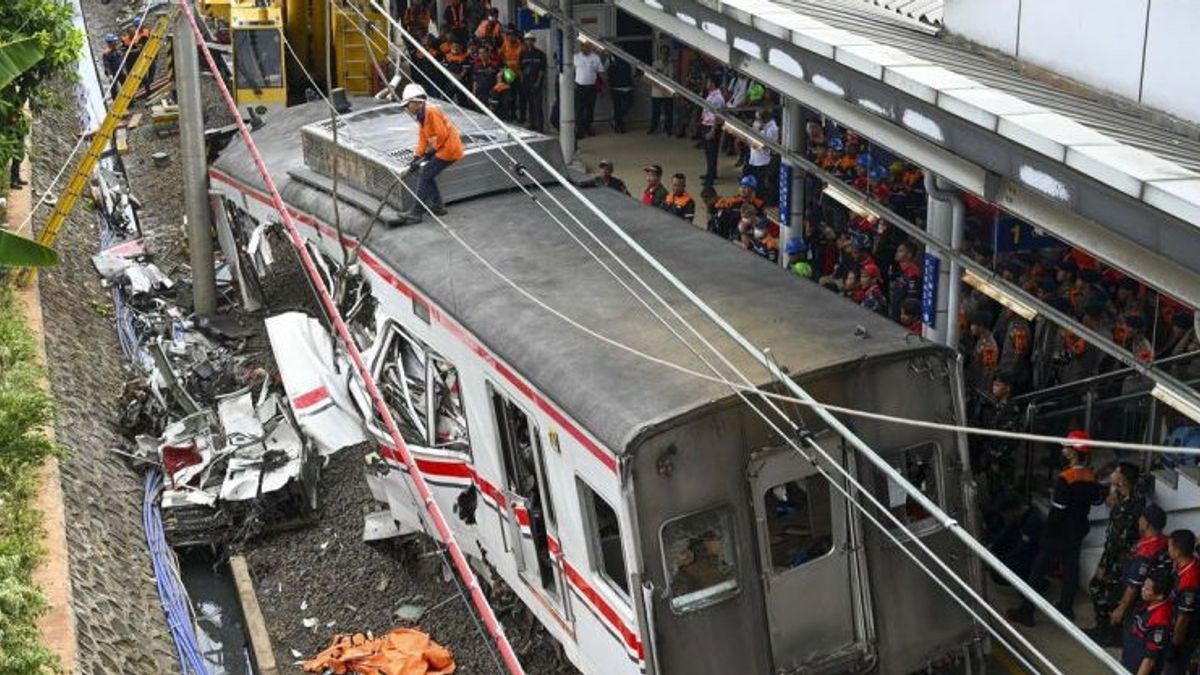


JAKARTA - The Indonesian Transportation Society (MTI) Railway Forum assessed the consecutive accidents involving long-distance trains and KRL at Bekasi Timur Station, Monday evening, April 27, which showed serious problems in the railway safety system.
Chairman of the MTI Railway Forum Deddy Herlambang said the incident was not a single incident, but a chain effect triggered by a disturbance on a piece of track.
The accident started from a Green SM electric taxi that broke down at the JPL 85 Ampera crossing and was tempered by the KRL. As a result, the KRL series behind was held up until it was finally hit by the Argo Bromo Anggrek train from behind.
He highlighted the pattern of accidents that were considered to be repeated, namely rear-end collisions. A similar case occurred in 2010 at the Petarukan Station, Pemalang.
"The incident at the BKST station on April 27, 2026, the alleged driver of the Argo Bromo Anggrek train was also considered negligent because he did not see the stop signal (red)," Deddy said in his statement, Tuesday, April 28.
The Jatinegara-Cikarang train line uses an open block signal which means that if there is a train set stopping, the signal behind it will automatically turn red, meaning that the train behind it must stop.
Thus, Deddy suspected that the factor of the negligence of the driver was one of the causes, especially related to non-compliance with the stop signal.
"If the driver is negligent or does not see the red signal, it is certain that a train accident will occur in front of the train," he said.
Deddy assessed that the safety system had not been fully strengthened by technology. One of them is related to the obligation to install the Automatic Train Safety System (SKKO/ATP) which is considered not optimal.
MTI sees two main issues in this accident, namely the crossing factor of a piece without adequate security and the potential for human error from the driver.
"Train accidents that have the potential to recur with the same cause mode will cause boundless concern," said Deddy.
Furthermore, MTI assessed that the national railway safety system is still reactive and not based on strong risk management. The lack of integration between facilities and infrastructure is also said to increase the potential for accidents.
For this reason, MTI encourages the acceleration of the separation of commuter and long-distance train lines through the construction of double-double track Bekasi-Cikarang to reduce cross-density.
In addition, an audit is needed for the centralized train travel control system (PPKT) as well as the implementation of safety technologies such as Automatic Train Protection (ATP) and modern signaling systems for KRL.
On the human resources side, MTI also highlighted the potential for fatigue and miscommunication as risk factors. "Human factors (human error mitigation) have the potential for fatigue/miscommunication," said Deddy.
He encouraged the implementation of a system for managing the fatigue of train drivers, training on emergency conditions simulators, and the principle of "safety over punctuality". MTI also emphasized the importance of implementing the Railway Safety Management System (RSMS) in its entirety as a risk-based prevention system.
Not less important, a piece of land crossing is called a vulnerable point that must be immediately addressed, including the preparation of SOP for drivers if the vehicle breaks down on the tracks.
In addition, MTI asked the National Transportation Safety Committee not only to investigate the causes of the accident, but also to evaluate other technical aspects, including the reliability of the vehicles involved in the initial incident.
"For the KNKT to conduct an investigation into the train accident later, it is hoped that it will also be mandatory to invest in the reliability of electric taxis that have the potential to go on strike on the railway tracks in JPL 85. If there is indeed a weakness in the reliability of the electric taxi, the licensing of the electric taxi can be re-evaluated," he added.
The English, Chinese, Japanese, Arabic, and French versions are automatically generated by the AI. So there may still be inaccuracies in translating, please always see Indonesian as our main language. (system supported by DigitalSiber.id)


