

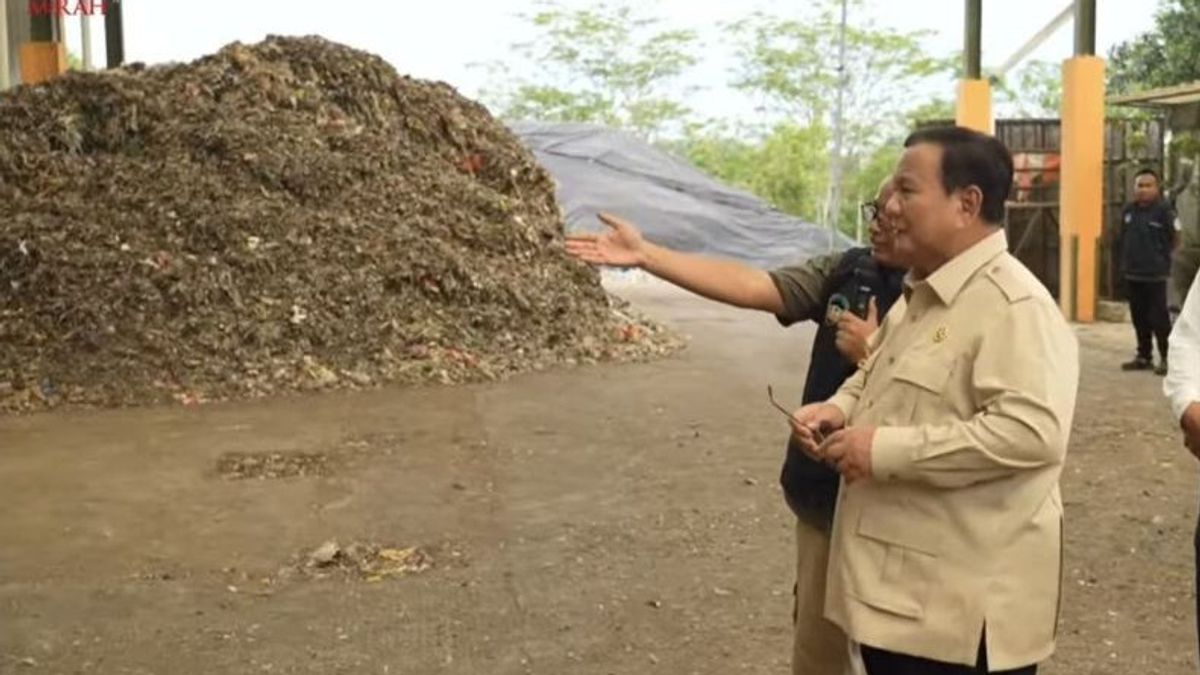


President Prabowo Subianto reviewed the waste processing facility into various economically valuable products such as tiles and paving blocks at the Banyumas Environmental-Based Integrated Waste Processing and Education (TPST BLE) in Central Java.
In a YouTube video broadcast of the Presidential Secretariat monitored in Jakarta, Prabowo carefully observed the products of plastic waste processing in the form of tiles and paving blocks which are now being used as public facilities in the local area.
The Head of State was seen occasionally holding the product while listening to the explanation from the officers regarding its durability and production process.
During the review, the President received a comprehensive explanation of various waste processing activities carried out by officers. Prabowo listened to an explanation of how the program flow was carried out, from sorting to becoming a final product ready to be marketed or reused by the community.
The President also observed the processed organic waste products produced by the facility in Wlahar Wetan Village. Some of the products on display include organic pellets for fish feed, as well as maggots in dry and live conditions that are useful as high-protein livestock feed.
The TPST BLE Banyumas facility itself is a modern waste management infrastructure that implements automatic sorting technology with a capacity of 75 tons per day. The location processes waste residues collected from various TPST throughout the Banyumas Regency area.
One of the advantages highlighted at this location is the One Day Process method which uses special machine technology. This system ensures that every waste that enters the facility will be processed within one day, so that there is no accumulation of waste in the work area.
Through this approach, TPST BLE Banyumas is striving to achieve the Zero Waste to Landfill target. This policy ensures that the Final Processing Site (TPA) no longer serves as an open waste storage site, but rather is transformed into a center for the production of high-value goods.
In addition to tiles and paving blocks, this facility also produces alternative fuels in the form of Refuse-Derived Fuel (RDF) and Solid Fuel (BBJP). These products are used as a mixture of coal in PLTU and cement industry, which at the same time supports efforts to transition to green energy in Indonesia.
The English, Chinese, Japanese, Arabic, and French versions are automatically generated by the AI. So there may still be inaccuracies in translating, please always see Indonesian as our main language. (system supported by DigitalSiber.id)


