

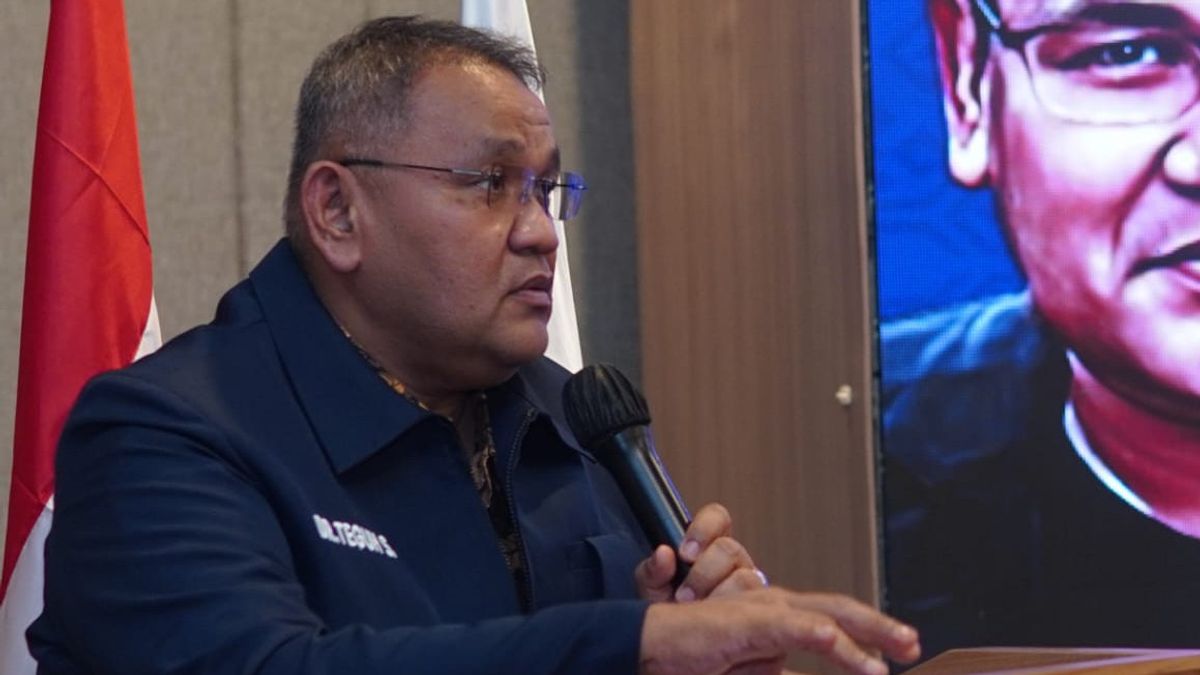


JAKARTA - GREAT Institute Geopolitical Director Dr. Teguh Santosa assessed that the ceasefire between the United States and Iran has not touched the root of the conflict. The current situation is only a lack of violence. The risk of escalation remains open, especially in the Strait of Hormuz, the world's most vital energy route.
According to Teguh, the long conflict since the 1979 Iranian Islamic Revolution is now based on two main knots, namely Iran's nuclear program and control over Hormuz. The two are interrelated and inseparable.
This crisis was also triggered by the US attack on Iran on March 28, 2026. From there, pressure on Hormuz increased because the strait is the world's energy entry and exit route.
Hormuz is a vulnerable point because about 20 percent of global oil consumption and 20 percent of the world's LNG trade cross the strait every day. Teguh, who is also a lecturer in International Relations at UIN Syarif Hidayatullah Jakarta, noted that 20-25 percent of Indonesian oil depends on the line. In normal conditions, 120 to 140 commercial vessels pass through every day.
The problem is, there is no common legal footing. The US and Iran are not parties to the United Nations Convention on the Law of the Sea (UNCLOS) 1982. Iran signed the convention, but did not ratify it. The US has not ratified either.
As a result, the interpretation of the right to cross ships in international straits has become a source of friction. The risk of miscalculation in the field also increases.
At the same time, the Iranian nuclear issue continues to heat up after the US withdrew from the Joint Comprehensive Plan of Action (JCPOA) in 2018. Iran then increased its uranium enrichment capacity and rate.
International Atomic Energy Agency (IAEA) data in 2025 showed Iran's stock of enriched uranium up to 60 percent increased significantly, even reaching an estimated 200 kilograms.
In fact, in the 2015 JCPOA, Iran agreed to strictly limit its nuclear program. The number of centrifuges was cut from around 19,000 to 6,104 units, enrichment levels were limited to 3.67 percent, and uranium stocks were only 300 kilograms. In return, sanctions were lifted and IAEA verification access was opened.
For Teguh, the framework is not a one-sided victory. The JCPOA is a draw. The West gets non-proliferation guarantees, while Iran gets recognition for its civilian nuclear program.
Without the JCPOA, these two crises are mutually locking. Nuclear tensions push the threat of closure of Hormuz. On the other hand, disruption in Hormuz directly shakes global energy prices.
Teguh noted that when the conflict peaked in 2026, tanker traffic fell to zero and oil prices jumped about 16 percent.
"The middle way is the 2015 JCPOA," Teguh said in a written statement received in Jakarta, Monday, April 27.
According to the Chairman of the Indonesian Cyber Media Network (JMSI), reviving the agreement is not only about holding Iran's nuclear program. It also concerns the stability of Hormuz and the security of world energy, including Indonesia.
The English, Chinese, Japanese, Arabic, and French versions are automatically generated by the AI. So there may still be inaccuracies in translating, please always see Indonesian as our main language. (system supported by DigitalSiber.id)
Most Popular Tags
#Prabowo Subianto #donald trump #2026 World Cup #Febrie Adriansyah #8791Popular


