

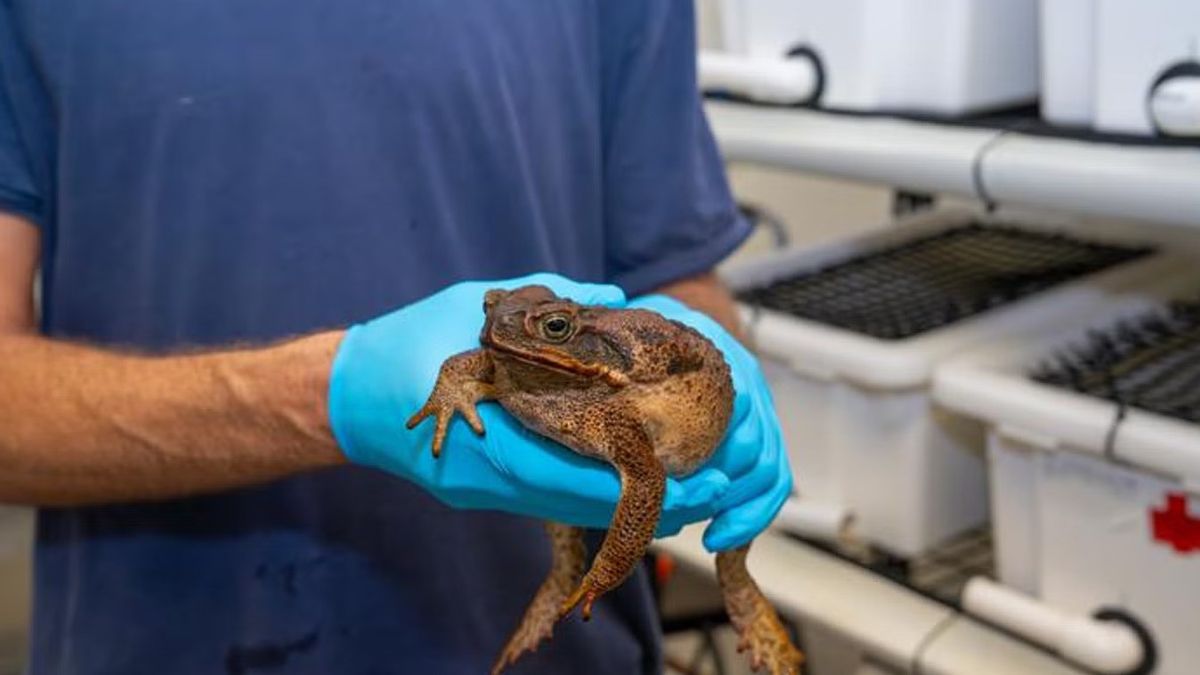


Invasive cane toads in Japan are growing bigger than their relatives in Australia. This finding makes scientists start to doubt the old assumption, whether evolution always goes slowly?
Quoted from The Independent, Friday, April 24, the latest study says that the cane toads on Ishigaki Island, southern Japan, have changed their size and body shape in less than 100 years.
The cane toad is native to northeastern South America. Now, this species has spread to more than 40 countries and is known as one of the most studied invasive species.
In Australia, these toads were once brought in to control beetles. However, the result was an ecological disaster. The toad is growing fast and endangering native wildlife.
The problem is with the poison. This hand-sized frog carries toxins that can kill predators, including quoll, crocodiles, and snakes.
In a study published in Royal Society Open Science, researchers compared cane toads from Japan, Australia, Hawaii, and South America. The results, adult toads from Ishigaki weighed an average of 190 grams. Toads from Australia averaged only 135 grams.
Rick Shine, an evolutionary biologist from Macquarie University, Sydney, said the populations of frogs in Japan and Australia had a similar history in Hawaii until the 1930s. That is, the size difference appeared in less than a century.
"The idea that evolutionary change happens very slowly is now challenged by the latest evidence," Shine said, quoted by The Independent.
However, the cause of Japanese toads growing larger is not yet known for sure.
"We don't have a clear picture of the evolutionary forces that might be involved," Shine said.
Researchers suspect Ishigaki's climate has a role to play. The island gets rain all year round. Lower predator pressure may also make the cane toads grow larger.
This finding is important because invasive species are not just the business of other countries. Indonesia is also familiar with similar problems. In Jakarta itself, the DKI Jakarta City Government is currently actively capturing and destroying invasive animals, namely the sapu sapu fish. This invasive animal, once it enters a new ecosystem, the impact can be difficult to reverse.
The English, Chinese, Japanese, Arabic, and French versions are automatically generated by the AI. So there may still be inaccuracies in translating, please always see Indonesian as our main language. (system supported by DigitalSiber.id)


