

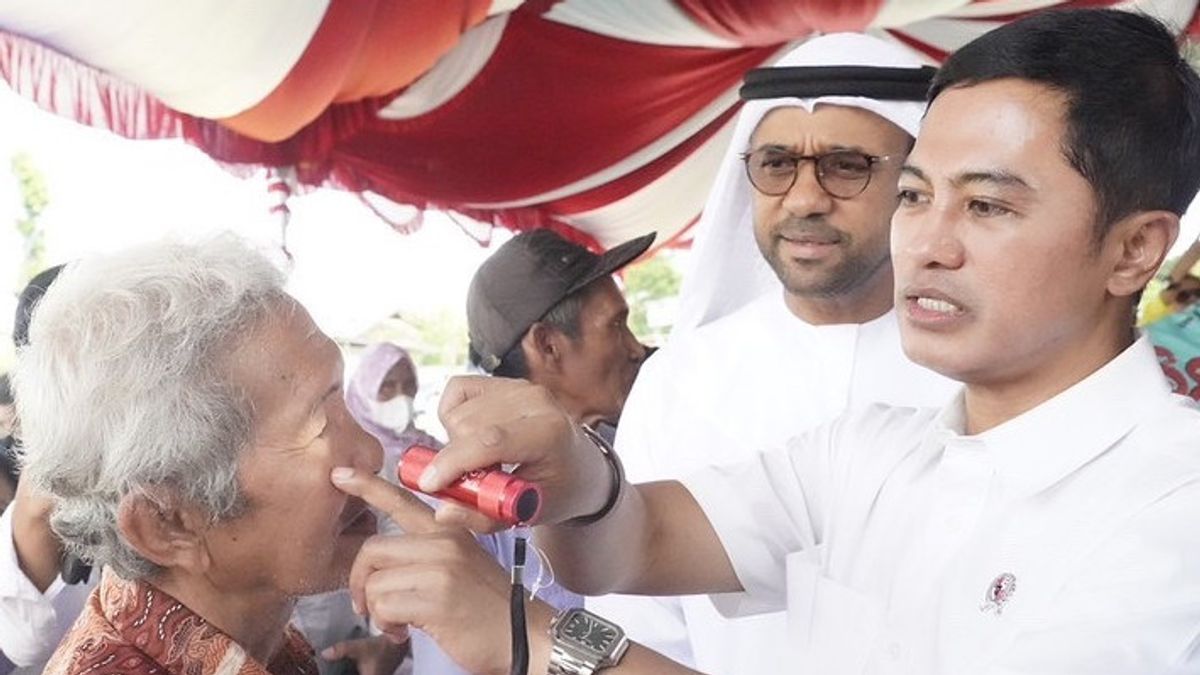


JAKARTA - The number of blindness due to cataracts in Indonesia is still high and has not been optimally handled. Throughout 2025, the case is estimated to reach 600 to 650 thousand people, the majority of which attack the elderly group who should still be able to remain productive.
Deputy Minister of Health Dante Saksono Harbuwono reminded that this issue is not just a health issue, but has a direct impact on national productivity.
"If cataracts are not treated, what is lost is not only vision, but also their social role and productivity," said Dante, quoted Sunday, April 26.
Data from the Ministry of Health shows that cataracts are the main cause of blindness in people over 50 years of age, with a proportion of 81.2 percent. This finding is reinforced by the results of the 2025-2026 Free Health Check (CKG) program screening. Of the 23.35 million people examined, about 2.95 million had eye disorders.
The magnitude of this figure illustrates the weakness of early detection and access to eye health services, especially in rural areas. Dante emphasized that vision loss due to cataracts has a major impact on a person's quality of life.
"The world that was clearly slowly becoming blurry. Sufferers seem to lose light in the rest of their lives," he said.
He also said that cataract sufferers lose access to about 80 percent of the information received through the sense of sight. This condition makes them vulnerable to relying on others and withdrawing from social and economic activities.
The government is now accelerating two main steps to reduce the number of blindness. First, include eye screening in the 2026 CKG program so that detection can be done earlier. Second, ensure cataract surgery is fully covered through the National Health Insurance (JKN) program.
On the other hand, collaboration with international parties has begun to expand. The government has partnered with the Noor Dubai Foundation and the Indonesian Association of Ophthalmologists (PERDAMI) to hold free operations for 500 patients until May 2026.
This program targets three high-need areas: Central Kalimantan with 200 patients, as well as West Nusa Tenggara and East Nusa Tenggara with 150 patients each.
The Ambassador of the United Arab Emirates to Indonesia and ASEAN, Abdulla Salem Obaid AlDhaheri, assessed that this cooperation is an important part of the bilateral relations between the two countries, as well as strengthening the humanitarian approach in the health sector.
He added that the program also reflects the humanitarian values inherited by the founder of the UAE.
"All procedures are carried out by Indonesian eye specialists. International support that empowers national expertise is the most effective partnership model," he said.
At the regional level, the need for cataract surgery is still far from being met. Kapuas Regent Muhamad Wiyanto revealed that the public's high interest in participating in this program, along with the high cost of independent surgery.
"Last year, there were about 150 participants, this year it increased to 200 patients. This increase shows the magnitude of community needs as well as confidence in this program," said Wiyanto.
He said that the cost of cataract surgery independently could reach Rp. 10 million per eye, a figure that is difficult for most people to reach.
Through the Vision Health Roadmap 2025-2030, the government targets at least 60 percent of cataract sufferers can get surgery with optimal vision results. In 2025, the national operating capacity was recorded at 634,642 actions or about 92 percent of the target.
However, with the findings of millions of cases of eye disorders from the results of screening, the government's homework is still big - not only increasing the capacity of operations, but also ensuring equitable access to services even to remote areas.
The English, Chinese, Japanese, Arabic, and French versions are automatically generated by the AI. So there may still be inaccuracies in translating, please always see Indonesian as our main language. (system supported by DigitalSiber.id)
Most Popular Tags
#Prabowo Subianto #donald trump #2026 World Cup #Febrie Adriansyah #8791Popular


