

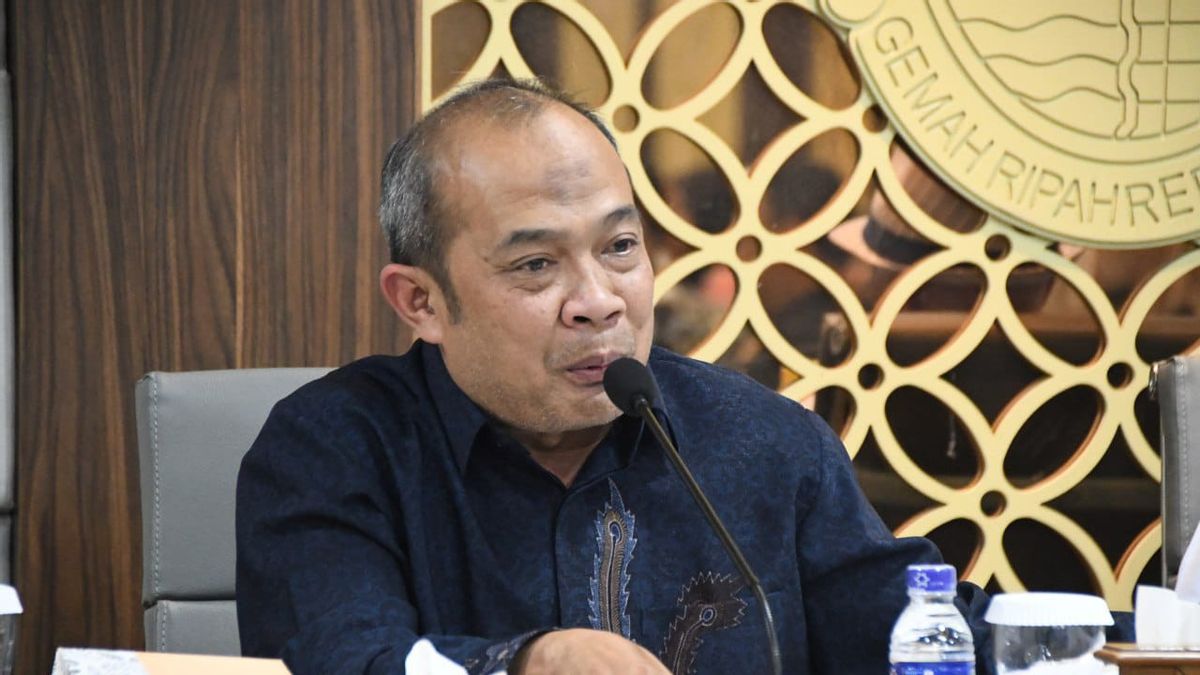


BANDUNG - Deputy Chairman of the West Java Provincial DPRD, Iwan Suryawan, gave serious attention to the report of the Meteorology, Climatology, and Geophysics Agency (BMKG) which predicts that 93 percent of West Java will be hit by a very dry dry season in 2026.
Iwan emphasized that this condition is not just a normal weather cycle, but a real threat to the social and economic stability of the community that must be anticipated immediately with quick and measurable mitigation steps.
The early warning of the BMKG which states that the peak of the drought will occur in August requires a proactive response from the West Java Provincial Government. Iwan asked Governor Dedi Mulyadi and his staff not to work alone, but to increase intensive coordination with the Central Government to ensure the readiness of infrastructure and logistics.
"The Governor and the Provincial Government must immediately sit down with the Central Government to secure emergency budgets and technical assistance. We must ensure the distribution of clean water through tanker trucks ready to target the red zone area," said Iwan in his statement, Monday, April 20, 2026.
The PKS politician's deepest concern lies in the agricultural sector, considering that West Java is a national food warehouse that contributes around 16 to 18 percent of national rice production. If 93 percent of the area experiences extreme drought, the potential for crop failure or puso will be a massive threat to national food stocks.
"Our contribution to the national stock is very large. This is not only a matter of the stomachs of West Java residents, but a matter of food security for the Republic of Indonesia," said Iwan. He also urged that irrigation audits, pump optimization, and consideration of weather modification technology (TMC) should be carried out immediately.
Apart from stomach affairs, Iwan also highlighted the potential for forest and land fires (karhutla) which often accompany long droughts. He asked the BPBD and the Fire Department to increase routine patrols in vulnerable areas to minimize risks.
Iwan reminded that the stability of food prices in the market depends very much on the smoothness of production upstream, so that disruptions in supplies from West Java are certain to trigger a spike in the inflation of basic goods that burden people's purchasing power.
Closing his statement, Iwan asked the relevant OPD to proactively "pick up the ball" to the relevant ministries in Jakarta so that there is synchronization of the drought handling program. He also appealed to the public to start cultivating water saving from an early age.
"We must not wait until the people scream for thirst or rice prices are unaffordable. Anticipation must be done today for the safety and food security of all of us," he concluded.
The English, Chinese, Japanese, Arabic, and French versions are automatically generated by the AI. So there may still be inaccuracies in translating, please always see Indonesian as our main language. (system supported by DigitalSiber.id)


