

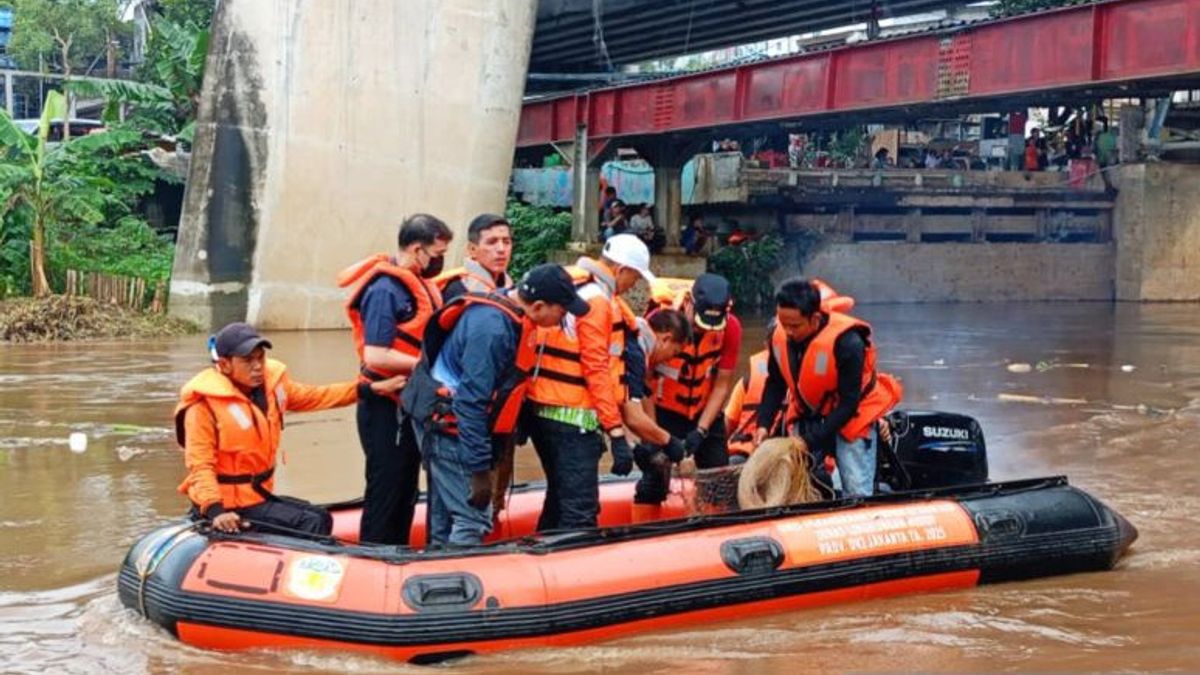


JAKARTA - Joint officers from five city administrative areas together with the DKI Jakarta Provincial Food, Maritime, and Fisheries Service (KPKP) have carried out a mop-up fishing operation on Friday, April 17, according to the instructions of the Governor of DKI Jakarta, Pramono Anung. With the involvement of 640 personnel, the number of mop-up fish that was successfully caught reached around 68,880 tails with a total weight of 6.98 tons.
Head of the Food, Marine, and Fisheries Directorate (KPKP) of the DKI Jakarta Province, Hasudungan Sidabalok, said that this arrest was carried out because the species had the potential to damage the environment, such as disturbing natural habitats and affecting the balance of the ecosystem through its habit of digging the bottom and banks of rivers.
"This mass sweeping fishing operation is a short-term strategy aimed at quickly reducing the population of sweeping fish and preventing its wider spread. So later coordination will be carried out with related parties, such as between administrative city areas, LH Offices, and other related parties so that this action can be carried out on a larger scale with more frequent frequency," said Hasudungan, in his statement, Saturday, April 18.
In addition, Hasudungan explained that the follow-up to the arrest was carried out according to procedure, namely the fish was turned off and buried hygienically in a designated location. This step is taken so that the fish does not return to the waters, is not traded, and can be used as natural compost.
"So, the fish catch is buried in a dead state. In addition, 1,000 kg of sapu-sapu fish originating from Setu Babakan were taken to the Fish Breeding Research Center, KKP as research material for the development of maggot culture media," he explained.
For information, the fish catch in the five administrative city areas is as follows:
North Jakarta: 545 heads with a total weight of 271 kilograms, located at PHB RW 06, West Kelapa Gading. West Jakarta: 71 heads with a total weight of 17 kilograms, located at Kali Anak TSI, Duri Kosambi, Cengkareng. Central Jakarta: 536 heads with a total weight of 565 kilograms, located in seven sub-districts. South Jakarta: 63,600 heads with a total weight of 5.3 tons, located at the Setu Babakan outlet gate, Srengseng Sawah, Jagakarsa. East Jakarta: 4,128 heads with a total weight of 825.5 kilograms, located in 10 sub-districts.Meanwhile, the evaluation of activities showed that the capture of sapu-sapu fishing in various regions of Jakarta faced diverse obstacles. In North Jakarta, the shallow, muddy, and full of garbage water conditions are a challenge. In West Jakarta, the limitations of the location and the high mud also complicate the capture process.
In Central Jakarta, the obstacle is murky water and the need for increased mitigation efforts. In South Jakarta, it was found that almost 100 percent of the fish in the Setu Babakan were swept away. Meanwhile, in East Jakarta, the condition of the Ciliwung River, which is high tide, high discharge, and fast-flowing, causes the capture to be carried out using rubber boats with environmental activists.
In addition, it is urged to the public not to use fish sapu-sapu as food because of the risk of health disorders caused by heavy metal residues such as lead (Pb) being above the threshold set by the Government, namely above 0.3 mg/kg.
The English, Chinese, Japanese, Arabic, and French versions are automatically generated by the AI. So there may still be inaccuracies in translating, please always see Indonesian as our main language. (system supported by DigitalSiber.id)
Popular


