

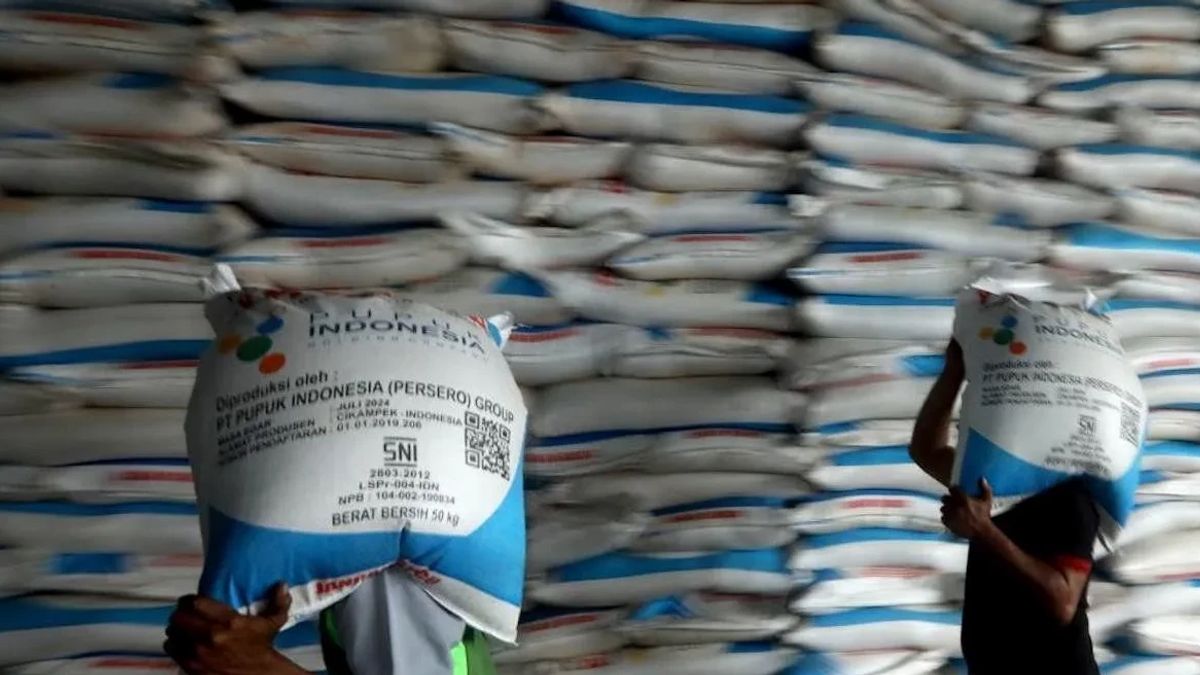


JAKARTA - Australian Ambassador to Indonesia Roderick Brazier met with Deputy Minister of Agriculture (Wamentan) of the Republic of Indonesia Sudaryono to explore the opportunity to import fertilizer from Indonesia amid increasing needs amid global geopolitical turmoil.
"So I received the Australian Ambassador to Indonesia in Jakarta. We talked about many things, especially agricultural affairs and especially again is related to fertilizer," said Wamentan in a statement in Jakarta, Thursday, quoted by Antara.
Sudaryono said his party had received a visit from the Australian Ambassador to Indonesia at the Ministry of Agriculture's Office on Wednesday (15/4), to discuss cooperation opportunities in the agricultural sector, especially regarding the import of urea fertilizer from Indonesia.
The meeting took place amid global dynamics due to disruptions in the world's fertilizer supply chain. According to him, global geopolitical conditions, including the impact of the closure of the Strait of Hormuz, have affected the distribution of world fertilizers.
Around a third of global fertilizer supplies pass through the route, so the disruption has a significant impact on international fertilizer availability.
"With this disruption, many countries need urea. Indonesia has an advantage because it is able to produce urea from domestic natural gas, so we are not dependent on imports for this commodity," said Wamentan.
The national urea fertilizer production capacity managed by PT Pupuk Indonesia (Persero) reaches around 9.36 million tons to 9.4 million tons per year.
He said that in 2026, it is targeted that urea production will reach 7.8 million tons, with a subsidy requirement of 6.3 million tons and there is a potential for exports of 1.5 million tons to secure domestic stocks. This surplus opens up export opportunities to various countries, including Australia.
However, Wamentan emphasized that meeting domestic needs remains the top priority.
"The need for fertilizer for Indonesian farmers is a super priority. After that is met, only the remaining production can be allocated for export," he said.
According to him, the interest in Indonesian urea does not only come from Australia, but also from a number of other countries such as India, the Philippines, and Brazil. However, the government remains cautious not to promise supplies that exceed the national production capacity.
Sudaryono also explained that the trade relationship between Indonesia and Australia is reciprocal. Indonesia, on the one hand, exports urea, but on the other hand also imports raw materials such as phosphates, including DAP (Diammonium Phosphate) types, from Australia.
"This is a reciprocal relationship. We need each other. The important thing is how we secure national interests while maintaining a healthy trade relationship," he said.
Furthermore, he ensured the availability of domestic fertilizers, especially subsidized fertilizers, in a safe condition. The high absorption of fertilizer by farmers is referred to as an indicator of increased planting activities in various regions.
"If there are farmers who can't find fertilizer at the kiosk, it's more about the distribution that is running fast. In 1-2 days it is usually available again. That means there is fertilizer and it is enough," he explained.
In the future, the government also plans to renovate old fertilizer factories to increase national production efficiency and capacity, as well as maximize export opportunities amid high global demand.
With this condition, Indonesia is not only able to maintain national fertilizer resilience, but also has the potential to strengthen its position as a fertilizer supplier in the international market.
The English, Chinese, Japanese, Arabic, and French versions are automatically generated by the AI. So there may still be inaccuracies in translating, please always see Indonesian as our main language. (system supported by DigitalSiber.id)
Most Popular Tags
#Prabowo Subianto #donald trump #2026 World Cup #Febrie Adriansyah #8791Popular


