

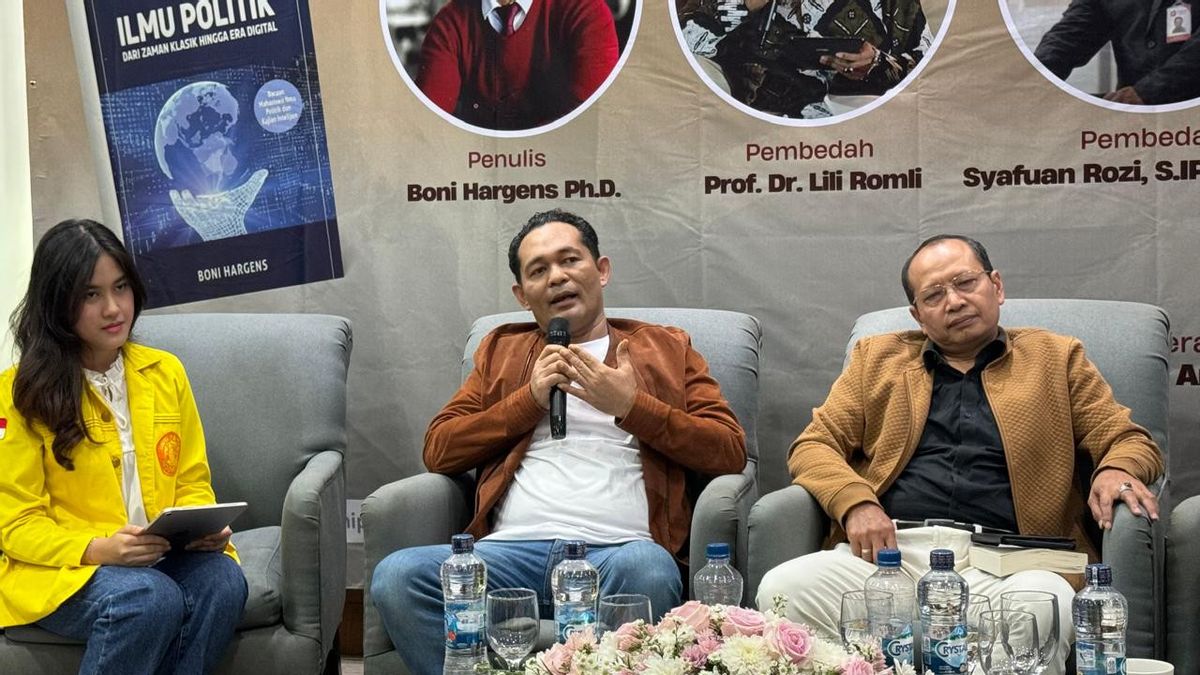


JAKARTA - Senior political analyst Boni Hargens responded to the statement of the founder of Saiful Mujani Research and Consulting, Saiful Mujani, who was considered provocative in relation to the invitation to "bring down" and rally against the Prabowo Subianto government.
According to Boni, the debate over the statement must be placed within the framework of political science that is intact and not unilaterally simplified.
"The debate about whether it falls into the category of treason or not, must be based on strong thinking about politics," said Boni in the launch and dissection of his book Political Science from the Classical Era to the Digital Era in Jakarta, Saturday, April 11.
Boni explained that Saiful Mujani's statement could be read from two different perspectives, namely the state and civil society. From the state's perspective, he assessed that the narrative could be considered as a pre-condition for a revolutionary situation due to the elements of ideas and the mobilization of power.
However, in the perspective of civil society, the statement was considered as part of freedom of opinion as well as a form of criticism against the minimal role of the opposition in the democratic system.
"From the perspective of civil society, it is a strong rebuke for political parties to present opposition in democratic practice," he explained.
Therefore, Boni emphasized the importance of the government maintaining a balance between the interests of the state and civil liberties in responding to political dynamics.
"The ideal government is one that is able to maintain the balance of these two paradigms, without neglecting the interests of the state or the voices of civil society," he said.
On this occasion, Boni also highlighted the importance of theoretical foundations in understanding democracy. He assessed that there are still many political actors who do not have a strong basis of thinking related to the relationship between the state, society, and the market.
Through his book, he seeks to present a conceptual framework that connects the development of political science from the classical era to the digital era, including the relationship between democracy and intelligence.
According to him, these two fields have a close relationship in maintaining national interests, even though they are often faced with a dilemma between the principles of confidentiality and openness.
"Intelligence is the eyes and ears of the state, while political science discusses the power and interests of the state. The two complement each other, but need a meeting point between secrecy and democracy," he concluded.
The English, Chinese, Japanese, Arabic, and French versions are automatically generated by the AI. So there may still be inaccuracies in translating, please always see Indonesian as our main language. (system supported by DigitalSiber.id)
Most Popular Tags
#Prabowo Subianto #donald trump #Febrie Adriansyah #8791 #giias 2026Popular


