

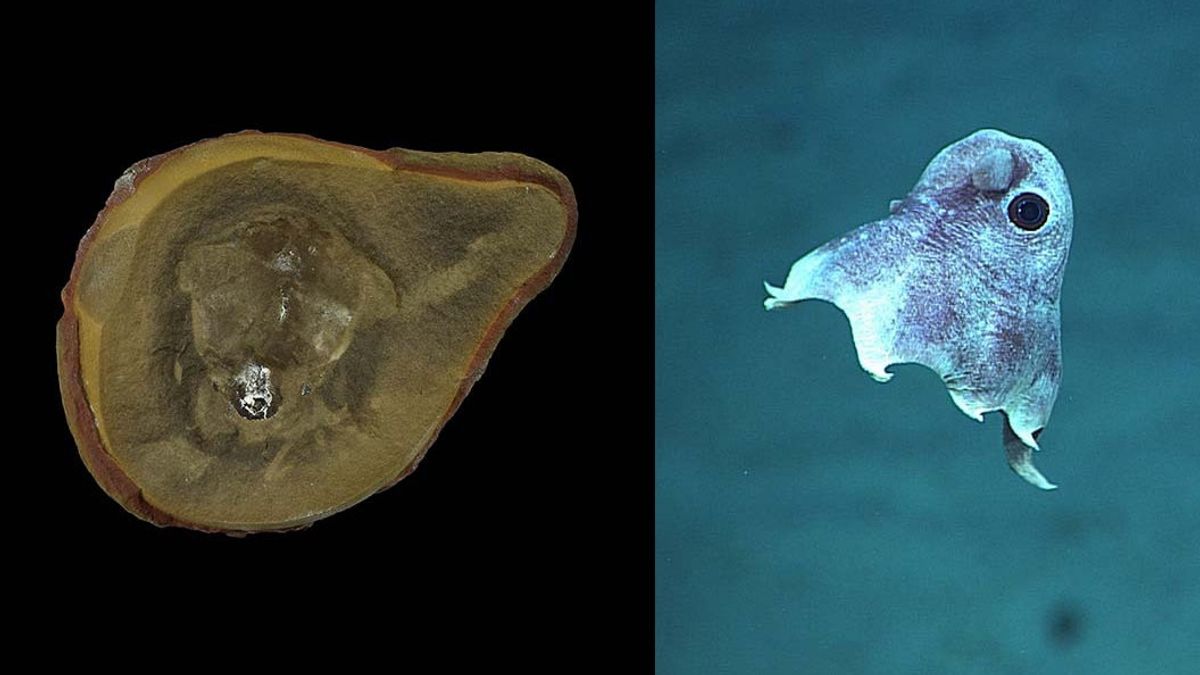


JAKARTA - The fossil that has been referred to as the oldest octopus in the world has been misidentified. Recent research shows that the 300 million-year-old sea creature is not an octopus, but a nautiloid, an ancient shelled sea animal that is still related to the nautilus. This finding makes Guinness World Records no longer record it as the oldest octopus fossil ever found.
The findings closed a long debate about Pohlsepia mazonensis, a fossil from the Mazon Creek area, Illinois, USA. Its shape is small, about the size of a human hand. However, the traces of its body are difficult to read, so it has long confused researchers. In an ABC News report, quoted Thursday, April 9, this fossil has long been the subject of scientific debate.
In 2000, the fossil was identified as a octopus. This claim immediately disturbed the old understanding of the origin of octopuses. The reason is, if true, octopuses have existed for 300 million years. However, the oldest known octopus fossil so far is only about 90 million years old. The distance is too far. At that point, scientists began to suspect.
A team of researchers from the University of Reading then re-examined the fossil with a synchrotron, a high-tech scanner used to see the inside of fossil rocks. The result, they found a radula or a tooth band, a kind of row of fine teeth that soft-bodied animals such as octopus, snails, and their relatives have. In the fossil, each row contains 11 teeth. While the octopus only has seven or nine teeth.
From there, the researchers concluded that the fossil could not belong to a octopus. The arrangement of its teeth is actually suitable for Paleocadmus pohli, a fossil of an ancient shelled marine animal found in the same area. According to lead researcher Thomas Clements, as quoted by ABC News, the identification error may have occurred because the creature had decayed and lost its shell before it turned into a fossil.
The results of the study, which was published this week in the journal Proceedings of the Royal Society B, made the old status of the fossil fall. Guinness World Records also stated that it would no longer include Pohlsepia mazonensis as the oldest octopus in the world.
The fossil is named after its discoverer, James Pohl, and is now housed at the Field Museum, Chicago. Despite the title of "oldest octopus", the collection is still important. Now the museum is actually storing the oldest soft-bodied nautilus known so far.
The English, Chinese, Japanese, Arabic, and French versions are automatically generated by the AI. So there may still be inaccuracies in translating, please always see Indonesian as our main language. (system supported by DigitalSiber.id)
Most Popular Tags
#Prabowo Subianto #donald trump #firearm #8791 #giias 2026Popular


