
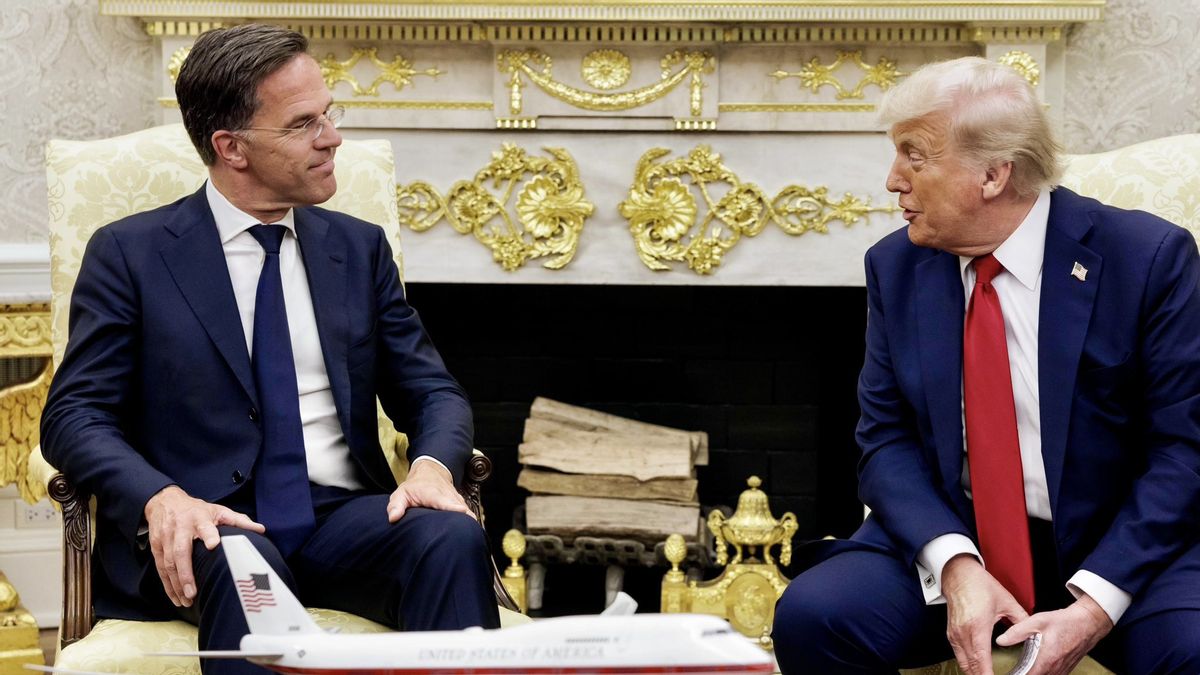


JAKARTA - The Secretary-General of the North Atlantic Treaty Organization (NATO) admitted President Donald Trump's disappointment with the alliance regarding the war in Iran, following their closed-door meeting on Wednesday, but on the other hand said he showed that the alliance still provided support to Washington.
Speaking after the meeting in Washington, Secretary-General Rutte said President Trump was "obviously disappointed" that many NATO allies did not support the US-Israeli war against Iran as he wanted.
Describing the meeting as honest and open, Secretary General Rutte told CNN he understood President Trump's frustration, but said he had shown the US President that many European countries were helping in other ways, including by providing logistics, cross-border flights, bases and other support, as quoted (9/4).
"It was a very honest, very open discussion. He clearly told me what he thought about what had happened over the past few weeks," said Secretary-General Rutte.
Previously, White House spokeswoman Karoline Leavitt said President Trump believed NATO had "been tested and they failed" during the Iran war, quoted by Anadolu.
"It is very sad that NATO has turned its back on the American people over the past six weeks when it is the American people who have funded their defense," he said.
The US and Israel launched an attack on Iran on February 28, triggering Tehran's response which led to the conflict spreading in the Middle East, before the US and Iran agreed to a two-week ceasefire on Tuesday.
President Trump himself after the meeting said NATO failed to support the US regarding the war with Iran, referring back to Greenland in a post on Truth Social.
"NATO was not there when we needed them, and they will not be there if we need them again," President Trump wrote.
"Remember Greenland, that big, poorly managed chunk of ice," he continued.
Asked if he agreed that some NATO countries "tested and failed," Secretary-General Rutte replied: "Some of them, yes, but most European countries, and that's what we discussed today, have done what they promised before in cases like this."
The NATO Secretary-General said he had told President Trump that most European countries were very helpful in terms of logistics and other commitments.
"Europe as a projection platform of strength for the United States has played a full role over the past six weeks. And yes, it is true, not all European countries have fulfilled this commitment, and I fully understand that he is disappointed about it," he added.
When asked how many NATO allies considered the US-Israeli war against Iran "illegal" and whether it was a "common view," Secretary-General Rutte replied "no."
"Because NATO has always taken the position that reducing nuclear and ballistic missile capabilities is very important," he said.
Asked about whether President Trump said he would try to pull the US out of NATO, Secretary-General Rutte replied: "I also pointed out to him the fact that it was his leadership that resulted in the Hague spending commitment. So 5 percent, which is a transformative change in NATO. It is a transformative legacy that he left behind," replied Secretary-General Rutte.
Earlier this year, President Trump criticized NATO's failure to support his efforts regarding Greenland. Instead of supporting, Western countries sent their armed forces personnel to Greenland as solidarity with fellow NATO members.
President Trump used the pretext of the presence of Russia and China in the Arctic region as a threat. He also threatened to impose tariffs on countries that support Denmark regarding its sovereignty in Greenland.
Secretary General Rutte at the end of January revealed that he and President Trump had agreed on two work streams to ease tensions related to Greenland that have been ongoing since December 2025.
This was achieved after Secretary-General Rutte and President Trump held a meeting on the sidelines of the World Economic Forum (WEF) in Davos, Switzerland, when European tensions with President Trump over Greenland escalated. He also threatened to impose tariffs on countries that support Denmark regarding its sovereignty in Greenland.
The English, Chinese, Japanese, Arabic, and French versions are automatically generated by the AI. So there may still be inaccuracies in translating, please always see Indonesian as our main language. (system supported by DigitalSiber.id)
Most Popular Tags
#Prabowo Subianto #donald trump #2026 World Cup #Febrie Adriansyah #8791Popular


