

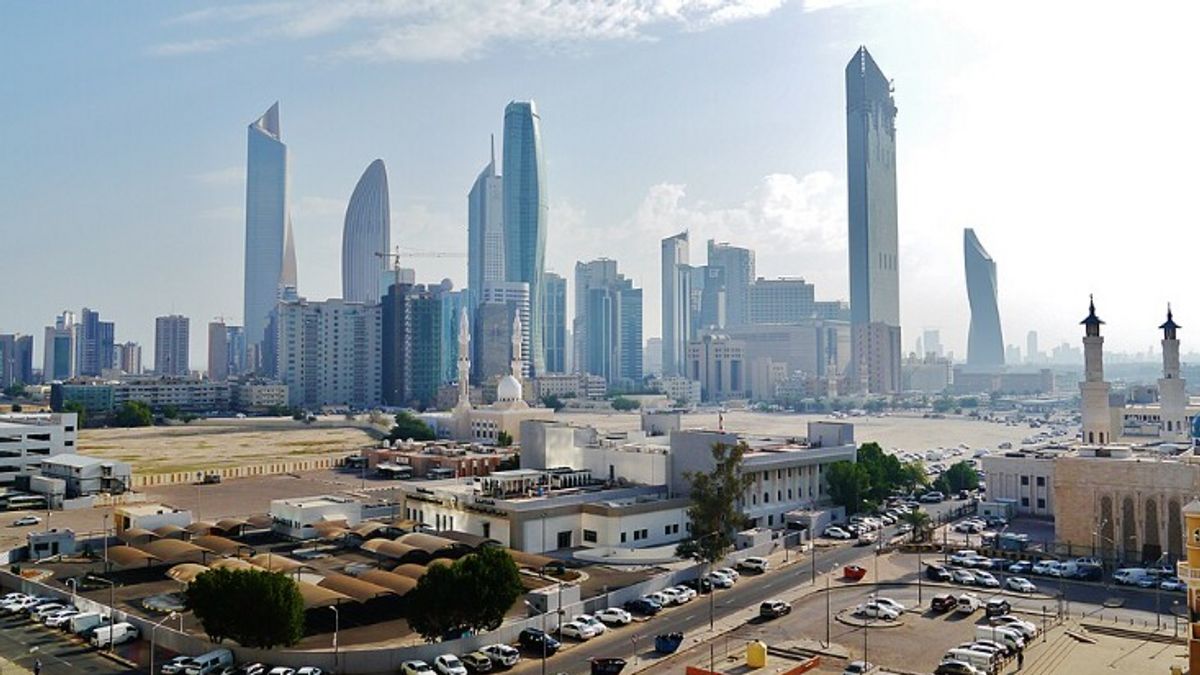


JAKARTA - The war involving the United States and Israel against Iran has begun to put pressure on the non-oil and gas sector in the Middle East. Citing a report by Arab News, Monday, April 6, S&P Global data showed business activity in the United Arab Emirates, Kuwait, and Egypt slowed in March due to trade disruptions, weakening demand, and rising costs.
The greatest pressure is in Kuwait. The country's Purchasing Managers' Index (PMI) fell sharply to 46.3 in March from 54.5 in February. The figure brought Kuwait's non-oil sector into the contraction zone for the first time in more than a year. In the UAE, the PMI fell to 52.9 from 55, the lowest level since July 2025, although it is still in the expansion zone. Meanwhile, Egypt's PMI fell to 48 from 48.9, the lowest point in almost two years.
PMI above 50 indicates expansion, while below 50 indicates contraction.
This slowdown comes after regional conflicts disrupted flights and shipping lanes, as well as increasing uncertainty in the Gulf economies.
S&P Global Market Intelligence Economics Director Andrew Harker said Kuwait's PMI data provided a clear picture of the impact of the war on non-oil and gas businesses during March. According to him, flight and shipping suspensions were the main factors that suppressed new orders and business activity. Companies also responded by holding off on hiring and purchases.
The survey showed non-oil and gas companies in Kuwait recorded a decline in output and new orders for the first time in 38 months. The contraction rate was also the sharpest since May 2021. Export demand also weakened as businesses struggled to obtain international business amid the conflict.
The easing of workloads prompted companies in Kuwait to cut jobs for the first time in a little over a year. Non-oil companies in the country also expressed pessimistic prospects for the first time in 26 months, although some still hope that growth can be supported by aggressive marketing and competitive pricing strategies.
Still referring to the Arab News report, in Egypt, pressure came from weaker demand and rising input costs. Raw material prices rose sharply in March, the fastest increase since the end of 2024. As a result, companies raised selling prices at the fastest rate in 10 months.
S&P Global Market Intelligence Senior Economist David Owen said that although Egypt's PMI fell to its lowest level in 23 months, the figure of 48 is still in line with the annual gross domestic product growth of around 4.3 percent. However, he added, the strengthening of the US dollar and high energy prices are beginning to put pressure on the financial balance sheets of Egyptian companies.
The survey also noted that expectations for future activity in Egypt's non-oil and gas private sector entered negative territory for the first time, with companies expecting output to decline in the next 12 months. Even so, its level of pessimism is still considered mild.
The English, Chinese, Japanese, Arabic, and French versions are automatically generated by the AI. So there may still be inaccuracies in translating, please always see Indonesian as our main language. (system supported by DigitalSiber.id)
Most Popular Tags
#Prabowo Subianto #donald trump #2026 World Cup #venezuela #konflik timur tengahPopular


