
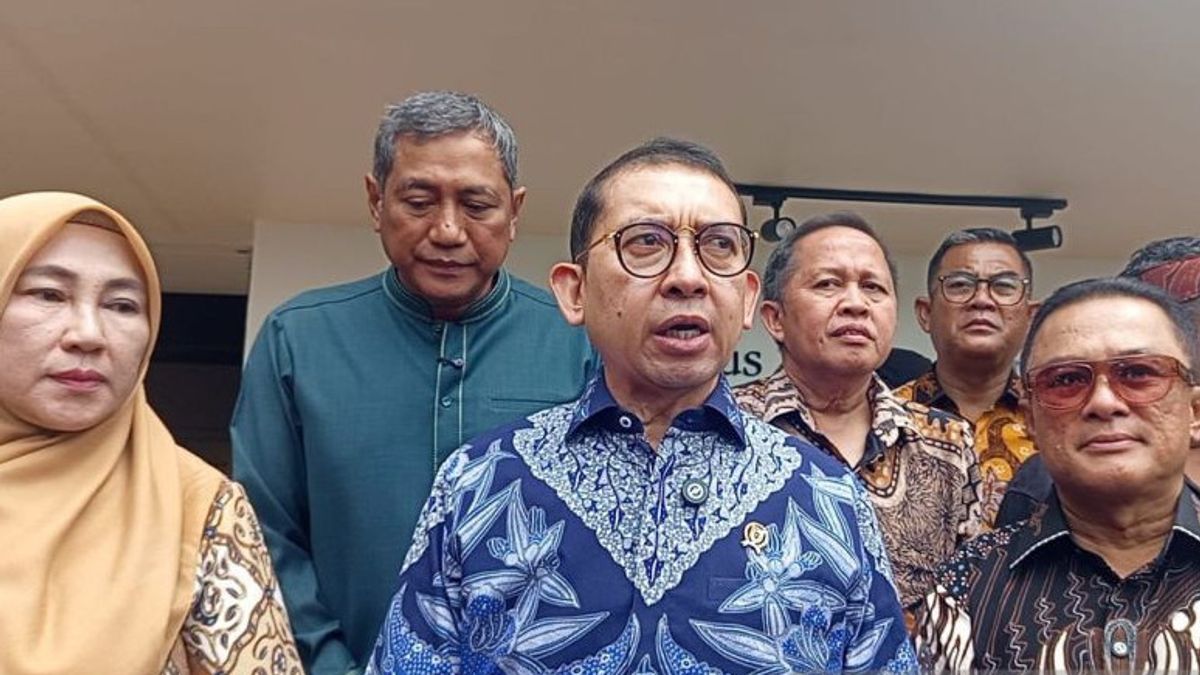


KUNINGAN - Minister of Culture (Menbud) Fadli Zon revealed the uniqueness of the stone tomb or sarcophagus at the Cipari Site, Kuningan Regency, West Java, which is a concrete proof of the burial technology of prehistoric people in the region.
The Minister of Education, during his working visit to Kuningan, Saturday, said the sarcophagus was unique compared to similar sites in other areas.
"The findings of sarcophagi or a kind of place for a unique-shaped stone tomb, this consists of four andesite stone slabs, not in one intact stone," he said, quoted from ANTARA, Saturday, April 4.
He explained that the shape of the sarcophagus was different from other findings which were generally in the form of intact or monolithic stones, so it showed a unique construction technique at that time.
According to him, the Cipari Site is a site that was discovered and began to be excavated by archaeologists since the early 1970s.
He said that in terms of chronology, the site dates back to the Neolithic to the Megalithic period with a time span of around 2,000 BC to 500 BC.
"In Cipari, if we look at it, the era is the Neolithic era, the Megalithic era, maybe around 2,000 years before the Common Era to around 500 years before the Common Era," he said.
The time period, he said, shows that the Kuningan area has been part of human civilization since thousands of years ago.
He also emphasized the importance of continuing excavations, to open the possibility of new discoveries in the area.
"Of course, in the future we hope that there will be more excavations, new findings later, working together with researchers," he said.
In addition to research, the government through the West Java Cultural Preservation Agency has revitalized museums in the area to store findings and present a learning flow for visitors.
The museum, he continued, is equipped with neat presentation and digital touch so that it can become an educational space for the younger generation.
He added that the Cipari Site area also has the potential to be developed as a cultural activity center because it is equipped with facilities such as an amphitheater with supporting landscapes.
"The utilization and activation of these sites as cultural spaces is also, I think, an important part for the Ministry of Education, working together with the provincial and district governments, as well as with communities and cultural activists," he said.
The English, Chinese, Japanese, Arabic, and French versions are automatically generated by the AI. So there may still be inaccuracies in translating, please always see Indonesian as our main language. (system supported by DigitalSiber.id)
Most Popular Tags
#Prabowo Subianto #donald trump #2026 World Cup #Febrie Adriansyah #8791Popular


