

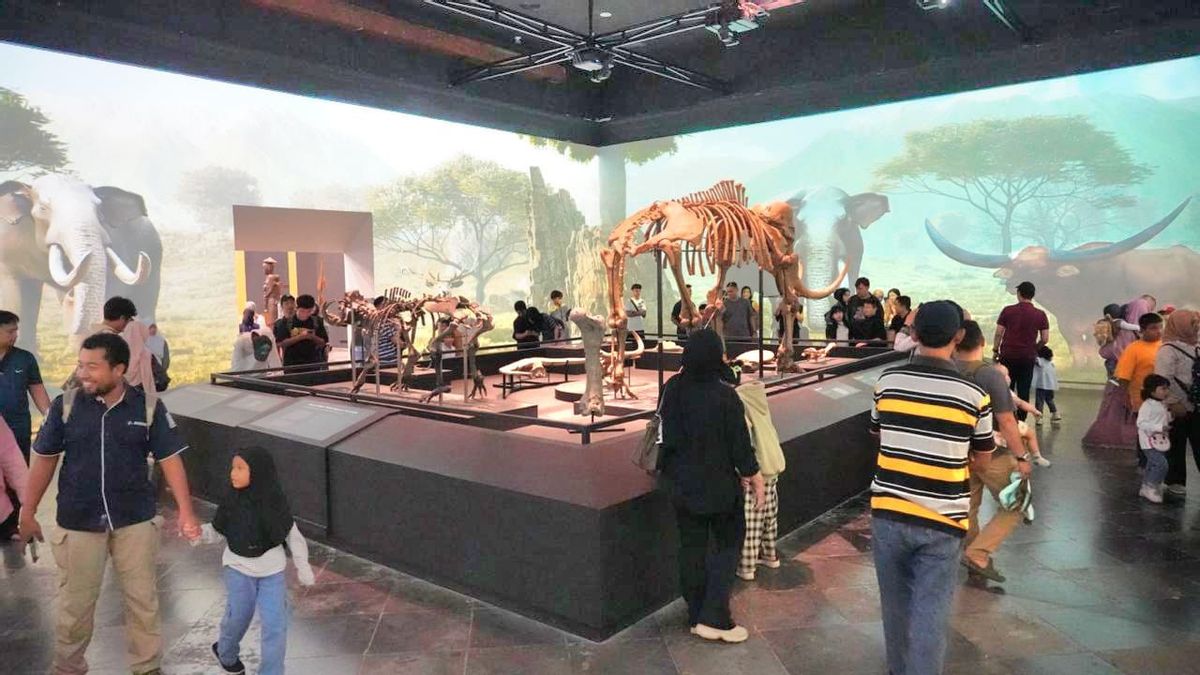


JAKARTA - The 2026 Lebaran holiday presents a new phenomenon in the national tourism map. Museums and cultural heritage sites are no longer just an optional choice. In the 11 days of the holiday, a total of 551,064 people visited 266 museums and cultural sites in various regions.
The data was conveyed by the Ministry of Culture in an official written explanation received in Jakarta, Wednesday, April 1. The registration period took place on March 16-27, 2026.
The surge shows a change in public taste during the Lebaran holiday. Cultural spaces that were once often seen as alternative destinations are now beginning to occupy a more prominent position.
The Directorate General of Cultural and Traditional Protection noted that the increase in visits was spread across many points. Museums and historical sites are increasingly being looked at because they offer recreational experiences that are not only entertaining, but also provide knowledge.
Of the total visits, 155,234 people came to 40 locations managed by the Museum and Cultural Heritage Service Agency (MCB). Borobudur Temple is the location with the highest number of visitors, namely 68,046 people. After that, Arjuna Temple recorded 22,246 visitors, while the National Museum of Indonesia received 18,914 visitors.
Similar trends were also seen outside the location managed by MCB. The Aceh Tsunami Museum UPTD recorded 28,006 visitors. The Percandian Bumiayu area was visited by 22,330 people. Meanwhile, the Sunan Giri Mausoleum Complex was visited by 18,226 people.
These figures show that historical tourism is no longer a complement during the holiday season. It began to become an attraction in the midst of a choice of tourism that has been dominated by shopping centers, amusement parks, and beaches.
Chairman of the Museum and Cultural Heritage Supervisory Board, M. Asrian Mirza, said the increase in visits was inseparable from the continuous improvements made at various museums and cultural sites. According to him, improvements not only touch on physical buildings, but also how collections are arranged, presented, and explained to the public so that they are more interesting and easy to understand.
"That is indeed the concern of the Minister of Culture Fadli Zon. Now the museum is being improved from many aspects, ranging from appearance, layout, to strengthening visual elements. This is done so that the museum is more friendly to visitors and can become a relevant tourist destination, as in many countries," said Asrian, Wednesday, April 1.
The Ministry of Culture has linked the surge in visits to the improvement of services at tourist sites. The digitization of information, space arrangement, and public programs during the holiday period are said to have encouraged people's interest in coming to museums and cultural heritage sites.
However, the increase in the number of visitors also brought other consequences. When public interest soared, the capacity of services, security systems, and the quality of visitor experiences were also tested. Managers are required not only to be able to attract the masses, but also to maintain the quality of visits so as not to damage the site or reduce public comfort.
The government through the Ministry of Culture stated that it would continue to strengthen the management and utilization of cultural heritage. The goal is not only to maintain sustainability, but also to ensure that cultural spaces provide economic benefits for the surrounding community.
The English, Chinese, Japanese, Arabic, and French versions are automatically generated by the AI. So there may still be inaccuracies in translating, please always see Indonesian as our main language. (system supported by DigitalSiber.id)
Most Popular Tags
#Prabowo Subianto #donald trump #2026 World Cup #Febrie Adriansyah #8791Popular


