
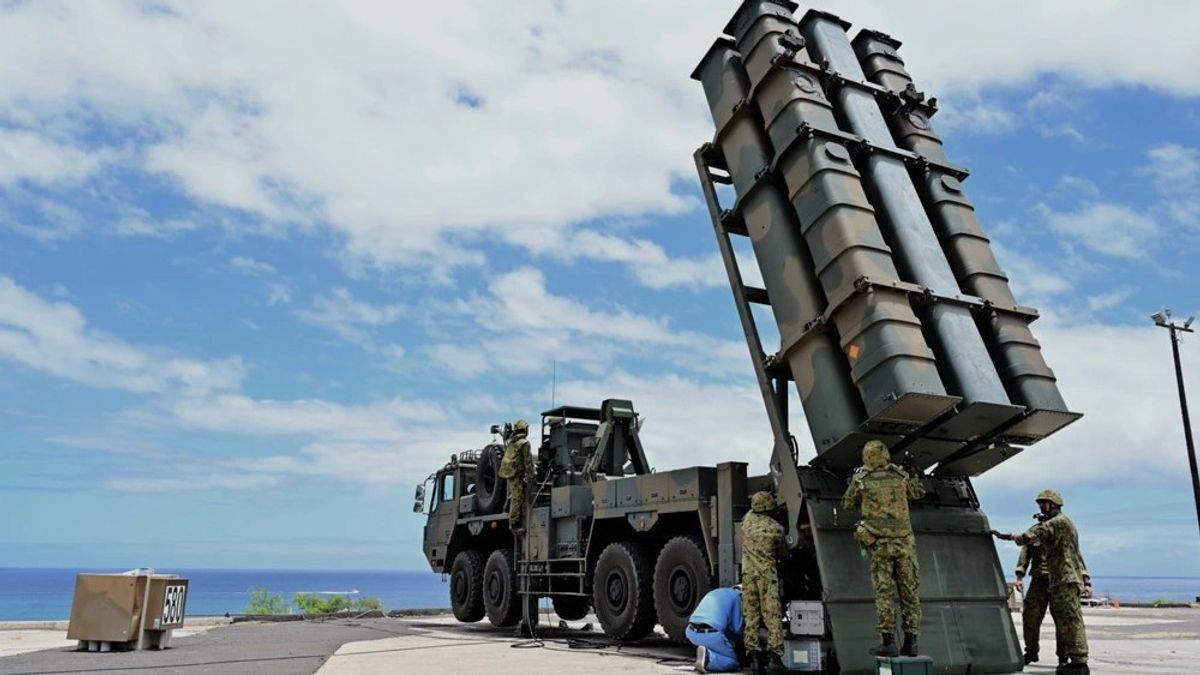


Japanese Defense Ministry on Tuesday said long-range missiles with counterattack capabilities have been operated at two Ground Self-Defense Force bases in the country.
The deployment of the missiles at Camp Kengun in Kumamoto Prefecture, southwest Japan, and Camp Fuji in Shizuoka Prefecture, central Japan, marks a shift from a policy of exclusive defense under the Constitution that rejects war.
Japan for the first time obtained the ability to counterattack, aiming to improve prevention after increasing tensions with China. It is known that the distance from Kumamoto to Shanghai, China is about 900 kilometers.
This ability allows Japan to attack enemy bases as soon as an imminent attack is deemed likely, even before damage is done, but miscalculation could result in a violation of international law, which prohibits preemptive strikes.
"This is a very important effort to strengthen our prevention and response capabilities in the face of the most severe and complex security environment in the post-war era," Defense Minister Shinjiro Koizumi told reporters, launching Kyodo News (31/3).
Although the ministry said the system was essential to strengthen deterrence amid a changing regional security environment, residents feared the location of the deployment could be targeted in the event of a conflict.
According to the ministry, Camp Kengun has been equipped with an upgraded version of the Type 12 land-to-ship guided missile, which is launched from land, with a range of about 1,000 kilometers and can reach part of the continental coastline from the Kyushu region.
Meanwhile, training units at Camp Fuji have been equipped with high-speed glide projectiles for the defense of remote islands.
Operational methods will be studied there, with plans to deploy the missiles to Kamifurano Camp in Hokkaido and Ebino Camp in Miyazaki Prefecture in the Kyushu region in fiscal 2026.
According to a source familiar with the matter, the model currently in use has a range of several hundred kilometers. The ministry is working to increase its range to around 2,000 km.
Around 50 residents protested on Tuesday in front of the camp's main gate, holding signs that read, "No to deployment" and "We don't need missiles."
"This is a day of anger," said resident Hidemitsu Horiuchi, 73, through a microphone.
"The surrounding area is densely populated with houses. Kumamoto will be a target," he continued.
When asked whether the ministry would hold a briefing session for Kumamoto residents, Koizumi said, "There are currently no such plans."
Previously, on March 17, two weeks before the deployment of the missiles, the Ministry of Defense held an exhibition of missile launchers and other equipment for local high officials, such as the prefectural governor and the mayor of the capital.
The possession of the counterattack capability is officially outlined in three security documents revised in 2022 during the term of Prime Minister Fumio Kishida.
The ministry plans to continue deploying long-range missiles to equip various units with attack capabilities. On Friday, the Japanese Maritime Self-Defense Force's Chokai destroyer, equipped with Aegis technology, acquired the ability to launch US-made Tomahawk cruise missiles.
Meanwhile, the Japanese Maritime Self-Defense Force's Teruzuki destroyer, based in Yokosuka, Kanagawa Prefecture near Tokyo, and the F-2 fighter jets at the Japan Air Self-Defense Force's Hyakuri Air Base in Ibaraki Prefecture are also scheduled to be equipped with Type 12 missiles.
In addition, the delivery of long-range Joint Strike Missile for the F-35A stealth fighter jet has also begun.
The English, Chinese, Japanese, Arabic, and French versions are automatically generated by the AI. So there may still be inaccuracies in translating, please always see Indonesian as our main language. (system supported by DigitalSiber.id)


