
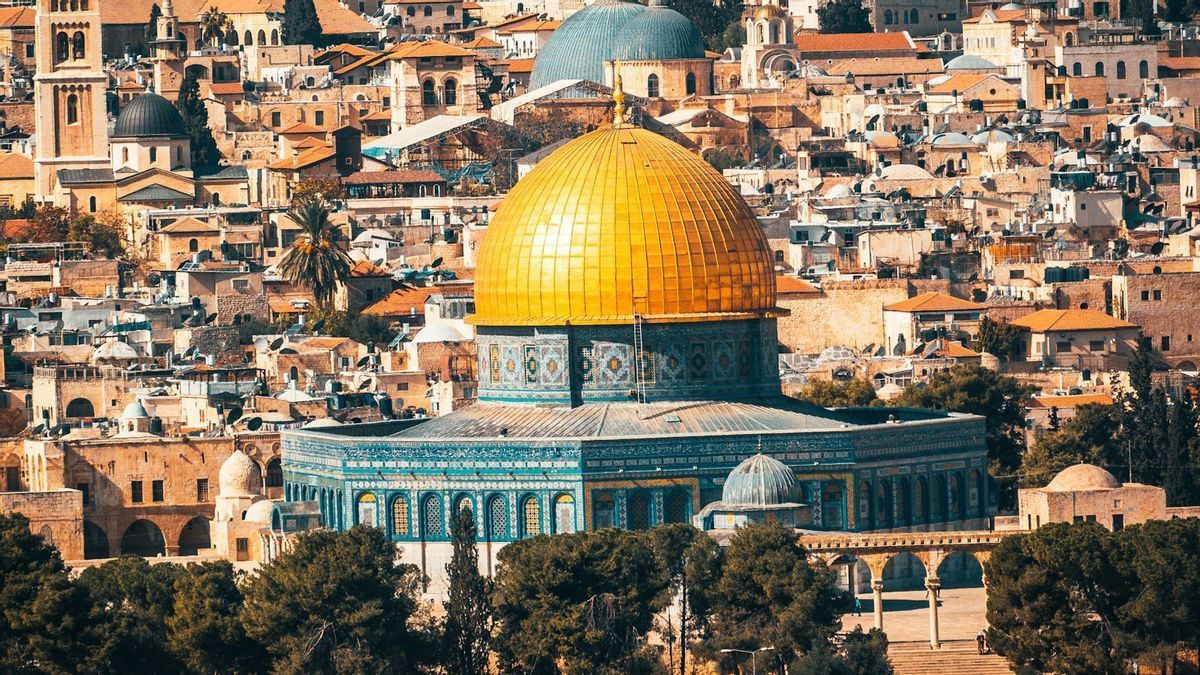


JAKARTA - For the first time since 1967, Israeli authorities have imposed a total ban on Muslims to perform Eid al-Fitr prayers at the Al-Aqsa Mosque. This policy has drawn harsh criticism because it is not considered merely a security matter, but a provocative political move.
Prof. Dr. Sudarnoto Abdul Hakim, Chairman of the MUI for Foreign Relations and International Cooperation, emphasized that this action has a very deep ideological and strategic dimension.
According to Prof. Sudarnoto, there are at least four main points that underlie why this ban must be watched by the international community:
Erosi "Status Quo" Masjidil AqsaSince the 1967 war, Israel has formally maintained a status quo that gives religious authority to the Islamic Waqf. However, this total ban is a strong signal that Israel wants to erode the rule and take full control over worship activities at the first qibla of Muslims.
Political Pressure and IdentityEid al-Fitr is not just a ritual of worship, but a symbol of the collective identity and self-esteem of the Palestinian people. Choosing the momentum of a big day to impose a ban is a form of psychological and political pressure aimed at crushing the spirit of the Palestinian people's struggle.
Shifting to a More Repressive PolicyIf previously the restrictions were based only on age or quotas, this total ban marks a much more repressive policy.
"This could be part of a long-term strategy to change the demographic and religious character of Jerusalem," said Prof. Sudarnoto.
Global Tension TriggerThe Al-Aqsa Mosque is a sensitive issue for 1.8 billion Muslims in the world. This Israeli move has the potential to trigger a wave of regional protests to a harsh reaction from international organizations, given the status of Al-Aqsa as a global holy symbol.
Urgency of International Legal Action and the Role of Indonesia
Prof. Sudarnoto called on the Islamic world not to stand idly by in the face of this arbitrariness. Considering that the action violates international law regarding freedom of religion in the occupied territories, there needs to be concrete steps in the form of real sanctions against Israel.
"Indonesia's role should be maximized," he concluded. As a country with the largest Muslim population, Indonesia is expected to be able to lead international diplomacy to urge an end to human rights violations at the Al-Aqsa Mosque.
The English, Chinese, Japanese, Arabic, and French versions are automatically generated by the AI. So there may still be inaccuracies in translating, please always see Indonesian as our main language. (system supported by DigitalSiber.id)
Most Popular Tags
#Prabowo Subianto #donald trump #2026 World Cup #Febrie Adriansyah #8791Popular


