

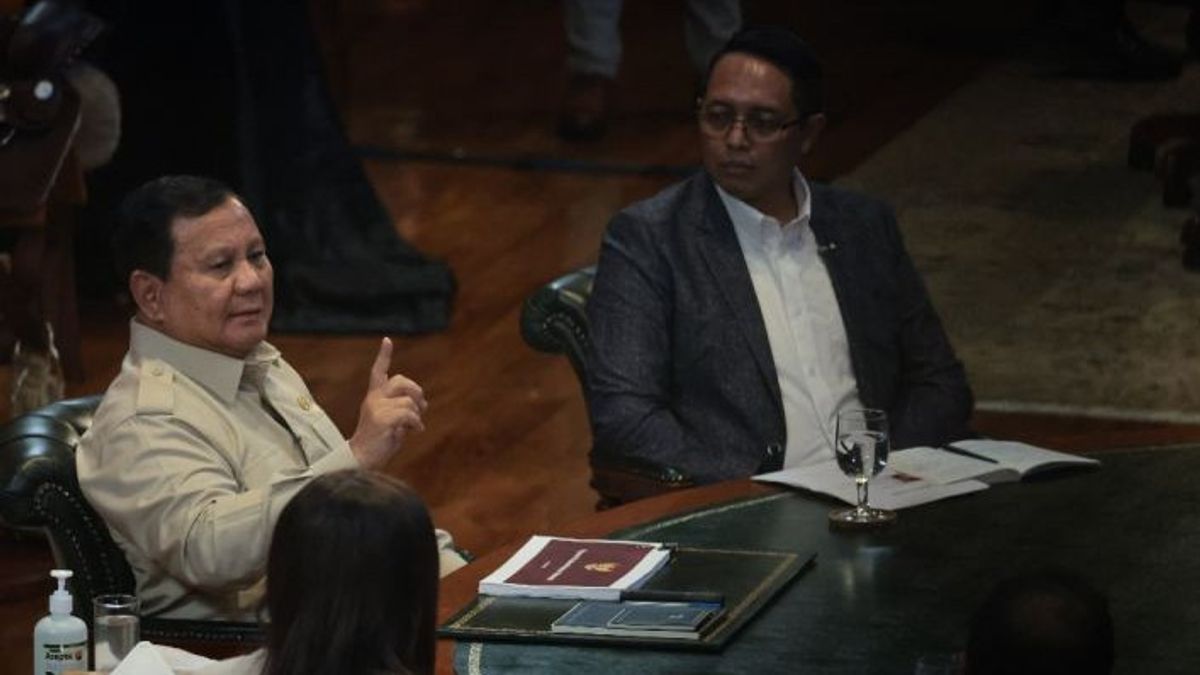


JAKARTA - President Prabowo Subianto explained the reason for cutting the state's budget for ministries and agencies that were considered unproductive in order to close the gap in irregularities in the use of the APBN.
"The first time we did efficiency, we saved Rp308 trillion from the central government. Where did it come from? From all the expenses that are unreasonable. My belief is that all of this Rp308 trillion, if it is not cut, this is towards corruption," said President Prabowo in a video received by ANTARA from the Presidential Secretariat Press Bureau, in Jakarta, Thursday, March 19.
The Head of State explained that the savings of Rp308 trillion were the result of the initial screening of central spending.
According to him, if the funds are left without supervision and cuts, it will become a burden on the state's finances without providing real benefits to the community.
The President also highlighted the economic indicator Incremental Capital Output Ratio (ICOR) Indonesia which is at the level of 6.5, much higher than neighboring countries.
The high figure indicates an inefficiency of around 30 percent or the equivalent of 75 billion US dollars from the total state budget which is close to the figure of Rp3,700 trillion.
A number of budget posts that are targets for cuts include ceremonial costs, the purchase of office stationery, to spending for meetings and seminars outside the office. The President assessed that these activities often do not touch on major issues such as poverty alleviation and job creation.
In addition, the government highlighted the habit of routinely procuring goods such as computers and office equipment which are carried out almost every year.
Prabowo emphasized that the efficiency of routine spending that is not essential still has a very large savings room for government agencies.
In the face of potential crises, the President also discussed the implementation of a new work pattern to reduce the burden on the state's operations. Schemes such as reducing working days or implementing work from home (WFH) are being considered for implementation for most employees.
"I see other countries, for example, working five days a week to four, the Philippines, Pakistan. Then work from home, work from home. During COVID, we did it quite successfully. I think we can do that too. Maybe 75 percent of employees or employees can work from home," said President Prabowo.
The English, Chinese, Japanese, Arabic, and French versions are automatically generated by the AI. So there may still be inaccuracies in translating, please always see Indonesian as our main language. (system supported by DigitalSiber.id)
Most Popular Tags
#Prabowo Subianto #donald trump #2026 World Cup #venezuela #konflik timur tengahPopular


