

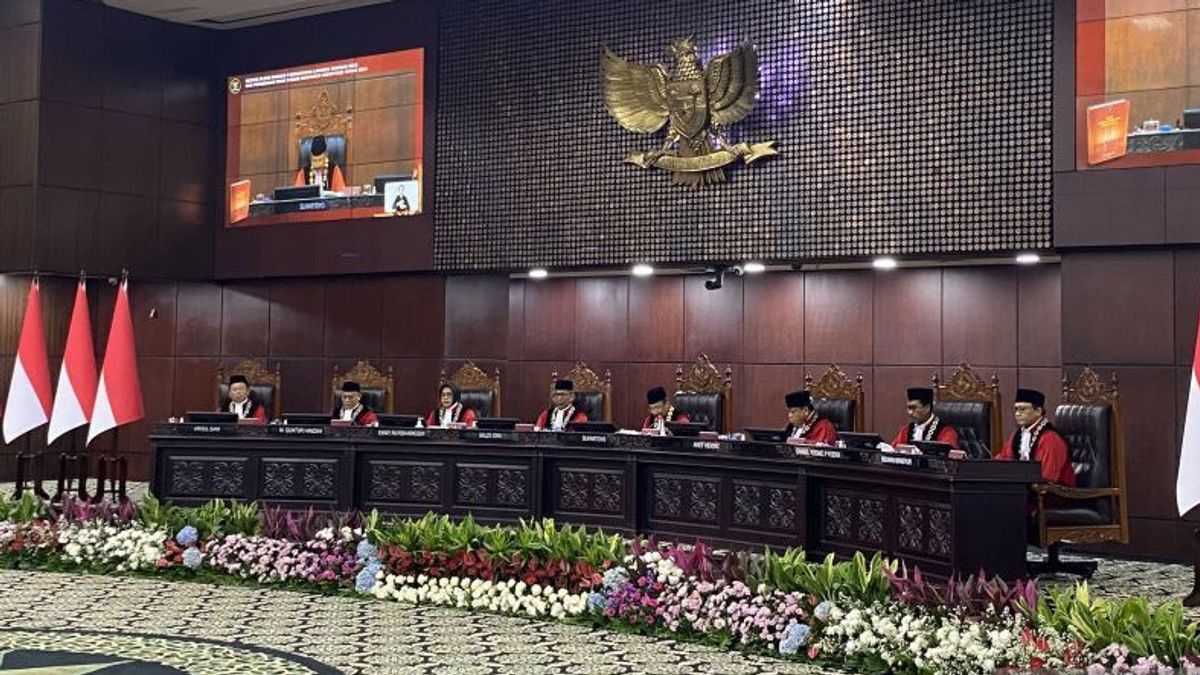


JAKARTA - The Constitutional Court granted a partial request for a material test related to pension arrangements for former high-ranking state officials, including members of the Indonesian House of Representatives. The court assessed that the current rules are no longer relevant to the development of the constitutional system so that they need to be immediately revised.
The verdict was read in a plenary session at the Constitutional Court building, Central Jakarta, Monday, March 16, in the case Number 191/PUU-XXIII/2025. The application for a material test was submitted by Ahmad Sadzali along with a number of other applicants who sued several articles in Law Number 12 of 1980.
The articles that are being tested include Article 12, Article 16, Article 17, Article 18, and Article 19 which regulate financial rights, including pensions for leaders and members of the highest state institutions.
In its consideration, the constitutional panel stated that the law was drafted at a time when Indonesia's constitutional structure was still different from the current system. After the reform, a number of state institutions experienced changes in functions, authorities, and mechanisms for filling positions.
"This law is no longer in accordance with the development of the state and the current conditions," the Constitutional Court considered in its ruling.
In addition, the old rules also often drew public criticism because they provided a lifelong retirement scheme for former DPR members even though their term of office was relatively short, namely five years. The scheme is considered not in line with the principles of social justice and state budget efficiency.
Based on the current regulations, former members of the DPR are entitled to receive a pension of around 60 percent of the basic salary of members of the DPR. The basic salary of members of the DPR itself is around Rp. 4.2 million per month so that the value of the pension received ranges from Rp. 2.5 million per month and is paid for life.
The scheme has repeatedly come under public scrutiny because it is considered disproportionate to the conditions of most people who do not have pension guarantees, while former legislators continue to receive pension payments even though they only served one term.
The court assessed that the regulations in the law have not fully reflected the principles of modern governance which require transparency, accountability, and compliance with the social and economic conditions of the community.
In addition, the Constitutional Court also assessed that the old rules had not clearly differentiated the categories of state officials based on the filling mechanism. In fact, currently there are various filling models, ranging from officials who are elected through general elections, officials who are selected through a competency-based selection mechanism, to officials who are appointed through political appointments such as ministers.
Therefore, the court considers that updating regulations is necessary so that the regulation of the financial rights of state officials, including pensions, is more proportional and in accordance with the current constitutional system.
Although it stated that a number of provisions in Law 12/1980 were contrary to the Constitution of the Republic of Indonesia in 1945, the Constitutional Court did not immediately cancel all of these rules.
To maintain legal certainty, the court gave time to the law-makers, namely the DPR together with the government, to draft new regulations within a maximum period of two years from the reading of the verdict.
During the transition period, the provisions of Law 12/1980 are still valid temporarily. However, if by the two-year deadline a new law is not issued, then all provisions in the law will lose their legal force permanently.
The Constitutional Court also provides a number of guidelines in the preparation of new rules regarding the financial rights of state officials. One of them is by paying attention to the principle of independence of state institutions so that officials who carry out strategic functions are still protected from potential pressures that can affect integrity and objectivity in carrying out their duties.
In addition, the mechanism for granting financial rights, including pensions, is requested to be structured proportionally and accountable by considering the socio-economic conditions of the community.
The court even opened the possibility for lawmakers to study alternative models, for example, replacing the lifelong pension scheme with a one-time honorarium mechanism after the term of office ends.
"The regulation regarding the financial rights of state officials must consider the principles of justice, accountability, and the socio-economic conditions of the Indonesian people," said the Constitutional Court in its ruling.
In the ruling read by the Chairman of the Constitutional Court Suhartoyo, the court stated that it granted part of the applicants' request and ordered the law-makers to revise or replace Law 12/1980 within two years.
Meanwhile, in another case with number 176/PUU-XXIII/2025 which also tested the same law regarding the abolition of pensions for former members of the DPR, the Constitutional Court stated that the application was not acceptable because the substance had been covered in the decision of case 191/PUU-XXIII/2025 which ordered a thorough update of the rules.
The English, Chinese, Japanese, Arabic, and French versions are automatically generated by the AI. So there may still be inaccuracies in translating, please always see Indonesian as our main language. (system supported by DigitalSiber.id)
Most Popular Tags
#Prabowo Subianto #donald trump #2026 World Cup #Febrie Adriansyah #8791Popular


