

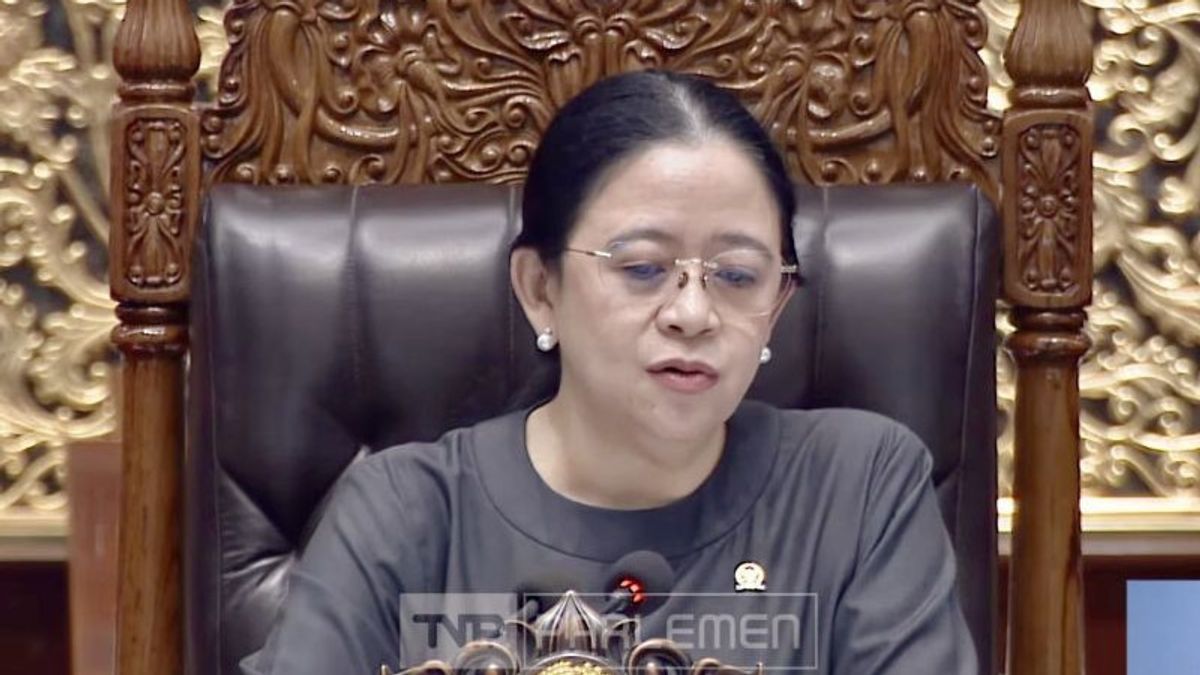


JAKARTA - The DPR plenary meeting passed the Draft Law on the Protection of Domestic Workers (RUU PPRT) as the DPR Initiative Bill. DPR Chairwoman Puan Maharani emphasized that this law will later guarantee that the Assistant House of Representatives (ART) will have equality with the employer.
According to Puan, the ratification of the PPRT Bill as a DPR initiative bill is an important step for the DPR in strengthening legal protection for millions of domestic workers in Indonesia who have not had comprehensive regulations. The PPRT Bill itself has been fought for for 22 years and promised by President Prabowo Subianto on May 1 Labor Day in 2025 to be immediately enacted into law.
"With the enactment of this bill as a DPR initiative, the next discussion process will be carried out together with the Government to produce laws that provide legal certainty, protection, and respect for the rights of domestic workers," said Puan at the DPR building, Senayan, Jakarta, Thursday, March 12.
In the report of the Chairman of the PPRT Bill Working Committee, Martin Manurung, which was read at the plenary meeting, this bill is in line with the mandate of Article 27 paragraph (2) of the 1945 Indonesian Constitution which states that 'Every citizen has the right to work and a decent living for humanity'. Meanwhile, millions of Indonesians work as ART, but the existence of the problem still continues and even becomes more complex.
Puan also said that the PPRT bill aims to provide recognition and raise the dignity and dignity and provide protection to the profession of Domestic Workers. "With the good faith of the DPR RI with the PPRT bill, the status of domestic workers has an equal position with the employer (equal) and as workers, of course, they get rights, especially protection for the domestic workers themselves," he explained.
Puan assessed that this was important considering that according to Jala PRT data, the number of PRT in Indonesia reached 4.2 million of the population. Meanwhile, according to the Ministry of Manpower, the figure could be higher, around 8-10 million people, including those who have not been recorded.
Puan also assessed that the data was very significant because it concerned the fate of domestic workers who were trapped in jobs that did not have signs and unclear labor standards. Given the ART for
this works without legal protection, without oversight by the
without authority, without a contract of employment, without a job description, inhuman working hours and wages, and without days off.
"This puts PRT in a very exploitative situation and condition. PRT is also a hidden problem, difficult to reach and neglected," said Puan.
In order to prepare the PPRT bill, the DPR Legislation Agency (Baleg) has held a series of discussions and asked for various inputs and opinions from experts, NGOs, labor activists, PRT placement companies, students, campus academics, and related government agencies.
Several related parties invited or presented by the Legislative Agency include the Indonesian Student Consolidation Alliance, JALA PRT, KOMNAS HAM, KOMNAS Perempuan, KPAI, PP Aisyiyah, LBH Apik, Rifka Annisa Women's Crisis Center, ILO Indonesia, Association of PRT Distributors Indonesia, Labor Party, and Coalition of Civil Society for the PPRT Bill. Then the Ministry of Manpower, the Ministry of Basic and Secondary Education, the Ministry of Social Affairs, BPJS Health, and BPJS Employment.
Puan revealed a number of issues regulated in the PPRT Bill, such as one of the rights of PRT, namely the right to receive health social security and employment social security. The candidate PRT is also entitled to receive vocational education and training, both from the Central Government and the Regional Government, as well as from the PRT placement company.
"Vocational education and training for prospective PRT, including education on social and cultural norms that live in society in accordance with the context of the workplace, so that the implementation of PRT can maintain sociocultural relations between Employers and PRT," said Puan.
Through the enactment of the PPRT bill as a DPR initiative, Puan emphasized that the DPR is committed to presenting regulations that favor vulnerable worker groups and ensuring that the principle of social justice is fulfilled for all Indonesian people.
"The DPR hopes that the discussion with the government can run constructively and produce a comprehensive and implementable law, so that domestic workers can get decent and dignified protection," he concluded.
The English, Chinese, Japanese, Arabic, and French versions are automatically generated by the AI. So there may still be inaccuracies in translating, please always see Indonesian as our main language. (system supported by DigitalSiber.id)
Most Popular Tags
#Prabowo Subianto #donald trump #Febrie Adriansyah #8791 #giias 2026Popular


