
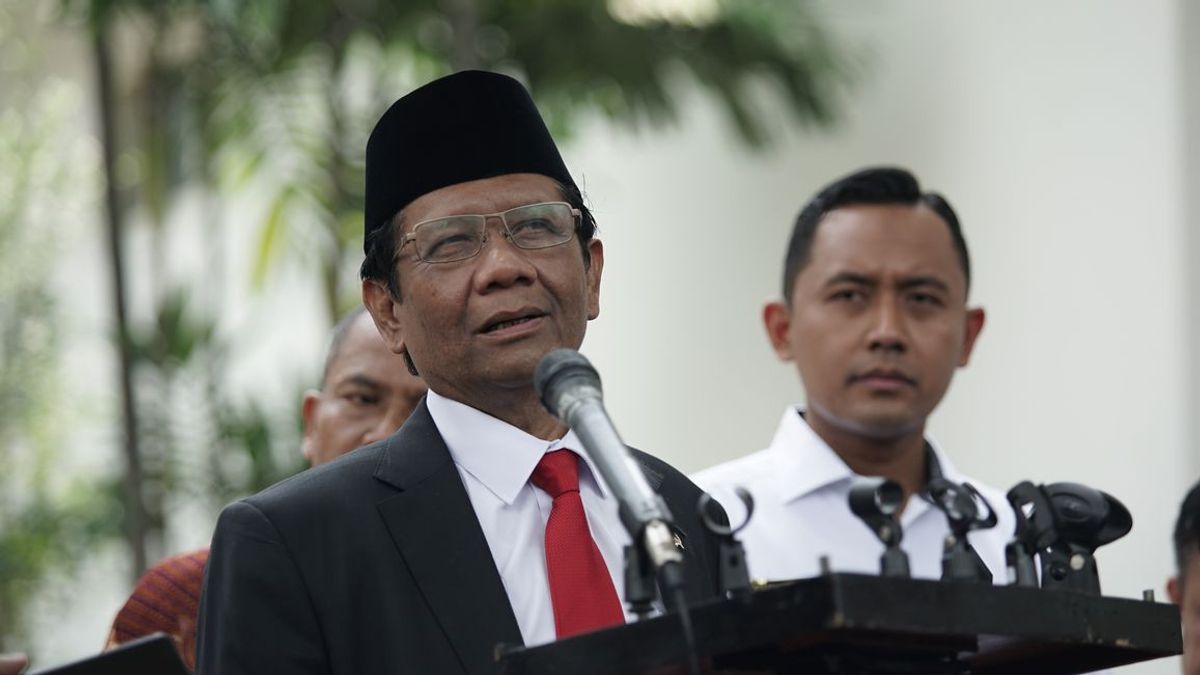


Guru Besar Hukum Tata Negara Prof Mahfud MD menyampaikan pandangannya terkait kasus kuota tambahan haji 2024. Kasus ini kini tengah memasuki proses sidang praperadilan yang diajukan oleh mantan Menteri Agama Yaqut Cholil Qoumas (Gus Yaqut) atas penetapan dirinya sebagai tersangka.
Mahfud emphasized his hope that the legal process for this case would run purely according to the rules, without criminalization or games that ignore law enforcement.
The former Coordinating Minister for Political, Legal, and Security Affairs (Menko Polhukam) reminded that although corruption is a barbaric act that must be dealt with firmly, law enforcement should not be arbitrary.
"Everything must be correct and in accordance with the rules," he said in a written statement, Sunday, March 8.
Determination of Suspects with Defective Procedures
In this case, Mahfud highlighted a number of procedural irregularities, one of which was the determination of the suspect by the head of the KPK who was not a status of investigator. Further responding to the facts in the pretrial hearing revealed that Gus Yaqut never received a letter of determination of the suspect, but only a notification letter. "
"Wow, that's not allowed. The KPK leadership is not authorized to determine the suspects," said the former Minister of Justice and Human Rights.
Hajj Quota Not a State Loss
Regarding the substance of the case, the Professor of State Law at the University of Indonesia (UII) Yogyakarta also launched a fundamental criticism. He considered it inappropriate if the Hajj quota was categorized as a state loss.
"This is from the beginning I was surprised. The quota for the hajj is not a loss to the state, it is not appropriate to be categorized in that way. There is no state money there, right?" he said. This statement also underlines the importance of caution in defining the elements of state losses in corruption cases.
On the other hand, Prof. Mahfud appreciated the implementation of the 2024 Hajj.
"I've heard a lot, the 2024 Hajj is good," he said.
According to him, the policy taken by the then Minister of Religion was a legitimate form of discretion, based on situational considerations and the authority inherent in his position. "Discretion cannot be prosecuted," said the former Constitutional Court (MK) Chairman.
He also explained the concept of the discretionary power or freies ermessen in administrative law. Namely, the policy taken by officials when there is no rule governing, but the situation demands a solution.
"Pure policies should not be prosecuted. If there are rules, follow the rules; if there are none, then discretion is needed," he said.
Mahfud warned that if discretion was imprisoned, the impact would be wide, namely officials would be afraid to make decisions, even reluctant to carry out their duties.
Mahfud emphasized the importance of distinguishing between policies and criminal acts. This is crucial so that officials do not hesitate to carry out their duties, including in taking the discretion that is their authority. He hopes that this case will run according to the legal corridor, without criminalization, but also without loopholes for violations.
"Hopefully everything goes well," he said.
From the perspective of Mahfud, who has held high positions in the legislative, executive and judicial fields, this assessment is that this case is not merely about the existence or absence of corruption, but also about how the law is positioned in the public policy space.
If law enforcement officers ignore procedures and mistakenly distinguish policies from crimes, then what is threatened is not only one suspect, but the future of government governance itself.
The English, Chinese, Japanese, Arabic, and French versions are automatically generated by the AI. So there may still be inaccuracies in translating, please always see Indonesian as our main language. (system supported by DigitalSiber.id)
Most Popular Tags
#Prabowo Subianto #donald trump #2026 World Cup #Febrie Adriansyah #8791Popular


