

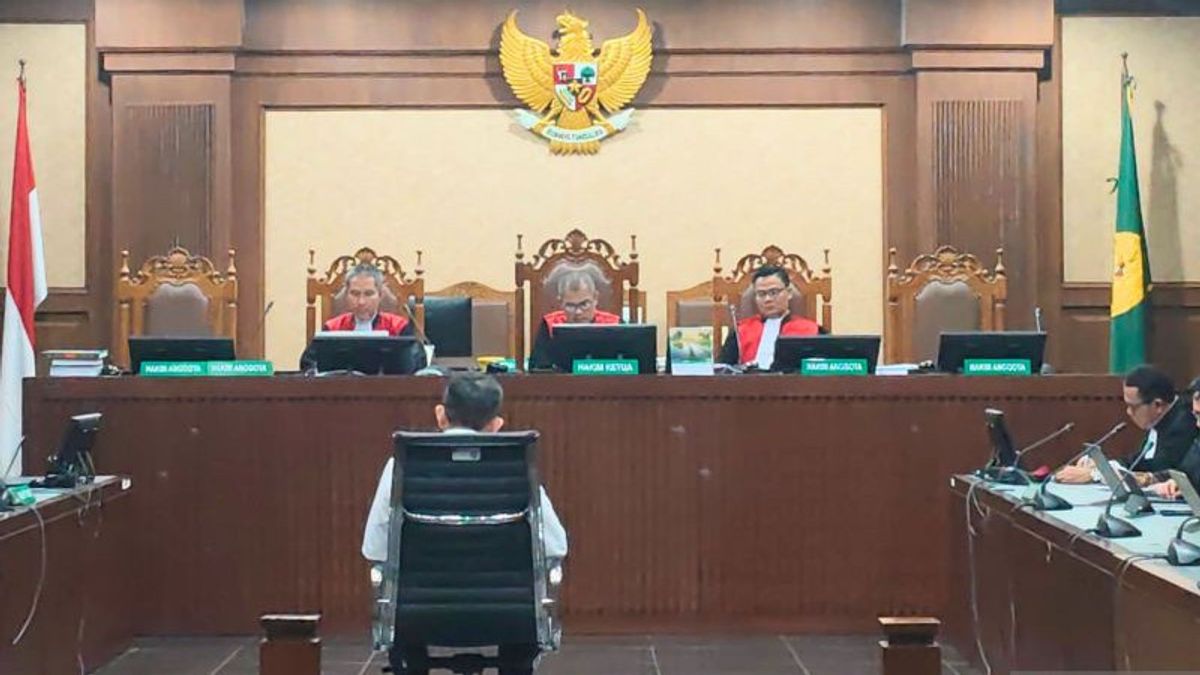


Head of Social Security Legal Wilmar Group Muhammad Syafei was sentenced to 6 years in prison for being proven to have helped bribe judges related to the crude palm oil (CPO) corruption case.
Presiding Judge Effendi stated that Syafei was proven to be legally and convincingly guilty of committing a criminal act, by helping to give a bribe worth Rp. 60 billion to the judge, together with lawyers Marcella Santoso and Ariyanto.
"The actions of the defendant Syafei have clearly fulfilled the elements of intentionally providing assistance at the time of the crime or at least intentionally providing the opportunity, means, or information to commit a crime," said the Chief Judge in the reading of the verdict at the Corruption Court at the Central Jakarta District Court, Tuesday, quoted by Antara.
In addition to imprisonment, the Chief Judge stated that Syafei was also sentenced to a fine of IDR 300 million with the provision that if it was not paid, it would be replaced (subsider) with a prison sentence of 100 days.
The panel of judges determined that there were three roles for Syafei in helping to provide bribes, namely, first, informing Marcella of the Rp20 billion fund from the company in dispute to bribe the judge.
The second role, namely receiving Ariyanto's phone number from Marcella and forwarding the number to the company in the lawsuit. Third, be a liaison between the Wilmar Group and Marcella.
Even so, the panel of judges stated that Syafei was not proven to have committed money laundering (TPPU), as previously charged.
Until the trial was completed, the presiding judge stated that the public prosecutor could not prove that Syafei received the 2 million US dollars that Marcella and Ariyanto enjoyed.
"The defendant Syafei has also reversed the proof of his wealth and can prove that all his wealth was obtained not from the proceeds of the bribery case," said the Chief Judge.
Before passing the verdict, the panel of judges had considered aggravating and mitigating circumstances. The aggravating circumstances, namely Syafei's actions did not support the commitment of the state in realizing a clean government free from corruption, collusion, and nepotism.
In addition, Syafei's actions in the company case are being tried in a corporate corruption case, which is also considered as a mitigating factor for the verdict.
"Meanwhile, the consideration for mitigating the sentence is that Syafei has never been sentenced and the initiative to give bribes does not come from Syafei," said the Chief Justice.
Thus, Syafei was proven to have violated Article 6 paragraph (1) letter a in conjunction with Article 18 of Law (UU) Number 31 of 1999 concerning the Eradication of Corruption as amended and supplemented by Law Number 20 of 2001 jo. Article 56 paragraph (1) of the Criminal Code.
The verdict is lower than the prosecutor's demand. Previously, Syafei was ordered to be sentenced to 15 years in prison; a fine of Rp. 600 million subsider; and a substitute money of Rp. 9.33 billion subsider 5 years in prison.
In the case of alleged bribery of the conditional release decision (ontslag) of the corruption case of providing CPPO and TPPU export facilities in 2025, Syafei was initially charged with bribing judges and committing TPPU.
The bribe was allegedly given worth Rp40 billion together with Marcella, while the TPPU action was allegedly carried out by Syafei together with Ariyanto and Marcella worth Rp52.5 billion.
The bribe money was intended for judges who handled the CPO corruption case, while the TPPU was carried out using the name of a company in the ownership of assets to mix the money from the CPO case corruption with legitimate income.
The TPPU consists of the form of United States dollars (USD) equivalent to Rp28 billion which is controlled by Marcella, Ariyanto, and Syafei as well as legal fees alias legal fees of Rp24.5 billion.
Specifically, Syafei, it was stated that the amount of TPPU carried out was worth Rp. 28 billion, which was controlled together with Marcella and Ariyanto, as well as operational money of Rp. 411.69 million.
The English, Chinese, Japanese, Arabic, and French versions are automatically generated by the AI. So there may still be inaccuracies in translating, please always see Indonesian as our main language. (system supported by DigitalSiber.id)
Most Popular Tags
#Prabowo Subianto #donald trump #Febrie Adriansyah #8791 #giias 2026Popular


