

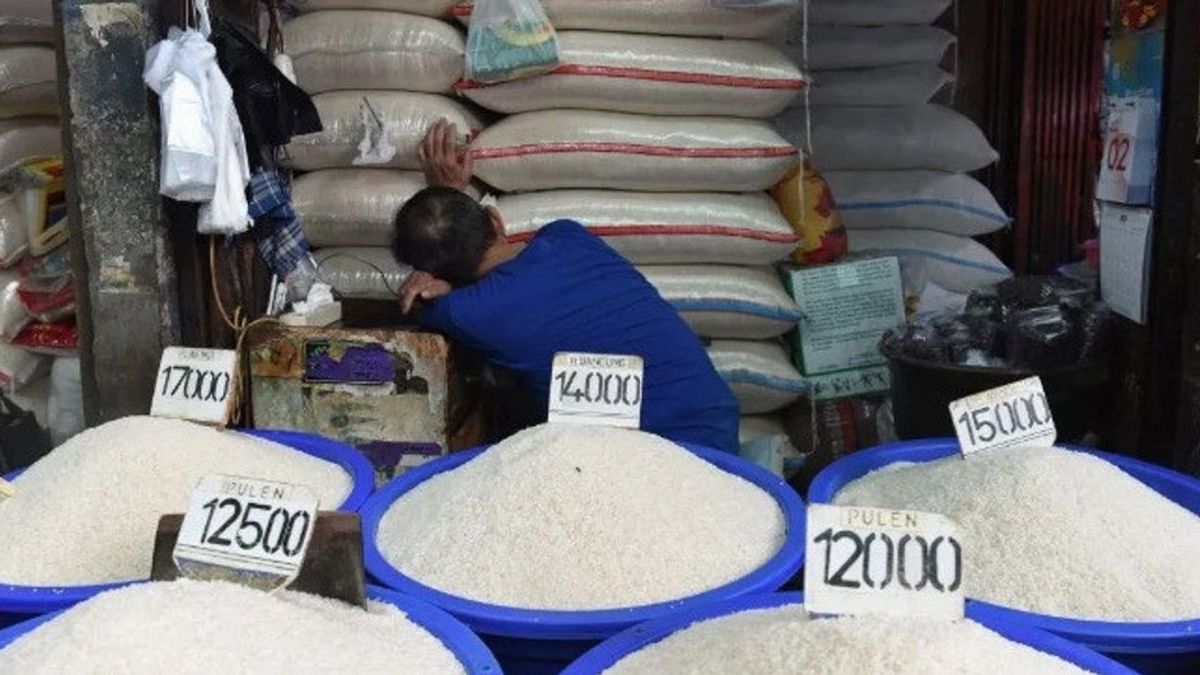


JAKARTA - SEAMEO BIOTROP Director, Edi Santosa, emphasized that the high price of rice in Indonesia is not a new problem and cannot be solely blamed on market mechanisms. According to him, the root of the problem lies in regulations that have not been thoroughly revised since the 1980s.
Edi, who is also an expert in agronomy and horticulture from IPB, revealed that the price disparity of rice between Jakarta and Bangkok has been seen since the 1980s.
"For 40 years, this expensive price problem has continued. So, we can't just blame market players. If the problem lasts for decades, it means that this is a regulatory problem that must be rearranged," he said in a statement, Friday, February 27.
He assessed that if the price of domestic rice is consistently higher than neighboring countries and the international market, then there is a fundamental problem in the national food governance.
"This indicates that there is a structural problem. Regulations, business rules, and the distribution system need to be comprehensively evaluated," he said.
Apart from the issue of price, Edi also highlighted the importance of public access to fresh rice. According to him, fresh rice has certain nutritional content and compounds that have an impact on the quality of public health.
"If our people eat fresh rice, Indonesia will definitely be a much happier country. In addition, this is very urgent regarding its nutritional content. If people consume fresh rice, the stunting problem can be overcome and the quality of our human resources will increase towards Indonesia 2045," he explained.
However, he reminded that access to fresh rice could only be realized if the turnover of the Government Rice Reserve (CBP) stock ran fast and was not stored in warehouses for too long. According to him, rice that has been stored for too long or aging rice actually generates significant additional costs.
"Rice that has been in the warehouse for a long time can jump up to Rp. 10,000 more expensive than the initial price due to the accumulation of storage costs. This makes the price higher downstream," he said.
As a solution, Edi suggested that the government carry out market-based intervention or captive market, such as the rice flour industry. He explained that the industry actually requires rice that has undergone storage processes.
"The rice flour industry cannot use fresh rice; they need aging rice. The government can channel old rice to the industry at competitive prices through cooperation with existing entrepreneurs," he said.
At the end of his statement, Edi emphasized that food self-sufficiency with a surplus of 4 to 8 million tons would not have the maximum impact without improving logistics and distribution. He encouraged synergy across institutions to comprehensively address food price and quality issues.
"Institutionally, this cannot be done alone. We have the Food Agency, the Ministry of Agriculture, the Ministry of Economy, the Nutrition Agency, to the BPOM. Inter-institutional synergy is needed to manage food surveillance and improve people's quality of life," he concluded.
The English, Chinese, Japanese, Arabic, and French versions are automatically generated by the AI. So there may still be inaccuracies in translating, please always see Indonesian as our main language. (system supported by DigitalSiber.id)
Most Popular Tags
#Prabowo Subianto #donald trump #2026 World Cup #Febrie Adriansyah #8791Popular


