

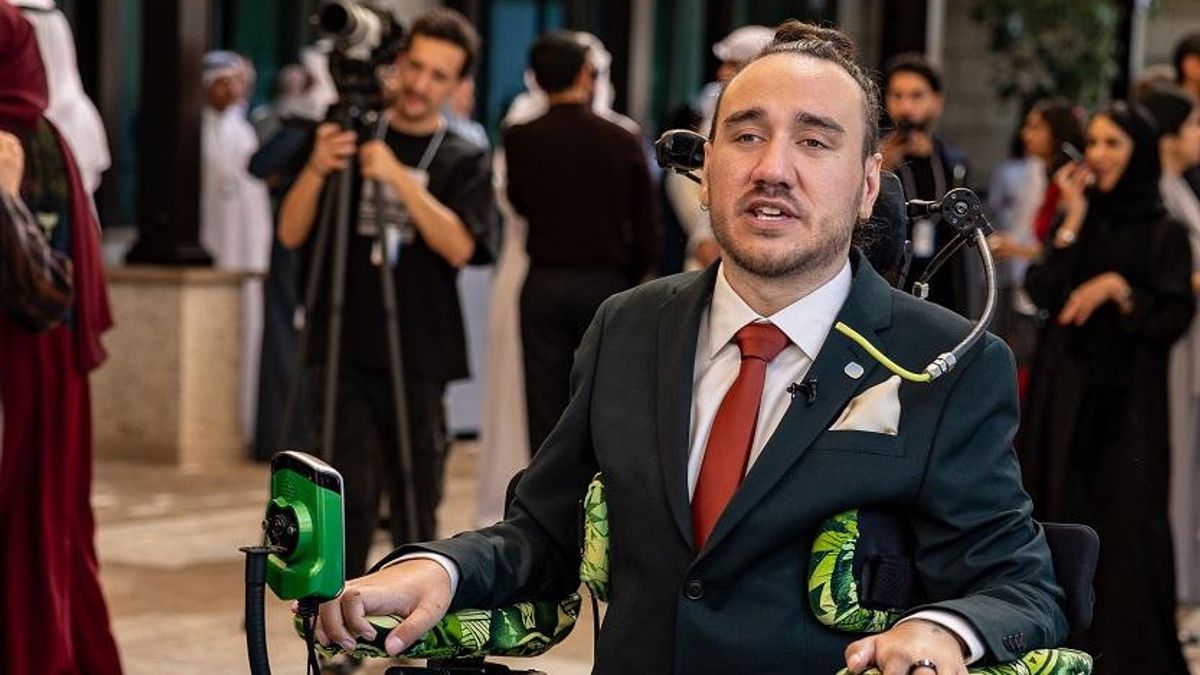


The Story of the First Human to Receive Neuralink Implants: "This Technology Has Brought My Life Back"
JAKARTA - Amid the excitement of the World Governments Summit (WGS) 2026 in Dubai, United Arab Emirates (UAE), a forum usually filled with majestic speeches, technological futurism and discussions of world leaders, there was a guest whose presence was the most silent, but his message was the most resounding.
His name is Nolan Aurbugh (29). He is not a minister, not a CEO, not an award-winning scientist.
Nolan is the first human to receive a Neuralink brain implant, a breakthrough that has only been present in science fiction books.
And in the forum held on February 3-5, Nolan brought a simple sentence: "This technology has brought my life back."
Nolan still remembers the day he was told he would be the first subject in human history to undergo a Neuralink implant. There were no tears, no long pauses like in a movie scene. There was urgency.
"Everything happened very quickly. All we think about is logistics: what to prepare, how to get there. But in my heart, I think about the possibilities. I think it will be fun, and I want to help people," he said on the sidelines of the WGS 2026 event, as quoted Friday (6/2).
The decision was not an easy one for someone living with quadriplegia, a condition that left him paralyzed from the neck down after an accident years ago. But for Nolan, the courage came from one thing: the belief that his life could still be of benefit.
Behind Nolan's smile and enthusiasm, there is a conversation that makes many adults may not be able to say it.
"I had to talk about the possibility of traumatic brain injury. I told the family, if something happens, if I lose cognitive function, I don't want them to take care of me anymore. It's too heavy," he said.
As someone who has depended on his family for years, the decision felt like the most painful form of affection, releasing the burden so that his loved ones would not suffer more.
"They are my rock. Without them, I would not have been able to get to this point," he recalled.
Back to Move, Back to LiveWhat happened after the surgery was not just a medical success story, it was the resurrection of a human who had lost most of his control over life.
From someone who used to take 15 minutes to type a message, Nolan can now do it in a matter of seconds with his mind.
"I never imagined I could fly again. But I just completed a 16-hour flight to Dubai," he said.
Nolan is now able to interact again, return to work, and even return to college, not just graduate, but complete 22 credits with a GPA of 4.0.
"I'm more independent. I have a goal again. It changes everything," he said.
One of the most touching changes came from her mother.
"Mom said I smile more now," Nolan said.
Smiling, something that seems simple, but it is a mirror of life that is back on.
For many people, brain implants sound like something complicated. But for Nolan, the technology feels like a natural extension of himself.
"There is no difficult learning process. Just calibration. After that, I can multitask while operating the device with my mind. It feels natural," explained Nolan.
There are challenges - such as the device automatically shutting down when it gets too hot, especially since Nolan lives in one of the hottest areas in the world. But for him, it's just the process of new technology.
"Overall, it is very reliable," he said.
One of Nolan's most honest admissions is how he feels like a burden on his family.
"I depend so much on other people. Everyone has to do everything for me," he said.
Neuralink's implants don't just let him speak faster or move a cursor.
The implant gave him what is probably the most coveted thing by anyone who loses mobility: independence.
"Every little bit of independence I get is a game-changer. I can take control of my life again," he said.
About the Worry of "Mind-Reading"In a world increasingly fearful of invasions of privacy, the question of "reading minds" is inescapable. Nolan confronts it calmly.
"This device reads neuron spikes, not thoughts. People often misunderstand. Maybe one day the technology is more advanced and that changes, but when that happens, protocols and ethical fences must be made," explained Nolan.
He did not deny the risk, on the contrary, he emphasized the importance of long-term research for the next six years.
Nolan has a message for anyone living with physical limitations, and for a world still groping for the future of technology.
"Don't give up. This technology gave me my life back. I want the world to know, because many don't even know about this technology. I want them to have hope," he concluded. (nfz)
The English, Chinese, Japanese, Arabic, and French versions are automatically generated by the AI. So there may still be inaccuracies in translating, please always see Indonesian as our main language. (system supported by DigitalSiber.id)
Popular


