



JAKARTA - President Prabowo Subianto's decision to join the Board of Peace (BoP) is considered in line with the principle of Indonesia's active foreign policy. This attitude is said to be related to efforts to stop violence in Gaza through the international system mechanism.
GREAT Institute Geopolitics Director Teguh Santosa said the BoP is an instrument born from the mandate of the UN Security Council through Resolution 2803/2025.
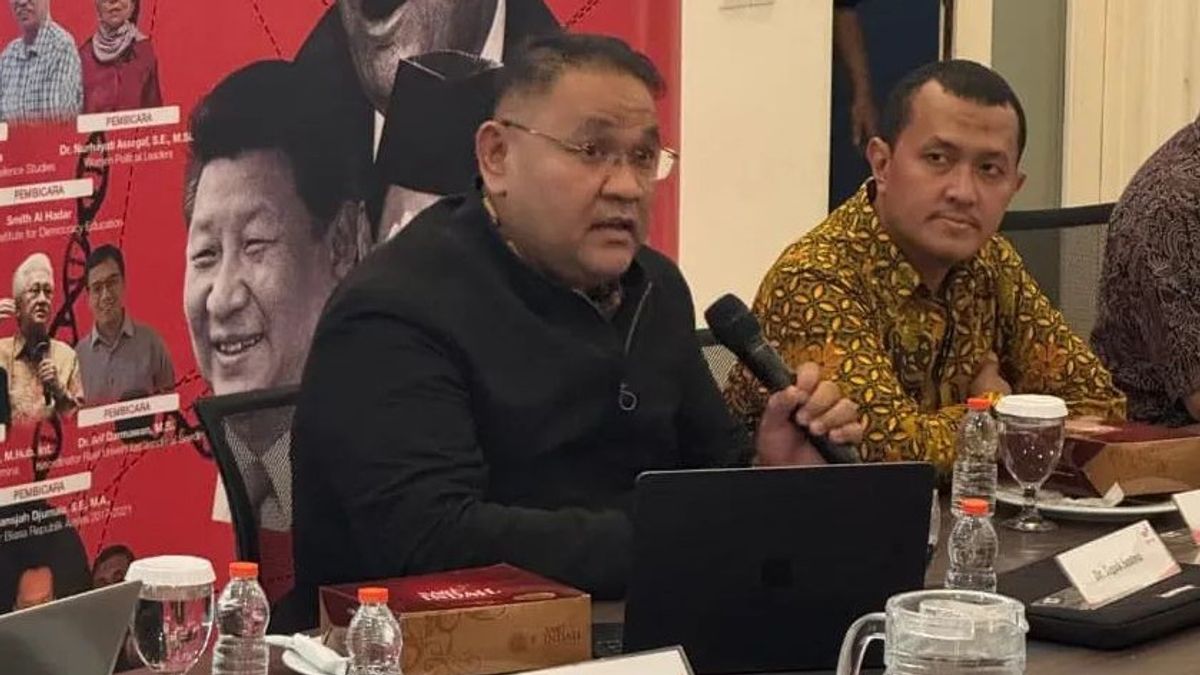
"BoP is expected to reach the first phase, namely negative peace or the absence of violence, where there is no more violence in Gaza," said Teguh in a webinar held by the Aqsa Working Group, Sunday (1/2/2026).
The resolution calls on Hamas to lay down its arms, the Israel Defense Forces to withdraw from Gaza, and to arrange for the exchange of hostages for life and bodies. The document also guarantees that no Gazan will be forced to leave his or her territory and that refugees can return.
The next stage is the "positive peace" phase. "In the language of the Bandung Charter, this phase of positive peace is called peaceful coexistence," said Teguh.
He assessed that Indonesia's decision to join the BoP was in line with the position of active free foreign policy. Teguh also alluded to President Prabowo's statement that he would evaluate membership if the BoP did not go as expected.
"That shows that Indonesia does not give a blank check for any country to use," he said.
In his presentation, Teguh quoted the story of the relationship between Indonesia and Palestine in 1992. At that time, the late Yasser Arafat planned to close the Palestinian Embassy due to a financial crisis. President Soeharto, through his son, Bambang Trihatmodjo, asked the embassy to remain open and Indonesia to help its operations.
"Palestinian independence has been in the minds of all of us for a long time," said Teguh.
The BoP was launched in Davos, Switzerland, with the participation of a number of countries. According to Teguh, Indonesia's presence provides an additional diplomatic dimension in maintaining the issue of Palestinian peace on the global agenda.
The English, Chinese, Japanese, Arabic, and French versions are automatically generated by the AI. So there may still be inaccuracies in translating, please always see Indonesian as our main language. (system supported by DigitalSiber.id)
Most Popular Tags
#Prabowo Subianto #donald trump #Febrie Adriansyah #8791 #giias 2026Popular


