


JAKARTA - The United Arab Emirates (UAE) on Monday said it would not allow its airspace, land and waters to be used in hostile military action against Iran, after a US aircraft carrier arrived in the Middle East.
The UAE Ministry of Foreign Affairs said dialogue and de-escalation are "the most effective foundation for addressing the current crisis, underlining the UAE's approach to resolving disputes through diplomatic means," Anadolu reported (27/1).
This statement follows increased tensions in the region, related to the United States' spotlight on the situation of demonstrations in Iran that killed thousands of people.
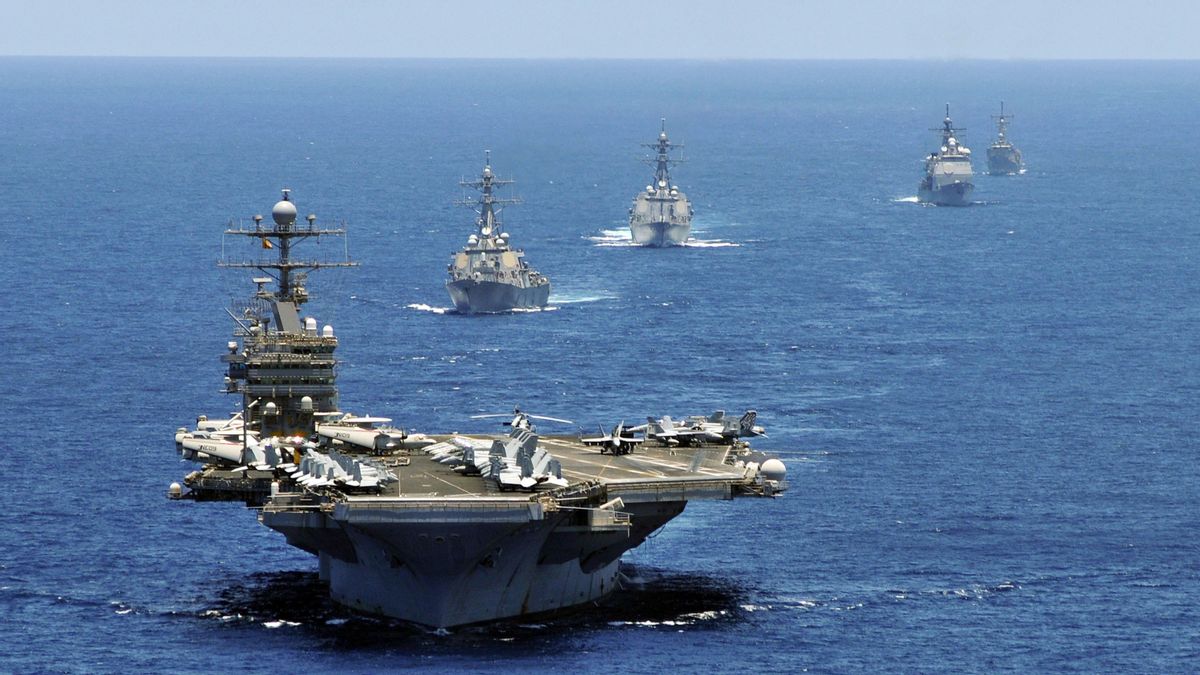
An American official told The National, the strike group of the USS Abraham Lincoln aircraft carrier, which consists of several warships and aircraft carriers, has arrived in the area of responsibility of the US Central Command (Middle East including Egypt, Central Asia and parts of South Asia)
That means the US now has a considerable firepower within striking range of Iran.
Separately, Israel's Channel 13 reported a ship carrying the missile defense system was heading to Israel, with the Thaad batteries expected to arrive in the coming days.
The arrival of the carrier strike group has sparked fears of a new military escalation between Washington and Tehran, with Iranian proxies threatening to intervene this time.
However, a US official said Washington was "open for business" and ready to hold talks.
Axios reported that US President Donald Trump said he thought Iran wanted to reach an agreement.
"They want to talk," President Trump said.
Last week, President Trump on Friday said a "fleet" of American warships was heading to the Middle East. He repeatedly threatened to intervene to support demonstrators in Iran after the crackdown on national demonstrations.
At least 5,800 people have died during the wave of protests in Iran, according to the US-based Human Rights Activists News Agency. About 17,000 other deaths are under investigation as the internet blackout continues, the agency added.
On the other hand, the Iranian authorities blamed the deaths on "foreign-backed" rioters, accusing the US and Israel of instigating violence in the country.
Trump reportedly considered military action against Tehran during the unrest, but refrained after being told the killing in the protests had abated and plans for a large-scale execution had been halted.
However, concerns about a military escalation remain as Iranian and US officials exchange threats.
"We have a big fleet headed in that direction and we'll see what happens," President Trump said upon his return to the US from the World Economic Forum in Davos, Switzerland, last week.
"I would rather not see anything happen, but we are watching them very closely," he added.
Meanwhile, Hezbollah leader Naim Qassem on Monday warned that any threat to Iran's supreme leader Ayatollah Ali Khamenei is considered a threat to the militant group.
"It is our duty to confront this threat with all measures and preparations," he said, warning that launching a war against Iran would burn the region.
Meanwhile, the Houthi group in Yemen, which is supported by Iran, also issued a threat to attack ships again.
The Iranian-backed Houthi rebels in Yemen also issued a warning, threatening to attack ships again.
It is known that the USS Abraham Lincoln aircraft carrier is accompanied by several guided missile destroyers. The carrier's air wing has F-35C fighter jets.
The assets are similar to military vessels sent by the US to the Caribbean Sea weeks before Trump launched a military operation to capture Venezuelan President Nicolas Maduro.
The English, Chinese, Japanese, Arabic, and French versions are automatically generated by the AI. So there may still be inaccuracies in translating, please always see Indonesian as our main language. (system supported by DigitalSiber.id)


