

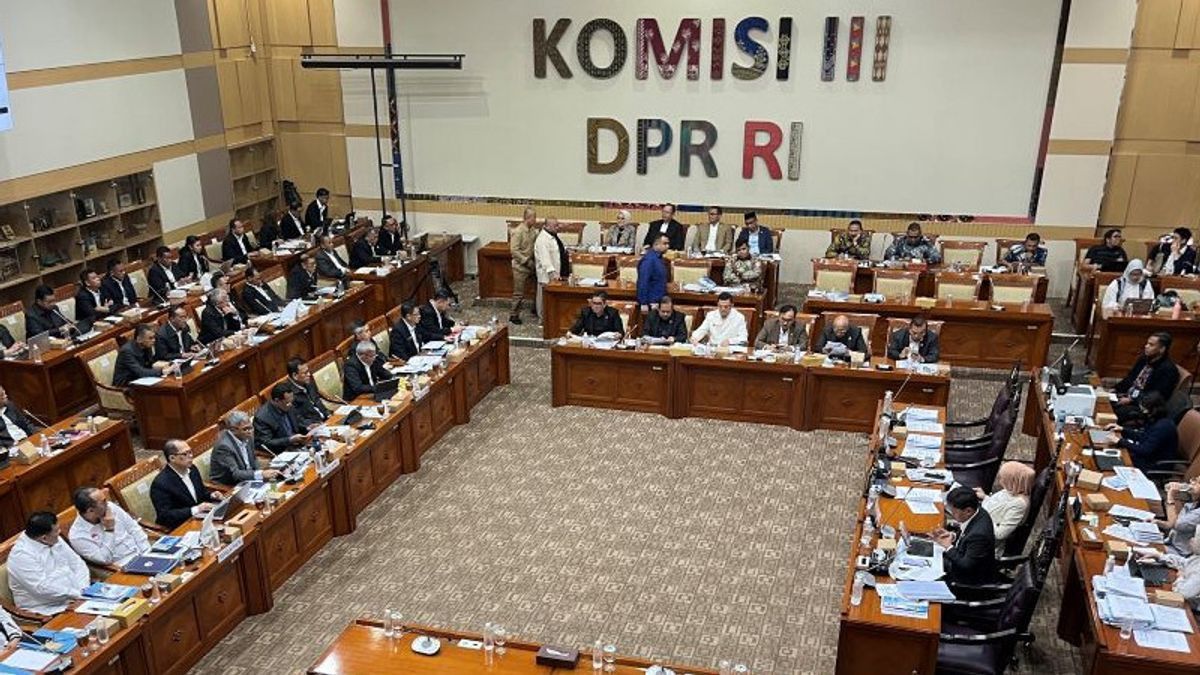


JAKARTA - Commission III of the Indonesian House of Representatives held a working meeting with the Chief of the Indonesian National Police (Kapolri) General Listyo Sigit Prabowo at the DPR building today. One of the things discussed in the meeting was the relationship between freedom of expression and the image of the National Police institution.
Chairman of Commission III of the DPR, Habiburokhman, emphasized that the values of Polri reform as stated in Article 30 paragraph 4 of the 1945 Constitution and TAP MPR Number 7 of 2000 must continue. Commission III of the DPR noted that during the reform era, the National Police had carried out a transformation that included at least seven lines.
"The seven lines, one, the position of the National Police and the state structure. Two, the performance of supervision over the National Police. Three, accountability for law enforcement. Four, the orientation of criminalization and the performance of protection of public welfare. Five, accountability for public service functions. Six, organizational governance and management. Seven, inter-agency relations," said Habiburokhman at the beginning of the DPR Commission III and the National Police Chief at the Parliament Complex, Senayan, Jakarta, Monday, January 26.
Habiburokhman said there were five important things that affected the image of the police in the public eye. First, how the National Police responded to freedom of expression and opinion.
Second, traffic law enforcement. Third, professionalism in handling criminal acts. Fourth, public service. Fifth, special duties such as disaster management.
"At the beginning of this working meeting, we specifically want to review the response of the National Police to freedom of expression and express opinions in quantity. This is only a small part of the implementation of the National Police's duties, but its influence on the National Police's image in the public eye is very large," he said.
"We assess that there is a relationship between the image of the National Police in the public eye and the response to freedom of expression and expressing opinions. The more persuasive the response of the National Police regarding this matter, the better the image of the National Police in the public eye. Likewise, the more repressive it will be, the more negative the image of the National Police in the public eye," continued the Gerindra legislator.
According to Habiburokhman, there are ups and downs in the response of the National Police to freedom of expression in expressing opinions. Referring to the records of Commission III of the DPR for the period 2009-2014, there were 47 cases of arrest and detention until trial related to the delivery of expression or opinion. The period 2014-2019 there were 240 cases and 2019-2024 there were 29 cases.
"Repression has started to decline since 2019 and has declined sharply since 2021 with the issuance of the circular of the National Police Chief Number SE/2/II/2021 and Perkap Number 8 of 2021 regarding the handling of criminal offenses based on restorative justice by the National Police Chief General Listyo Sigit Prabowo," he said.
Habiburokhman explained that the circular of the National Police Chief focuses on the imposition of criminal sentences as a last resort or ultimum remidium, especially for handling cases involving ITE.
"The circular emphasizes preventive and preventive efforts through virtual police which aims to monitor and educate and prevent the public from cyber crimes. Meanwhile, number 8 of 2021 encourages the resolution of problems of differences of opinion with a consensus-based approach," he explained.
"The two products of the rules are the starting point for the cultural reform of the National Police in responding to the delivery of differing opinions for now and in the future we already know that we already have a new Criminal Code and a new Criminal Code that maximally regulates the mechanism of restorative justice which can be ensured to make it even more with the repressive tool in responding to freedom of expression and expressing opinions. decreasing," he concluded.
The English, Chinese, Japanese, Arabic, and French versions are automatically generated by the AI. So there may still be inaccuracies in translating, please always see Indonesian as our main language. (system supported by DigitalSiber.id)
Most Popular Tags
#Prabowo Subianto #donald trump #2026 World Cup #Febrie Adriansyah #8791Popular


