
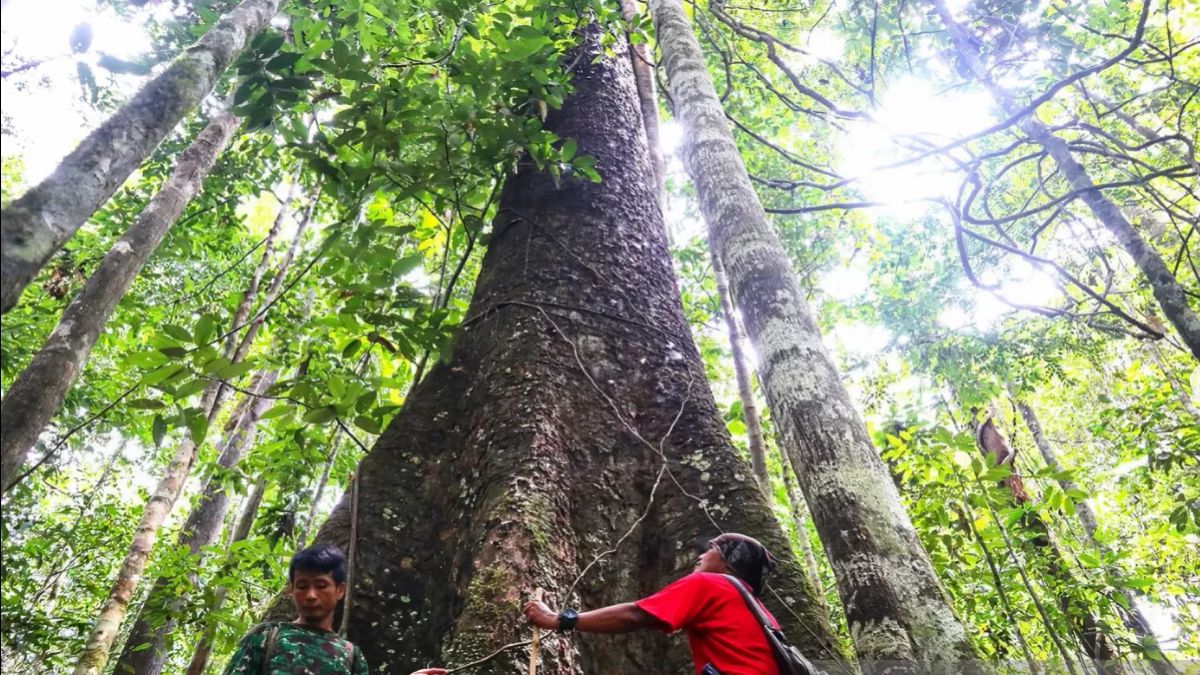


JAKARTA - Member of Commission II of the Gerindra Faction, Azis Subekti, emphasized that the report on the results of the Forest Area Regulation Task Force (Satgas PKH) presented by the Minister of State Secretary Prasetyo Hadi deserved wide attention.
In the midst of the rapid flow of information, this report marks an important step, the country is beginning to reorganize forest areas that have been eroded for years by economic practices that violate governance.
"Under the direction of President Prabowo Subianto, the PKH Task Force has managed to regain millions of hectares of forest areas from illegal possession and violations of permits," said Azis, Sunday, January 25.
This achievement is not a simple job. It takes political courage, consistency in law enforcement, and cross-agency work that has often been stalled.
Therefore, appreciation should be given, the country shows a willingness to correct old mistakes.
This step of discipline becomes increasingly relevant if it is placed in the context of repeated disasters in various regions.
Aceh, North Sumatra, West Sumatra, and a number of other regions show the same pattern: upstream forests are damaged, mining and plantation activities develop without control, then floods and landslides hit downstream residents.
In this context, forest area control is not merely an administrative matter, but a real effort to protect public safety.
"Appreciation is also deserved because the order touches crucial areas that have long been in the spotlight, including Tesso Nilo National Park. The presence of the state in areas like this sends an important message: the law and environmental interests should not always lose out to short-term economic interests," Azis continued.
According to him, the data presented by the government shows the magnitude of the problems faced. Millions of hectares of oil palm are built in forest areas, including in protected and conservation areas.
In many mining areas, former mines are left without adequate reclamation, even in disaster-prone areas.
Azis emphasized the facts, stressing that environmental damage was not an incidental event, but the result of governance that was too long loose and permissive.
"Therefore, the next challenge is much more important: ensuring that this order really has an impact on the ground. Data, maps, and statistical achievements must be translated into real recovery. Areas that have been recaptured need to be greened, water catchments restored, and former mine land seriously rehabilitated - not just fulfilling obligations on paper," he said.
This is where the collective movement according to Azis is the key. The state can prepare policies, budgets, and seeds for plants, but the future of forests will not recover without the involvement of citizens.
The government prepares seeds, the community plants and takes care of it - in critical land, in buffer areas, around settlements, even in the remaining small spaces. Planting trees is not just a symbol of concern, but a long-term investment for ecological and social safety.
"Government work will also not be enough without wider public support. The public needs to actively provide input, convey field data, and report any use of forest resources that is not in accordance with provisions. This participation is important so that forest area enforcement does not stop as a momentary project, but becomes a sustainable policy that is jointly supervised," said da.
According to Azis, if the PKH Task Force works diligently and consistently - touching forest areas, mining areas, and disaster-prone areas - Indonesia will not only become a safer and more comfortable place to live.
More than that, Indonesia can be a valuable example of how a nation learns from damage, then rises by rearranging its relationship with nature.
"In the end, forests and agrarian resources are not just economic assets. It is a shared living space and a legacy for future generations. Protecting it is a collective responsibility. When the state arranges and the community participates in planting, the hope is no longer abstract - it grows slowly, as high as the tree that will shade the future," said Azis Subekti.
The English, Chinese, Japanese, Arabic, and French versions are automatically generated by the AI. So there may still be inaccuracies in translating, please always see Indonesian as our main language. (system supported by DigitalSiber.id)


