
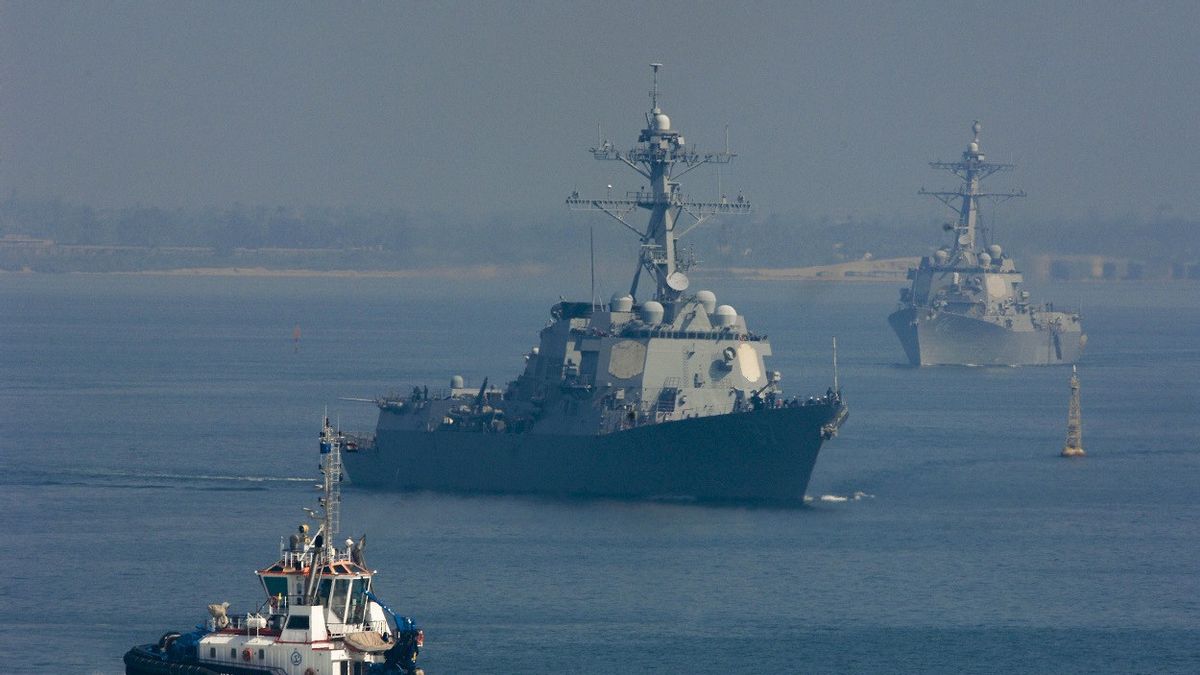


JAKARTA - President Donald Trump said a "fleet" of the United States was heading to the Gulf, after US officials had also said about plans to bring aircraft carriers and other military assets to the region, with Washington closely monitoring Iran.
President Trump has repeatedly opened up new military action options against Iran, after Washington supported and joined Israel in a 12-day war in June targeting Tehran's nuclear and ballistic missile programs.
On his way home from the World Economic Forum (WEF) in Davos, Switzerland, President Trump told reporters on Air Force One that the United States was sending a "large armada" to Iran "just in case," as reported by Al Arabiya from AFP (23/1).
"We are watching Iran," President Trump emphasized.
"I would rather not see anything happen but we are watching them very closely," he said.
Last week, President Trump backed down from threats to attack Iran over a deadly crackdown on protests that have convulsed the country since December 28, 2025, after the White House said Tehran had halted a planned execution of the demonstrators.
The two-week protests shook Iran's leadership under Supreme Leader Ayatollah Ali Khamenei, but the movement has subsided amid a crackdown that activists say has killed thousands of people, accompanied by an unprecedented internet blackout.
Prospects for immediate U.S. action against Iran appear to have receded in recent days, with both sides insisting on giving diplomacy a chance.
Yesterday, two US officials said an aircraft carrier and Washington military assets would arrive in the Middle East in the coming days, Al Arabiya reported from Reuters.
US warships, including the USS Abraham Lincoln (CVN-72) aircraft carrier, several destroyers and fighter planes began moving from the Asia-Pacific last week, as tensions between Iran and the United States escalated after a crackdown on protests across Iran in recent months.
One of the officials said additional air defense systems were also being considered for the Middle East.
The United States often increases the number of US troops in the Middle East at times of heightened regional tensions, something experts say can be entirely defensive in nature.
Earlier, speaking at the WEF on Thursday, President Trump said the United States attacked Iran's uranium enrichment site last year to prevent Tehran from making nuclear weapons. Iran denies its nuclear program is aimed at making a nuclear bomb.
"We can't let that happen," President Trump said, adding: "And Iran does want to talk, and we will talk."
Separately, the commander of the Iranian Revolutionary Guard Corps (IRGC) also warned Washington on Thursday that the Iranian elite forces were "ready to press the trigger."
IRGC commander General Mohammad Pakpour warned Israel and the United States "to avoid miscalculations" and learn from "what they learned in the imposed 12-day war, so that they do not face a more painful and regrettable fate."
"The beloved Iranian Revolutionary Guard Corps is ready, more ready than ever, ready to carry out the orders and actions of the supreme commander," he quoted as saying on state television on the IRGC's national day.
Meanwhile, the head of the Iranian Joint Command Headquarters, General Ali Abdollahi Aliabadi, warned that if the United States attacked, "all US interests, bases, and centers of influence" would be "legitimate targets" for Iranian forces.
The English, Chinese, Japanese, Arabic, and French versions are automatically generated by the AI. So there may still be inaccuracies in translating, please always see Indonesian as our main language. (system supported by DigitalSiber.id)


