

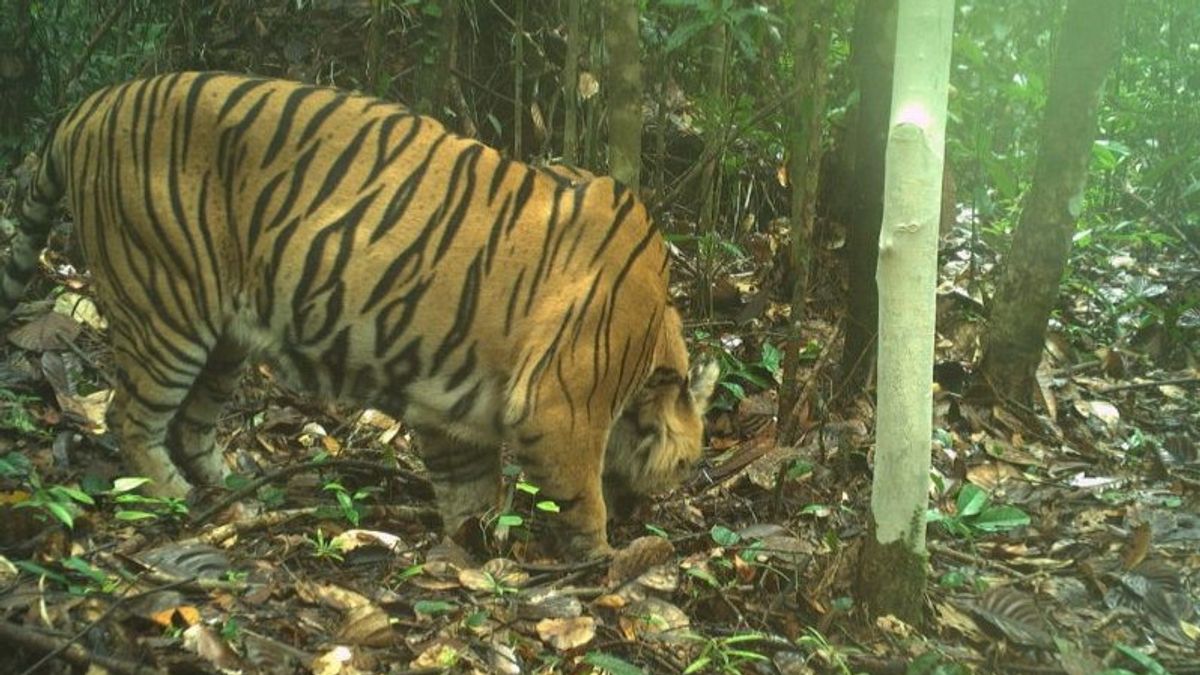


JAMBI - Camera traps (camera traps) managed to record two Sumatran tigers (Panthera tigris sumatrae) in the Berbak National Park (TN) through monitoring activities carried out by the Berbak and Sembilang National Park Office (BTNBS) in 2025 in a small part of the tiger habitat (site) monitoring Berbak.
Head of the TNBSYunaidi Center said his party could not conclude an estimate (estimate) of the density of one of the top predators, given the lack of data on encounters with Sumatran tigers.
This year, his party has set up 15 plots (grids) measuring 3x3 square kilometers (km2) in the tiger habitat (site).
In total, there are three monitoring locations, with details of one site in the Berbak National Park (TN) and two sites in the Sembilang TN spread across the Ngirawan Benu site and the Bungin Sembilang site.
Yunaidi explained that monitoring efforts in the Berbak TN area have been carried out since 2007.
For almost the last 18 years, the tiger population in Berbak National Park has tended to be stable in the first ten years (decade) and decreased at the end of the second decade.
Based on population monitoring in the 2010 period, 1.02 individuals were found per 100 square kilometers (km2). Then the 2015 period increased to 1.2 individuals/100 km2.
Meanwhile, in the 2018 period, it increased again to 1.46 individuals/100 km2, in the 2020 period it decreased to 0.53 individuals/100 km2, and in the 2021 period it increased to 1.69 individuals/100 km2.
The increase in density from 2010 to 2018 is an indication of an increase in the population and population growth of tigers in Berbak in that period.
Indications of the occurrence of population growth were also obtained from photos of pregnant tigers and photos of tiger cubs.
Meanwhile, the decrease in density values in the 2020 period does not necessarily indicate a decrease in tiger populations in the wild.
However, after monitoring, the period of 2021 experienced a significant increase, he said, this was marked by the encounter of 18 individuals in 23 forest area divisions (grids) from a total of 51 grids in the core block of tiger monitoring.
Several other individuals are new tigers that were newly detected in the 2021 monitoring activities. Then in 2022 BTNBS again carried out the monitoring activities of the Sumatran Tiger population in Berbak TN and managed to increase the density of Sumatran Tigers to 0.66 Individuals/100 km2.
According to him, this population decline is strongly suspected due to the scarcity of wild boar prey animals, so that the temporary hypothesis is that the Sumatran tiger migrates to other locations to find the main prey animals.
"The implementation of tiger monitoring in this 2020 period was only three months after the forest fire at the Berbak monitoring site, so it is possible that some of the tiger individuals living in this site have temporarily shifted to more conducive locations," said Yunaidi.
The English, Chinese, Japanese, Arabic, and French versions are automatically generated by the AI. So there may still be inaccuracies in translating, please always see Indonesian as our main language. (system supported by DigitalSiber.id)
Most Popular Tags
#Prabowo Subianto #donald trump #2026 World Cup #Febrie Adriansyah #8791Popular


