

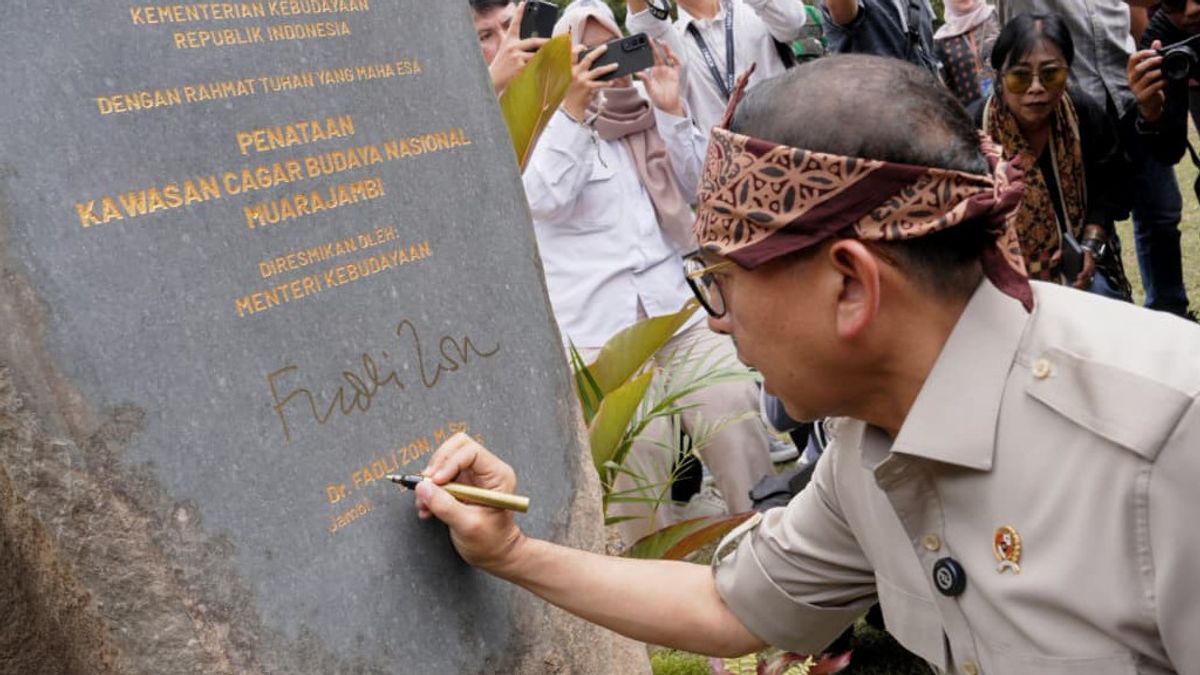


JAMBI - The government is speeding up the arrangement and restoration of the Muarajambi National Cultural Heritage Area (KCBN) to strengthen its position as one of the largest ancient civilization centers in Southeast Asia. Minister of Culture Fadli Zon inaugurated the arrangement of the area as well as the completion of the restoration of a number of main temples in Muarajambi, Jambi Province, Thursday, December 18.
The inauguration includes the full restoration of the Candi Parit Duku, Candi Gedong I, Mandapa and Gapura Candi Tinggi, Candi Alun-Alun, and Candi Teluk 1. This step is a signal for accelerating the preservation of sites believed to have developed from the 6th to the 13th century and are closely related to the intellectual network of the Buddhist world.
"Muarajambi stretches around 3,950 hectares with approximately 115 temple structures. This is one of the largest temple complexes in the world," said Fadli Zon. Until now, only 12 structures have been restored. The government targets the acceleration of restoration of major sites with the principles of authenticity, scientific studies, and strict supervision by experts.
Fadli opened the opportunity for a public-private partnership scheme, but emphasized that the entire process was under the control of archaeologists, historians, cultural heritage experts, and Buddhist figures. "The spiritual and scientific value must not shift," he said.
The arrangement of the area is carried out in an area of about 150 hectares. The focus is on connecting roads, canal normalization, basic facilities, and cultural activity spaces involving residents. The government is also preparing to strengthen the local economy through MSMEs, creative economy, canal boat management, village markets, and the initiation of the living museum concept starting next year.
In addition, the construction of a large-scale museum on land of around 30 hectares is being completed. Facilities include collection rooms, immersive areas, theaters, amphitheaters, to gastronomic and souvenir UMKM zones.
"Muarajambi is not just a site, but a living space for culture that must provide real economic benefits," said Fadli. The government targets this area to grow as a global competitive destination for religious, cultural, historical, natural, and culinary tourism.
The English, Chinese, Japanese, Arabic, and French versions are automatically generated by the AI. So there may still be inaccuracies in translating, please always see Indonesian as our main language. (system supported by DigitalSiber.id)


