

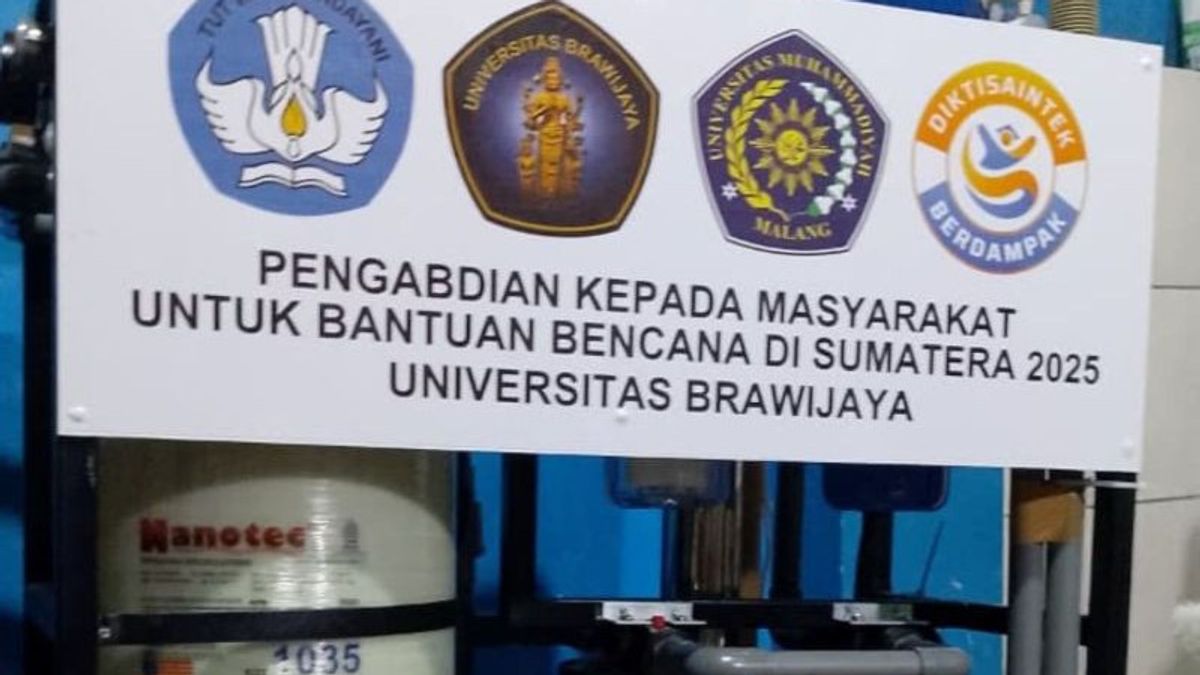


MALANG - Universitas Brawijaya (UB) sent assistance for cleaning up portable water to disaster-affected areas in West Sumatra (West Sumatra) as a form of institutional contribution to recovery after the disaster.
UB Faculty of Engineering (FT) lecturer who is also a technical developer of a portable clarity tool sent to a natural disaster site in West Sumatra, Dr. Riyanto Haribowo, said aid shipments were made on Sunday (7/12), coinciding with the series of Dies Natalis UB, as a symbol of campus active involvement in humanitarian efforts.
A total of 10 units of water clarity equipment and 10 units of generators were dispatched to Palembayan, Agam Regency, one of the areas that needed clean water access support.
This program is a cross-cultural collaboration, initiated by lecturer at the Faculty of Fisheries and Marine Sciences (FPIK) Muhammad Fakhri and technically developed by FT UBDr lecturer Riyanto Haribowo.
Furthermore, UB plans distribution to various other locations based on the results of mapping needs in the field.
The innovation of water clarity tools departs from real needs when a disaster occurs, when access to clean water is often cut off.
Riyanto Hariwibowo said the idea of making the tool emerged from UB service activities that focused on helping disaster victims in West Sumatra.
The idea of making this tool departs from service activities to the people of Universitas Brawijaya, to help people affected by disasters in West Sumatra. In disaster situations, access to clean water is often cut off, so practical equipment is needed, easy to move, and is able to produce water that is suitable for use quickly," he said as quoted by ANTARA, Thursday, December 11.
The water purification tool developed by the FT team uses a multilevel filtration and sterilization system.
The unit is equipped with a Multi Sand Filter FRP 1035, four 10-inch housing filters containing active sediment and carbon, as well as a 12 GPM UV sterilizer. This system is also supported by water pumps, electrical panels, pressure gauge, and a galvanical framework with PVC pipes.
We complete this tool with a multi-grade filtration and sterilization unit, starting from the Multi Sand Filter to filter the riots, housing filters containing the sediment and activated carbon, to UV sterilizers to ensure bacterial free water. We designed all the components to be easy to move and use directly in the field," he said.
The tool design process is carried out by focusing on emergency needs at the disaster site, starting from the initial design, component selection, fabrication process, to functional testing, all stages are prepared so that the equipment is ready for use as soon as it arrives at the affected location.
"In the process of developing it, we start from the needs of the field, which is to provide a tool that can produce water that is close to the quality of drinking water, but still compact. After the design, we selected components, fabrication, pipeline installations and cables, as well as testing the function so that the equipment is really ready for use in emergency conditions," he said.
Apart from being sent to the affected location, the tool was also officially introduced in the momentum of Dies Natalis UB.
"We have officially launched this tool at the Dies Natalis Universitas Brawijaya. At that momentum, we will introduce this tool as one of UB's contributions in supporting disaster management and clean water services in affected areas," he said.
As part of the follow-up, the research team led by Dr. Riyanto and Dr. Fakhri left for West Sumatra on Tuesday (9/12) to conduct a direct survey to the field.
SEE ALSO:
-
 | BERITA
Malaysia Gerak Cepat Beri Bantuan Rp2 Juta untuk Pelajar RI Terdampak Bencana
11 Desember 2025, 15:35 -
 | BERITA
3 Anggota Garda Revolusi Iran Tewas Diserang Saat Patroli Dekat Perbatasan Pakistan
11 Desember 2025, 15:16 -
 | BERITA
Demo Antipemerintah Bulgaria Meluas, Puluhan Ribu Orang Turun ke Jalan
11 Desember 2025, 14:49
This survey includes mapping the condition of water sources, determining the point of placement of equipment, and evaluating additional needs in other regions. The survey results will form the basis for UB's planned advanced distribution in the following weeks.
With the departure of water clarity tools and technical support, UB emphasized its commitment to optimizing the role of universities for humanity.
This cross-cultural collaboration shows that campus research and innovation can be implemented directly to help the community, especially in meeting basic needs during the emergency response and recovery period.
The English, Chinese, Japanese, Arabic, and French versions are automatically generated by the AI. So there may still be inaccuracies in translating, please always see Indonesian as our main language. (system supported by DigitalSiber.id)


