
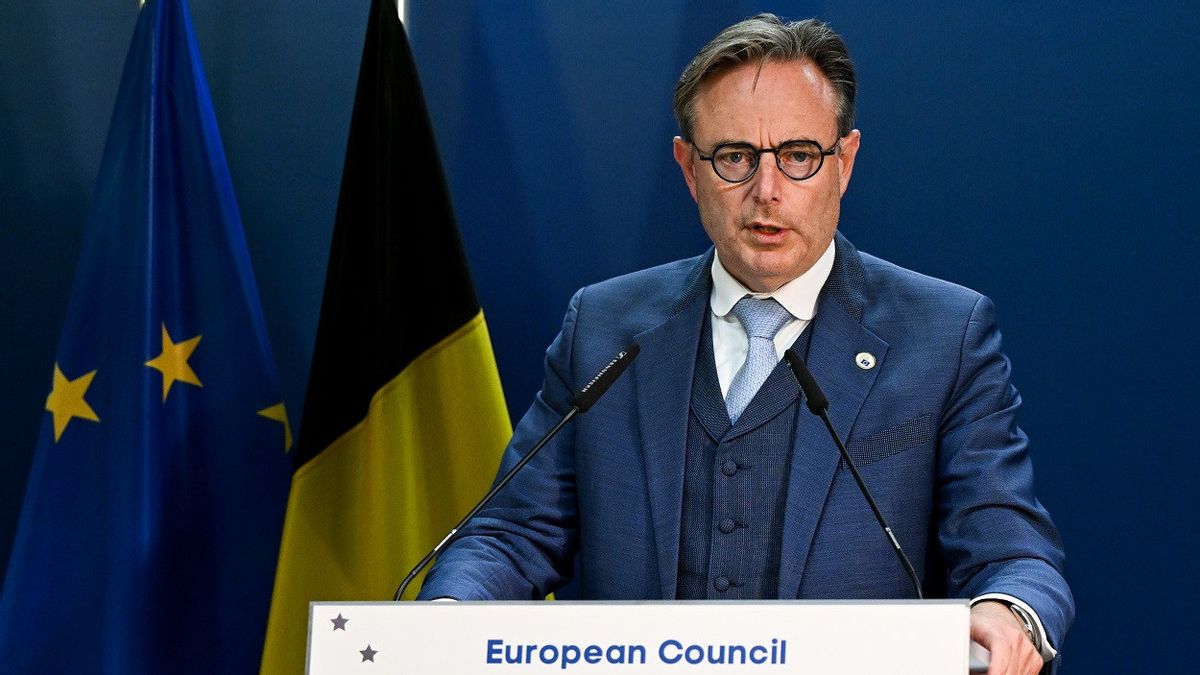


JAKARTA - Belgian Prime Minister Bart De Wever warned that the EU's plan to use frozen Russian state assets to fund Ukraine could jeopardize the chances of a potential peace deal reaching a war that has lasted nearly four years.
"Continuing a hasty proposed reparasion loan scheme will have a negative impact, namely that we as the European Union effectively prevent a peace agreement from reaching," PM De Wever said in a letter to European Commission President Ursula von der Leyen, seen by Reuters. November 28.
Previously, the Financial Times first reported on the letter on Thursday night.
Based on a plan put forward by von der Leyen, Russia's frozen central bank assets in Europe will be loaned out to Ukraine so Kyiv can use them for defense and routine budget needs.
Belgium's support for this plan is critical, as assets expected to be used by the European Union are held by Belgium's financial institution, Euroclear.
"I think the proposed reparasion loan scheme is fundamentally wrong," De Wever said, adding historically, during the war, immobileized assets were never used.
"These assets have become the object of decision in the postwar settlement, usually in the context of war repatriation by the losers," he said.
It is known that EU leaders at a summit last month tried to agree on a plan to use 140 billion euros in Russian state assets frozen in Europe as a loan to Kyiv, but failed to get Belgian support.
The European Commission did not respond to requests for comment outside of regular working hours.
The European Commission, the executive body of the European Union, hopes to address Belgium's concerns in a draft legal proposal to be submitted this week on the use of frozen state assets to support Kyiv by 2026 and 2027, EU officials said.
In the letter, De Wever said Belgium had not seen "any legal language proposed by the commission."
In addition to the 185 billion euros frozen in Belgium, an estimated 25 billion euros of Russian assets are frozen in EU banks elsewhere, mainly in France and Luxembourg.
Belgium previously stated that other countries that have Russian assets, including Canada, Japan, the UK, and the US which are all members of the Group of Seven rich countries must also be included in the scheme.
Euroclear has previously warned that the use of frozen Russian assets for reparations loans to Ukraine risks increasing the cost of Europe's debt, in a letter to European Commission President Ursula von der Leyen and EU Council President Antonio Costa.
According to the Brussels-based central securities storage agency, such a mechanism will be considered a "confiscation" outside the European Union and scare investors, the newspaper reads, as quoted by TASS.
It said the loan plan would undermine the investment climate in Europe "because investors, particularly state and central bank wealth funds, would consider this initiative to be equivalent to the confiscation of central bank reserves, which undermine the rule of law," said Euroclear CEO Valerie Urbain, in the letter.
In addition, such action would lead to "compensation payments by member states (EU) to Euroclear," the British newspaper quoted him as saying.
SEE ALSO:
-
 | BERITA
Negara Uni Eropa Tegaskan Israel Harus Menghormati Hukum Internasional di Tepi Barat
28 November 2025, 16:00 -
 | BERITA
Badan Antikorupsi Ukraina Geledah Kantor Kepala Staf Kepresidenan Andriy Yermak
28 November 2025, 15:05 -
 | BERITA
Mediator Gelar Perundingan Mengenai Anggota Hamas di Wilayah Gaza yang Dikendalikan Israel
28 November 2025, 15:00 -
 | BERITA
Rusia akan Mengangkat Isu Persiapan Uji Coba Nuklir dalam Perundingan dengan Amerika Serikat
28 November 2025, 14:00

Separately, Russian Foreign Ministry spokesman Maria Zakharova this week warned European countries should return blocked Russian assets if they do not want to be "known as European thieves" and receive the harshest punishment for their crimes.
"Only Russia has the right to decide what will happen to the assets of the Russian Federation," said Zakharova.
"And those holding the Russian Federation's money illegally should return it if they don't want to be known as European thieves and receive the harshest punishment for their crimes," Zakharova stressed.
The English, Chinese, Japanese, Arabic, and French versions are automatically generated by the AI. So there may still be inaccuracies in translating, please always see Indonesian as our main language. (system supported by DigitalSiber.id)
Most Popular Tags
#Prabowo Subianto #donald trump #2026 World Cup #Febrie Adriansyah #8791Popular


