

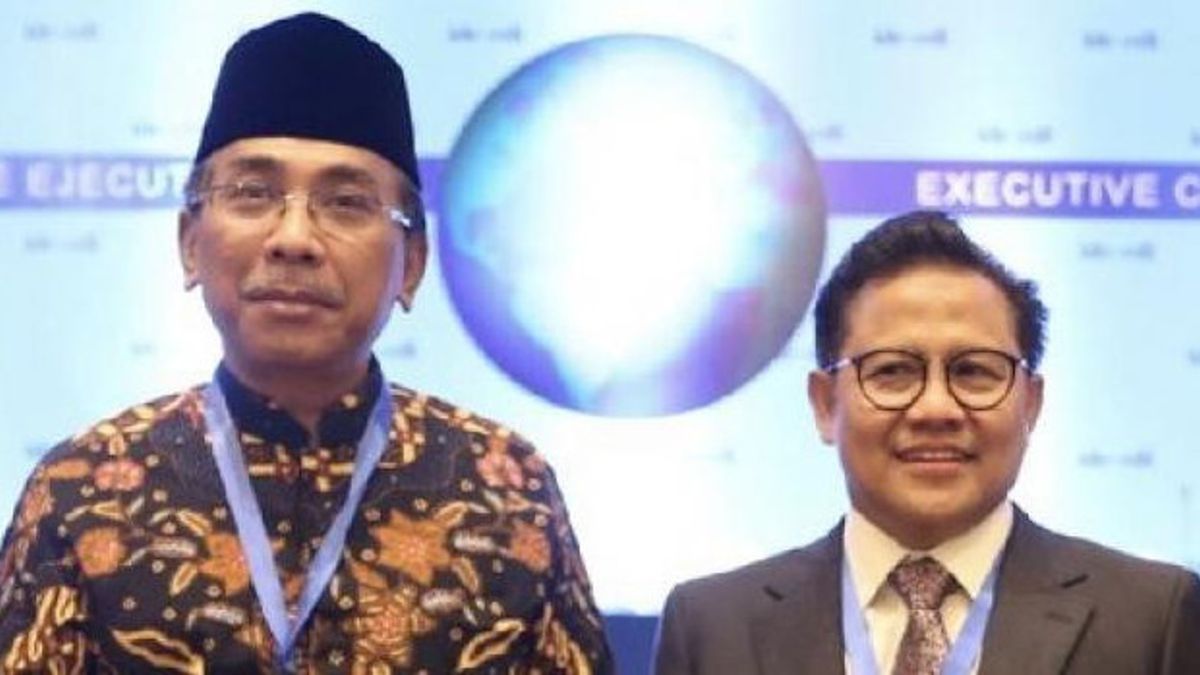


Political observer Muhammad Huda assessed that Rais Aam Syuriah PBNU Kiai Miftachul Akhaiyar's demands for PBNU General Chair Kiai Yahya Cholil Staquf (Gus Yahya) to resign from his position became a political victory for PKB Chairman Muhaimin Iskandar (Cak Imin).
According to him, although Cak Imin openly did not interfere with PBNU's internal affairs, Kiai Miftachul AKiaiyar's decision to ask Gus Yahya to resign was not just an issue of organizational ethics, but rather a strong signal to the public the tension of conflict between Gus Yahya's camp and Cak Imin's camp to reach its peak.
"Cak Imin does not need to intervene. When Rais Aam asked Gus Yahya to resign, the public automatically read that there was a conflict that could not be covered up between Gus Yahya and the NU network which was close to Cak Imin. Politically, this is a winning point for Cak Imin," explained Huda, Sunday, November 23.
He said this tension did not appear suddenly. Since the first year of Kiair, a number of PWNUs have reportedly undergone a change of leadership which is strongly suspected to be related to their affiliation with Cak Imin.
Gus Yahya is said to have taken steps to consolidate to strengthen PBNU's control of external political dynamics, especially from the influence of PKB which has long had strong roots on the nahdliyin base.
"When several PWNU heads who are considered close to Cak Imin are removed or shifted, it is considered a form of resistance to the expansion of the PKB network. This step increases tension," he said.
This situation, continued Huda, raises the perception that there is a control fight over the NU mass base ahead of the general election and the dynamics of national politics.
Although PBNU has always emphasized that its position is outside of practical politics, friction between elites who are close to party figures cannot be avoided.
Furthermore, he revealed that there are three reasons why this dynamic benefits Cak Imin. First, strengthening Gus Yahya's narrative, he lost the support of the elderly cleric.
Because, if Rais Aam is the highest position in the sharia structure, he intervenes to ask for a step back, meaning that Gus Yahya's moral legitimacy is considered shaky considering that in Nahdliyin's culture, the support of the elderly kiai is very decisive.
Second, open a new space for the PKB network. Huda stated, if Gus Yahya resigns or weakens, then the movement space for kiai and administrators close to PKB has the potential to reopen, especially in PWNU.
SEE ALSO:
-
 | BERITA
Sekjen PBNU Meminta Seluruh Warga NU untuk Tetap Tenang dan Tidak Terprovokasi
22 November 2025, 18:05
Third, strengthen public perceptions of rivalry won by PKB.
"Persepsi adalah segalanya dalam politik. Dan saat ini, persepsi kemenangan itu jatuh kepada Cak Imin," sambungnya.
He emphasized that this elite conflict has the potential to bring PBNU to a critical point, especially in maintaining distance from practical politics.
The regional kiaidi are said to be starting to get restless because the internal polemic has an impact on structural activities and community activities in their respective areas.
In addition, the future of PBNU's leadership after the polemic will determine the direction of organizational relations with political parties and NU's own internal stability.
"If PBNU does not immediately find a balance point, polarization can widen. Moreover, NU has a strategic role in maintaining social moderation and national stability," concluded Huda.
The English, Chinese, Japanese, Arabic, and French versions are automatically generated by the AI. So there may still be inaccuracies in translating, please always see Indonesian as our main language. (system supported by DigitalSiber.id)
Most Popular Tags
#Prabowo Subianto #donald trump #earthquake #independence day #8791 #hut riPopular


