

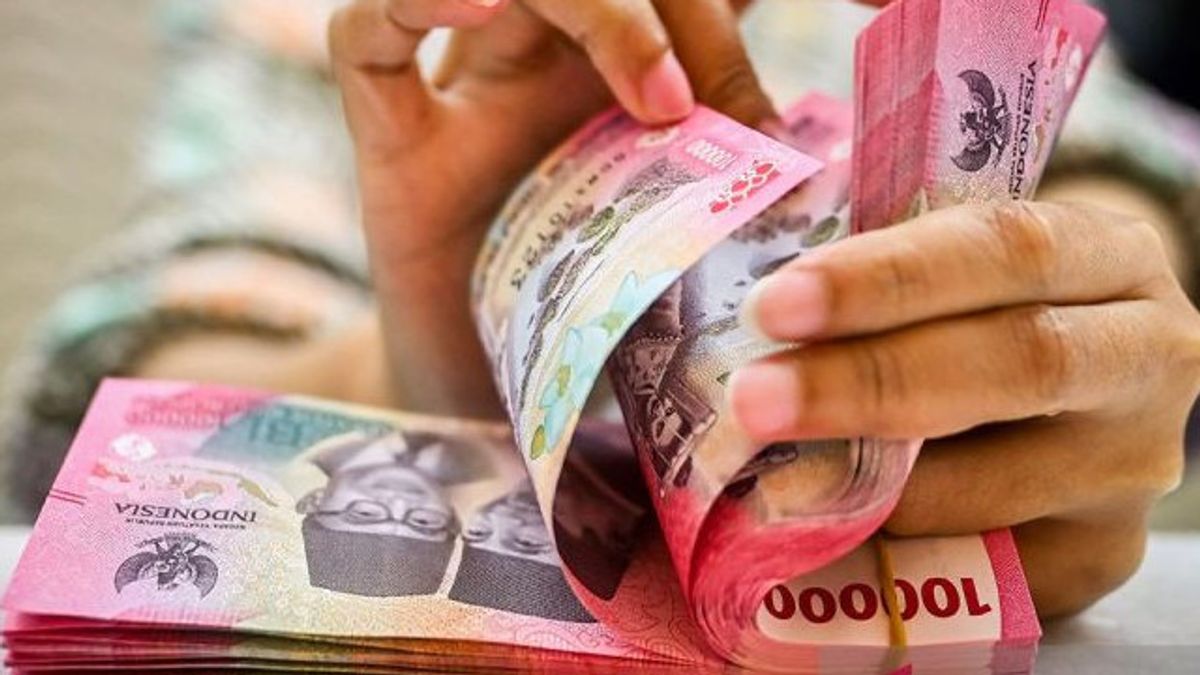


JAKARTA Indonesian Audit Watch (IAW) highlighted the weak transparency and supervision of the process of printing rupiah managed by Peruri for the last two decades. For 20 years, according to IAW, the heart of the rupiah printing has never been touched by an adequate thematic audit and has become an unsupervised dark space.
"Why is it silent? Because the state does not have data, does not have a baseline, and does not have any audit reports to answer public questions," said IAW's Founder Secretary, Iskandar Sitorus, Friday, November 21.
Iskandar said the issue of the money series number that emerged and contained a political aroma actually showed the country's stuttering in explaining it to the public due to the weakness of the data foundation.
IAW noted that in 2004 '2005', Peruri formed a joint venture with Swiss security ink company SICPA SA, named PT Sicpa Peruri Securink (PT SPS). The company is the main supplier of security ink for rupiah, including OVI ink, magnetic, and optical variables that determine the authenticity of the money.
"Why doesn't the BPK audit touch PT SPS as the core supplier? Money won't be printed without them. Two decades since 2005 '2025, BPK has surrounded the core, but has never entered the ceiling," said Iskandar.
According to IAW, BPK has routinely audited Peruri, but only related to financial reports, service income and capital expenditures, fixed assets, passport and stampage projects, to digital transformation. Meanwhile, audits of the upstream process of printing money are always considered as a state secret.
"The reasons used every time the upstream process audit is asked to always be the same: this is the secret of the money security system. Even though what is hidden is not state security, it is the potential for waste and inefficiency," he said.
IAW calls this situation a systemic failure of state governance because all parties think the supervision is already running. As a result, the core printing of the rupiah has become a black box that has never been opened.
The inaccuracy of the money supply data (M0), according to IAW, could have a serious impact if series numbers, waste, reprint, and the use of ink were not audited. This condition has the potential to cause monetary policy errors and difficulties in controlling inflation.
If the kitchen is dark, how do you want to believe the number of side dishes is correct? This is no longer a Peruri issue. This is a matter of monetary sovereignty," said Iskandar.
IAW assessed that the series number polemic series and alleged printing of certain money for political purposes showed the absence of a baseline audit. As a result, law enforcement officers (APH) often stutter when cases arise.
"APH works like a police officer who is asked to catch thieves, but the state has never recorded the contents of the warehouse," he said.
IAW offers a solution in the form of a PDTT audit (Pemeriksaan Dengan Tujuan Tertentu) on the core process of printing money, which they think is legal and commonly carried out in many countries such as Germany, England, Switzerland, South Korea, and India.
"Why is Indonesia the darkest? Why haven't law enforcement officials gone down yet? This is not just negligence. This is a pattern of structural omission," said Iskandar.
SEE ALSO:
-
 | BERITA
Harga Ayam dan Telur Mulai Naik, Pemerintah Lakukan Penyesuaian Menu MBG
21 November 2025, 08:06 -
 | MEMORI
Kontroversi IKN: Kala Jokowi Berikan HGU hingga 190 Tahun ke Investor
21 November 2025, 07:00
According to him, solving this problem is very crucial because it involves public trust in the national monetary system.
When the country is silent, the people ask. In the monetary system, trust is a currency that is more expensive than gold. monetary sovereignty will never be achieved if the heart of the printing money is left dark," concluded Iskandar.
The English, Chinese, Japanese, Arabic, and French versions are automatically generated by the AI. So there may still be inaccuracies in translating, please always see Indonesian as our main language. (system supported by DigitalSiber.id)
Most Popular Tags
#Prabowo Subianto #donald trump #Febrie Adriansyah #8791 #giias 2026Popular


