

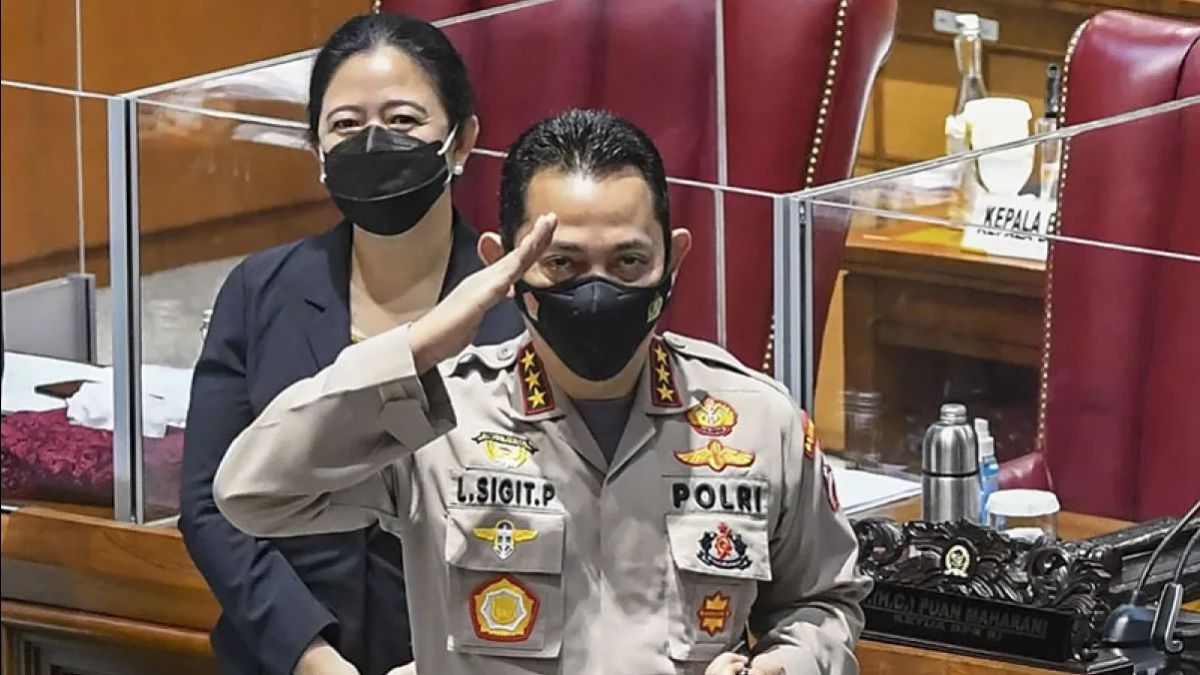


JAKARTA - Member of Commission III of the DPR RI, Rudianto Lallo, assessed that the National Police must respect and implement the decision of the Constitutional Court (MK) regarding members of the Bhayangkara corps who actively occupy positions outside the police must resign or retire from the police service.
He emphasized that the National Police Chief could no longer appoint active police officers to occupy civilian positions.
"I have not read the decision of the Constitutional Court. But if it is true that the decision of the Constitutional Court to cancel articles related to the prohibition of Polri officials, active generals, to serve as civil institutions or institutions, in my opinion, the Police must respect and implement the decisions of the Constitutional Court," said Lallo at the Parliament Complex, Senayan, Jakarta, Thursday, November 13.
"This means that when an official wants to move to another institution, he must resign. Do not even have the status of a police officer, but he is working actively in the institution. That's right, this is what happened," continued the NasDem legislator.
According to him, there are no problems regarding the latest Constitutional Court's decision regarding the Police Law. He also emphasized that the National Police Chief must obey and obey the Constitutional Court's decision.
"I don't think it's a problem. If it becomes the decision of the Constitutional Court, then all must obey and obey the decision of the Constitutional Court. Article 28 yes," said Lallo.
Previously, the Constitutional Court (MK) accepted all requests for judicial review of Law Number 2 of 2002 concerning the Indonesian National Police (UU Polri). The Constitutional Court emphasized that the National Police Chief could no longer appoint active police to occupy civilian positions before retiring or resigning from the police service.
In its ruling, the Constitutional Court stated the phrase or not based on the assignment of the National Police Chief in the Explanation of Article 28 paragraph (3) of the Police Law contradicts the 1945 Constitution and does not have binding legal force.
"Granted the petitioners' petition in its entirety," said Chief Justice of the Constitutional Court Suhartoyo when reading the verdict in the trial with case number 114/PUU-XXIII/2025 at the Constitutional Court Building Jakarta, Thursday, November 13.
SEE ALSO:
-
 | BERITA
Kerusuhan Penjara Imigran di Yunani, 2 Polisi Terluka Digigit-Dilempar Batu
13 November 2025, 11:57



SEE ALSO:
-
| BERITA
Kerusuhan Penjara Imigran di Yunani, 2 Polisi Terluka Digigit-Dilempar Batu
13 November 2025, 11:57
In their consideration, the Court assessed whether the phrase or not was based on the assignment from the National Police Chief in the explanation of Article 28 paragraph (3) of the Police Law caused uncertainty in norms and opened multi-interpretation spaces.
Meanwhile, Constitutional Justice Ridwan Mansyur explained that the provisions in Article 28 paragraph (3) of the Police Law were actually quite clear. The article explains that members of the police can occupy positions outside the police after resigning or retiring from the police service.
"Substantively, this provision confirms one important thing, namely that members of the National Police can only hold positions outside the police after resigning or retiring from the police service. This is an absolute requirement that must be met," said Ridwan.
The English, Chinese, Japanese, Arabic, and French versions are automatically generated by the AI. So there may still be inaccuracies in translating, please always see Indonesian as our main language. (system supported by DigitalSiber.id)
Most Popular Tags
#Prabowo Subianto #donald trump #2026 World Cup #Febrie Adriansyah #8791Popular


