
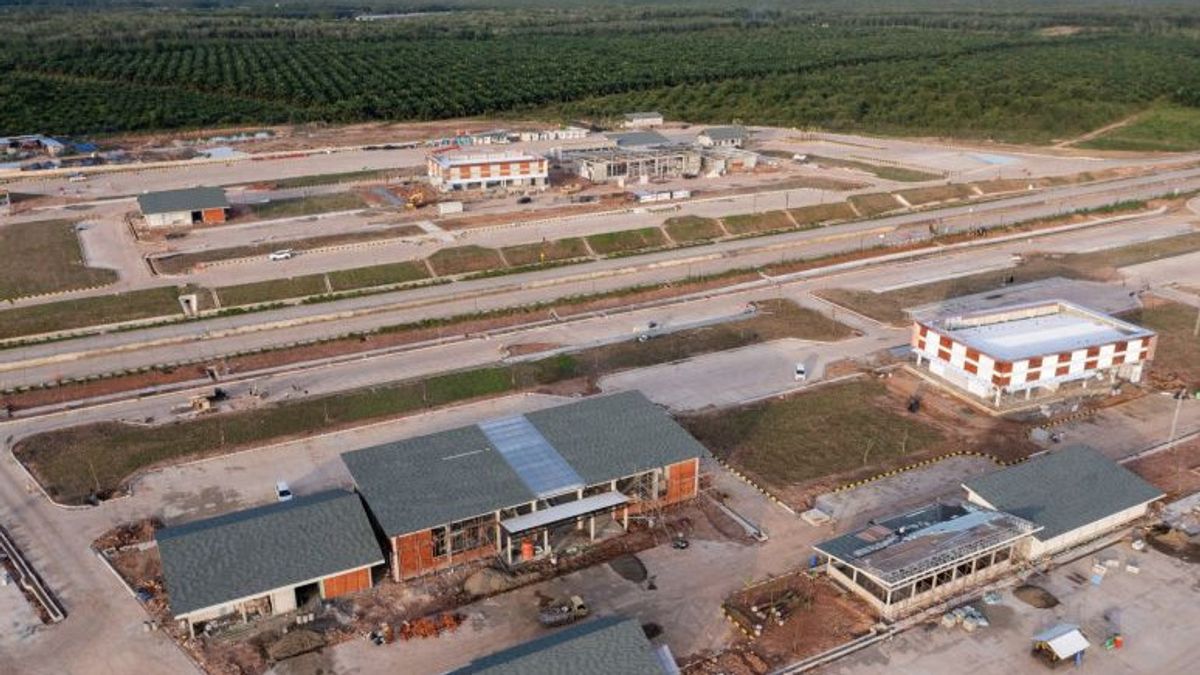


JAKARTA - Although it has been fully operational, a number of toll roads in Indonesia show minimal traffic volume. Experts in the infrastructure field assess that this condition is caused by two crucial factors: the high cost of toll tariffs that apply and the lack of infrastructure connection with existing distribution networks.
Executive Director of the Strategic Infrastructure Study Center (PUKIS) MM Gibran Sesunan stated that the main problem with the low use of toll roads lies in the government's planning.
According to him, the feasibility study, which has been the basis for toll road development, has been too optimistic and unrealistic about economic conditions and community mobility patterns.
"Overestimism makes traffic projections in feasibility studies not in accordance with reality. As a result, many projects end up losing money and find it difficult to meet minimum service standards," he said from ANTARA, Saturday, November 8.
SEE ALSO:
-
 | BERITA
Indikator Politik: Jika Pilpres Digelar Hari Ini, Prabowo Kembali Terpilih
08 November 2025, 18:08 -
 | BERITA
McDonald's Jepang Hentikan Penggunaan Sedotan Kertas Pertengahan Bulan Ini
08 November 2025, 18:00

Previously, the Minister of Public Works (PU) Dody Hanggodo revealed that there were 21 toll roads in Indonesia with traffic levels below 50 percent of the assumptions listed in the Toll Road Concession Agreement (PPJT). The data refers to the realization in 2024.
Gibran Sesunan added that the high tariff as the main inhibiting factor increased the number of express road users. For example, the tariff for class 1 vehicles on the Manado-Bitung Toll Road reaches Rp. 1,200 per kilometer for one pass, a number that is considered burdensome for the logistics and transportation sector of goods.
Similar conditions occurred in Bengkulu-Taba Penjung, Krian-Legundi-Bunder-Manyar, Kanci-Pejagan and a number of other toll roads which were also reported to be empty of users.
Several examples of toll roads built with logistics orientation, he said again, show that the infrastructure that has been presented has not yet fully provided added value for the national supply chain.
"In fact, increasing logistic access has a big role as the backbone of economic connectivity and can encourage strengthening economic growth," he also said.
The potential for existing toll roads that have not been maximized, according to him, shows the weak coordination and supervision of the Toll Road Regulatory Agency (BPJT) under the Ministry of Public Works.
Until now, he also said, there has been no concrete step to reduce tariffs or review the design of the toll-toll business that failed to attract users.
In fact, the problem of low traffic on these 21 toll roads, he assessed, has the potential to become a 'time bomb', such as a failure to return investment that could hinder the development and construction of new toll road projects in the future, hampering economic growth.
Meanwhile, the efforts of the Minister of Public Works, which stated that they were encouraging infrastructure integration through the approach of the national logistics corridor, according to him, had not yet touched the root of the problem.
Many new toll roads are built without adequate connections to industrial areas, ports, or economic centers.
"Without regional integration and regulatory policies in favor of users, toll road construction is only a concrete monument," said Gibran Sesunan.
He emphasized that the government needs to immediately audit BPJT and review business assumptions in toll projects so that investment in trillions of rupiah actually provides economic benefits, not just adding to the long list of toll roads that are empty of users.
The English, Chinese, Japanese, Arabic, and French versions are automatically generated by the AI. So there may still be inaccuracies in translating, please always see Indonesian as our main language. (system supported by DigitalSiber.id)
Most Popular Tags
#Prabowo Subianto #donald trump #Febrie Adriansyah #8791 #giias 2026Popular


