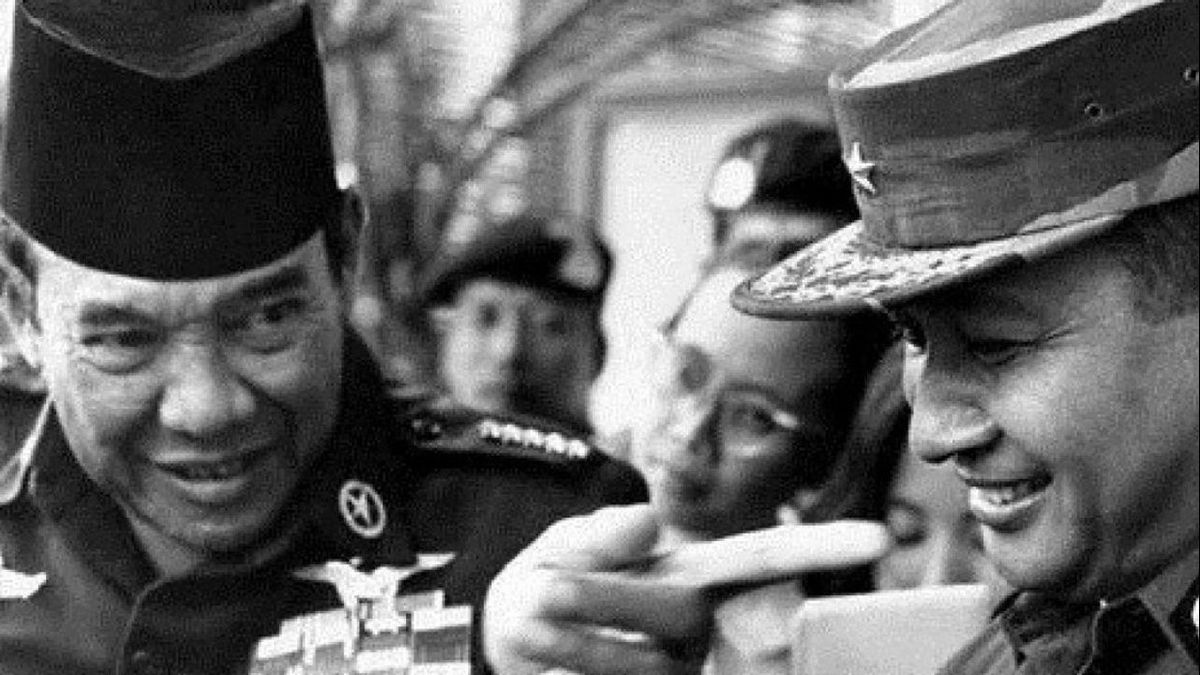


YOGYAKARTA - Not many know where Suharto and Soekarno were when the G30S/PKI incident took place on September 30, 1965. In fact, that night became a turning point in Indonesia's history, marked by kidnappings and killings of generals, as well as the emergence of important roles for national figures.
The G30S/PKI incident was not just a dark note, but also a crucial moment that determined the direction of the nation's politics. In an atmosphere full of tension, the existence of Soekarno and Suharto at that time was the key to understanding the dynamics of power that occurred.
As VOI once wrote in an article entitled Where was President Soekarno during the G30S PKI event?, on the night of September 30, 1965, President Soekarno was known not to be at the Merdeka Palace.
Soekarno is known to have stayed at Wisma Yaso, the residence of his wife Ratna Sari Dewi, on Jalan Gatot Subroto, South Jakarta. The next morning, October 1, 1965, at around 06.00 WIB, Soekarno left there for the Merdeka Palace with his bodyguards.
But in the middle of the trip, Soekarno instead changed the direction towards his other wife's house, Haryati, in the Slipi area, after receiving news that the Palace had been surrounded by armed forces.
From Slipi, Soekarno was then advised to evacuate to Halim Perdanakusuma Base. Soekarno arrived at Halim at around 09.00 WIB, greeted by Air Force Commander Omar Dhani.
At Halim Perdanakusuma, Soekarno planned to meet with the generals, but at that time they had become victims and their bodies were found in Lubang Buaya.
Based on an article published by the Cendana Nusantara Media Working Team, from themissionsoharto page, on the night of September 30, 1965, Lieutenant General Suharto was at Gatot Subroto Hospital with his wife.
Suharto was written as visiting his youngest son, Tomy, who was four years old and was treated for hot water. At around 22.00 WIB, Suharto even saw Colonel Abdul Latief walking in front of the treatment room where his son was being treated.
Towards midnight, at around 00.15 WIB, Suharto decided to return to his home on Jalan Haji Agus Salim, Jakarta, while his wife continued to accompany Tomy at the hospital.
Suharto admitted that he had rested until early morning. However, on October 1 at around 04.30 WIB, Suharto received news from his neighbors and colleagues about gunfire at several points in Jakarta. Shortly thereafter, he received shocking information about the kidnapping of a number of high-ranking Army officers.
As a comparison of Suharto's testimony regarding his whereabouts on the night of September 30, 1965, a number of documents examined by historian Jess Melvin actually revealed another side of the military role.
In his book The Army and the Indonesian Genocide: Mechanics of Mass Murder, Melvin revealed that the mass massacre operation against people accused of being involved in the PKI in the 1965 period '1966 was coordinated directly by Major General Suharto, who then rose to become President replacing Soekarno.
Interestingly, based on these findings, the military is said to have prepared a chain of command even before October 1, 1965.
Then on October 4, a military emergency was imposed in Sumatra, followed by instructions for civilians to be involved in the crackdown.
Next on October 14, a Yudha Room was formed to coordinate this operation. Melvin emphasized that the territorial command structure such as Kodam, KOTI, RPKAD, and Kostrad was under Suharto's control at the center.
The G30S/PKI events do leave many versions of the existence and role of important figures such as Soekarno and Suharto. From personal testimony to the findings of historians, all illustrate how complex the situation was at that time.
SEE ALSO:
-
 | TEKNOLOGI
Zhipu AI China: Kecerdasan Buatan Super Penuh Tak Mungkin Tercapai pada 2030
01 Oktober 2025, 02:05

Although the details are still being debated, it is clear that this momentum is a turning point in Indonesia's history which changes the nation's political direction as well as affirms the military's position in the dynamics of power.
In addition to discussing where Suharto and Soekarno were during the g30s/pki incident, follow other interesting articles on VOI, to get updated news, don't forget to follow and monitor all of our social media accounts!
The English, Chinese, Japanese, Arabic, and French versions are automatically generated by the AI. So there may still be inaccuracies in translating, please always see Indonesian as our main language. (system supported by DigitalSiber.id)