
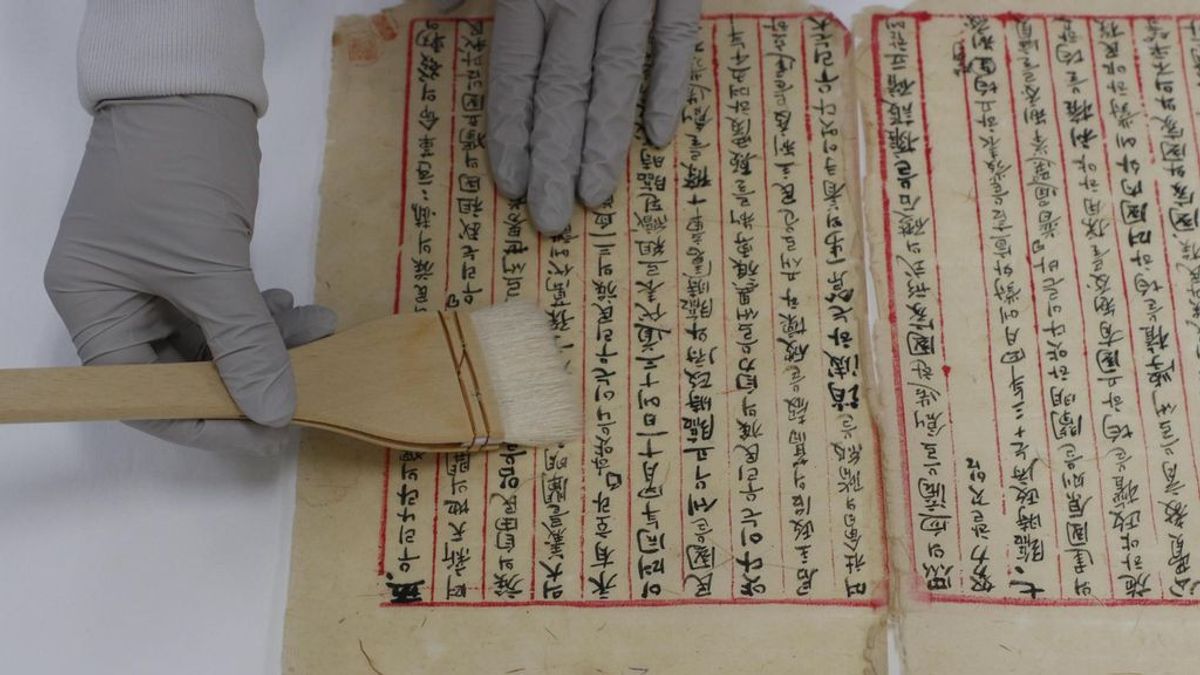


The rare winds that provide a glimpse into Korea envisioned by the Temporary Government after the release from Japanese colonialism in 1910-1945 have been restored to its original shape.
The Center for Conservation Science at the National Institute of Cultural Heritage Research in July completed the job of preserving the draft of the Korean founding charter.
Written by politician Jo So-ang (1887-1958), the document outlines a vision for future independence and nation-building movements, based on his philosophy of Three Equality Principles, quoted from The Korea Times September 8.
This theory calls for an ideal society rooted in equality between individuals, ethnic groups, and the state, with political equality, economy, and education as its main pillar.
Accepted in 1941 by the Temporary Government, this manuscript later became the philosophical foundation of South Korea's first Constitution in 1948.
The 10-page draft contains Jo's own handwritten text with ink, along with a visible correction as evidence of historical value.
However, time has eaten away at it. For decades, deep folding marks have formed along the middle of the pages. The edges are torn and frilled, and some parts have been temporarily repaired with tape, leaving stains and color changes.
In response to this, the conservation center began its restoration work in December last year.
Using organic solvents, conservators clean the deposits and glue residues. They adjust the level of paper acidity to support long-term preservatives and strengthen brittle parts with similar textured paper, which is naturally colored using solutions made of boiled alder tree. In addition, a special archive box was created to protect documents from further damage.
This budgeted rally will be exhibited to the public from August 12 to October 12 at the upcoming exhibition "Pemerlang Kemerdekaan Warisan" in Dondek Hall, Deoksu Palace, downtown Seoul.
SEE ALSO:
-
 | BERITA
Tentara Bayaran hingga Gengster Anti-muslim Kendalikan Distribusi Bantuan Gaza
13 September 2025, 05:00 -
 | BERITA
UNICEF Peringatkan Lonjakan Mengkhawatirkan Angka Malnutrisi Anak di Gaza
12 September 2025, 21:45 -
 | BERITA
Dubes RI dan Negara OKI di Rumania Gelar Aksi Solidaritas untuk Palestina
12 September 2025, 20:45 -
 | BERITA
Laporan HAM PBB Sebut Korea Utara Tingkatkan Pengawasan dan Eksekusi
12 September 2025, 20:15
Marking the 80th anniversary of Korea's release, the exhibition will feature more than 110 artifacts, including "Taegeukgi from Jingwan Temple in Seoul" a Korean flag made by painting on the Japanese flag using black ink.
It is believed that it was used during or after the March 1 Independence Movement in 1919, this object was designated as the state treasury in 2021.
Historical documents related to Seo Yeong-hae (1902-?), the first Korean ambassador to France under the Temporary Administration, which was designated National Cultural Heritage earlier this year.
The English, Chinese, Japanese, Arabic, and French versions are automatically generated by the AI. So there may still be inaccuracies in translating, please always see Indonesian as our main language. (system supported by DigitalSiber.id)


