

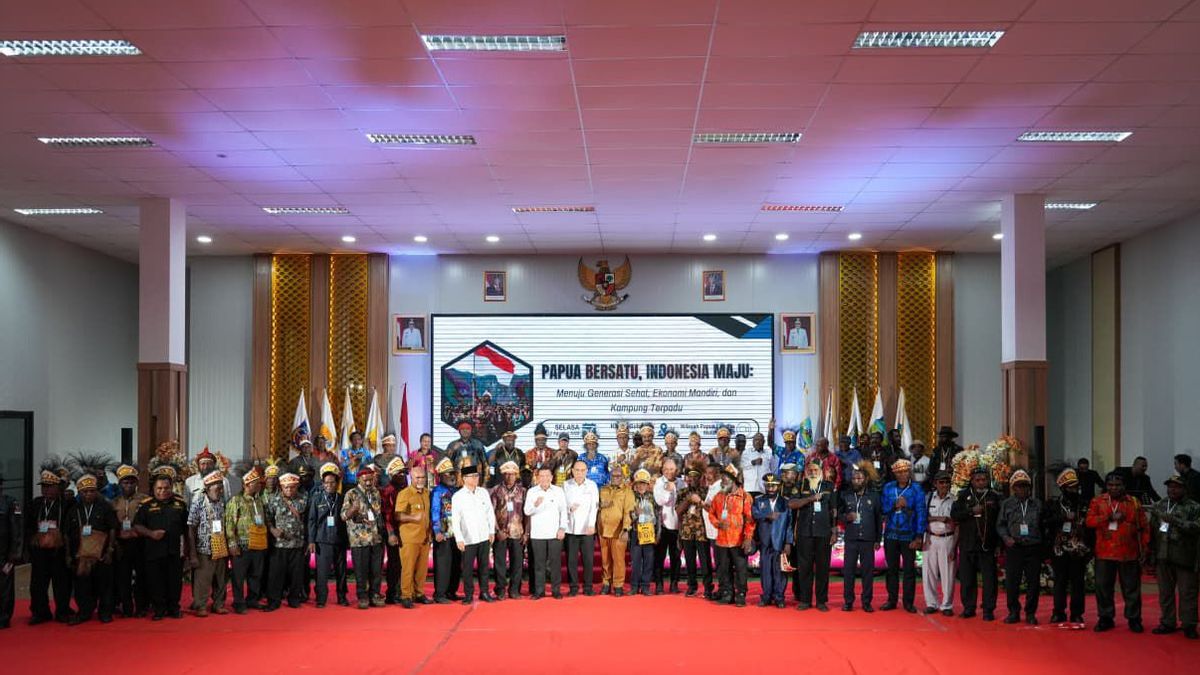


JAKARTA - The government continues to be committed to building Papua with various strategic programs, ranging from Free Nutrition Food (MBG), Free Health Checks (CKG), social assistance, Red and White Village Cooperatives (KDMP), to Integrated Village Economic Transformation (TEKAD).
The committee was conveyed directly to tribal chiefs, religious leaders, traditional leaders, community leaders, youth, and representatives of community organizations in an activity wrapped with the theme "United Papua, Advanced Indonesia: Towards a Healthy Generation, Independent Economy, and Integrated Villages" and carried out in Nabire, Central Papua, Tuesday, August 12.
The Governor of Central Papua, Meki Fritz Nawipa explained that the acceleration of the MBG Program was carried out starting from the formation of a Working Group chaired by the Deputy Governor, adding healthy kitchen points in eight districts, providing regional budgets, to mapping schools as location for implementation.
"We know that the implementation of MBG has a multi-effect on all elements. Starting from the provision of food ingredients that have an economic impact on farmers and breeders, to improving children's nutrition, breastfeeding mothers, pregnant women, and stunting children," said Fritz.
In addition to MBG, the Central Papua Provincial Government has also implemented the provision of Additional Food and BLT for toddlers, Free Health Checks, the establishment of 1,045 village cooperatives, as well as the development of Integrated Village Economic Transformation (TEKAD) in Nabire and Dogiyai since 2023.
Head of the National Nutrition Agency (BGN), Dadan Hindayana, said that Papua is the fastest region in the realization of MBG which has reached 25 percent of the target.
Overall, in Papua alone there are 101 out of 414 based on population count. In Papua Province there are 38 SPPGs. In West Papua there are already 27, then in South Papua there are 3, in Central Papua there are 14, then there are Papua Mountains 4, and Southwest Papua there are 15, "he explained.
In addition, it is emphasized that the use of local raw materials continues to be strengthened as a strategy to encourage the community's economy.
"So we hope that later the Nutrition Agency will spend a lot of funds on the Papua region for raw materials from local origin, then cooked by mothers or local communities, and then given to pregnant women, breastfeeding mothers, toddlers, and all school children from PAUD to vocational school children," he added.
In the village economic sector, Central Papua recorded the achievement as the first province in the Papua region to form the Red and White Village Cooperative in all villages/kelurahan.
Minister of Cooperatives Budi Arie Setiadi gave his appreciation to the Central Papua Provincial Government for its achievements as the first province in the Papua region to form 100 percent of the Red and White Village Cooperative (KDMP).
"I appreciate Central Papua being the first province in the Papua region to successfully form the Red and White Kopdes in all villages/kelurahan 100 percent," he said.
Budi Arie emphasized that the presence of KDMP is not only a driving force for the economy, but also a pillar of village independence. With full support from the central government, local governments, traditional leaders, religious leaders, and the community, it is hoped that this cooperative will be able to encourage economic equity to remote villages.
"I hope this cooperative in Papua can be an example for other regions, that economic independence can be built from villages, from the community, with the spirit of unity and togetherness," continued Budi Arie.
Meanwhile, PDTT Village Minister Yandri Susanto emphasized the importance of building from villages for economic equality.
Papua is an inseparable part of the Unitary State of the Republic of Indonesia. Building a village in Papua is actually us building Indonesia," he said.
Yandri said that village funds in Papua reached almost IDR 6.5 trillion every year, with Central Papua receiving IDR 1.089 trillion this year, an increase of IDR 50 billion from the previous year. In addition, the Ministry of Villages is also implementing the TEKAD (Integrated Village Economic Transformation) program which focuses on empowering the community's economy.
Another strategic program is the Red and White Village Cooperative, which was initiated to strengthen the people's economy at the village level. According to Yandri, this step is in line with the government's efforts to move the economy to remote areas.
"If the nutritious lunch is successful, the village cooperative is successful, it is those who enjoy the villages, villages. Because all the money rounds are in the village," he said.
Mendes also invited all stakeholders to maintain cohesiveness, collaboration, and mutual cooperation for the success of the development program.
"We will never get tired, we will never stop paying attention to the Land of Papua. The land of Papua is the pride of all of us. Let's take care of this Papuan land, let's fill it with something positive, build it from the village," he said.
On the same occasion, the Head of the Nabire Tribe, Central Papua, Melkisedek Rumawi, expressed his support for the MBG program and assessed that the presence of the National Nutrition Agency brings great benefits to indigenous peoples. He emphasized the importance of fulfilling nutrition for traditional children so that they grow healthy, have an education, and will be able to lead Indonesia in the future.
"The presence of the National Nutrition Agency is very good, especially for indigenous peoples, traditional children who are prepared as a young generation for Indonesia. In terms of nutrition so that they can be healthier and enjoy education so that they can lead in our country, Indonesia we love together," said Melkisedek Rumawi.
It should be noted that in the Nabire, Jayapura, Wamena, Merauke, Sorong, and Manokwari areas, a series of activities were also carried out, starting from providing social assistance (bansos), free health checks, and groundbreaking of the MBG kitchen.
The English, Chinese, Japanese, Arabic, and French versions are automatically generated by the AI. So there may still be inaccuracies in translating, please always see Indonesian as our main language. (system supported by DigitalSiber.id)
Most Popular Tags
#Prabowo Subianto #donald trump #2026 World Cup #venezuela #konflik timur tengahPopular


