

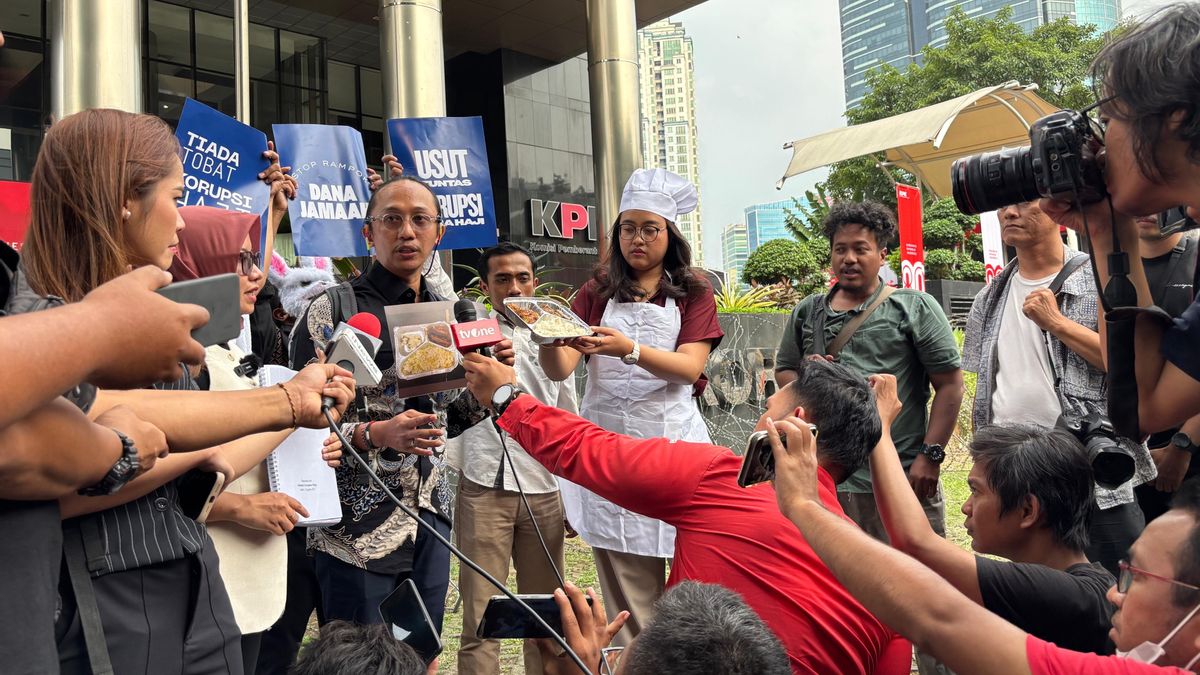


JAKARTA - Indonesia Corruption Watch (ICW) reported allegations of corruption related to the implementation of the Hajj to the Corruption Eradication Commission (KPK) today. There is a state administrator and two employees who they call involved.
"ICW has officially reported allegations of corruption related to the implementation of the hajj. There are three people (namely, red) state administrators and two civil servants in the ministry," said Head of the Legal and Investigation Division of ICW Wana Alamsyah to reporters at the KPK's Merah Putih building, Kuningan Persada, South Jakarta, Tuesday, August 5.
There were two points of the report submitted by ICW, Wana said. First, regarding the community or public services for pilgrims following the process from Arafah, Muzdalifah, and Mina.
Then the second relates to the reduction in the consumption specifications of the pilgrims. Wana on that occasion also showed a receipt of the report to the media crew.
He then detailed the alleged issue of community service, based on the results of the ICW investigation, there are allegations that there are two companies that are providers but are owned by one person who is the same. This condition contradicts Law Number 5 of 1999 concerning the Prohibition of Monopoly Practices and the Practice of Unhealthy Business Competition.
"Based on our tally, the individuals who own the two companies control the market by about 33 percent of the general services whose total Hajj pilgrims are around 203,000 people," he said.
Meanwhile, regarding the procurement of catering, continued Wana, the food provided was not in accordance with the Minister of Health Regulation Number 28 of 2019 related to the recommended nutritional adequacy figures for the Indonesian people.
Based on the Permenkes, Wana said that ideally a pilgrim needs around 2,100 kilo calories (kkal).
However, based on the ICW calculation, the average food provided by the Ministry of Religion through providers to pilgrims ranges from 1,715 to 1,765 kcal. "This means that from the planning process, the consumption given is not in accordance with the nutritional needs given to pilgrims. That is the first problem," said Wana.
The second problem regarding the alleged levies made by one of the reported parties is civil servants for consumption given by the Ministry of Religion.
The third finding is related to the reduction in food specifications received by the pilgrims. His party found that there was a decrease in specifications of at least 4 riyals per dish.
"Which, if calculated to the rupiah, the potential loss to the state to reduce consumption specifications is around Rp. 255 billion," he said.
"From here, we hope that the KPK can follow up on all the information and analysis that we convey so that next year's Hajj can run smoothly and in accordance with such documents," concluded Wana.
The English, Chinese, Japanese, Arabic, and French versions are automatically generated by the AI. So there may still be inaccuracies in translating, please always see Indonesian as our main language. (system supported by DigitalSiber.id)


