

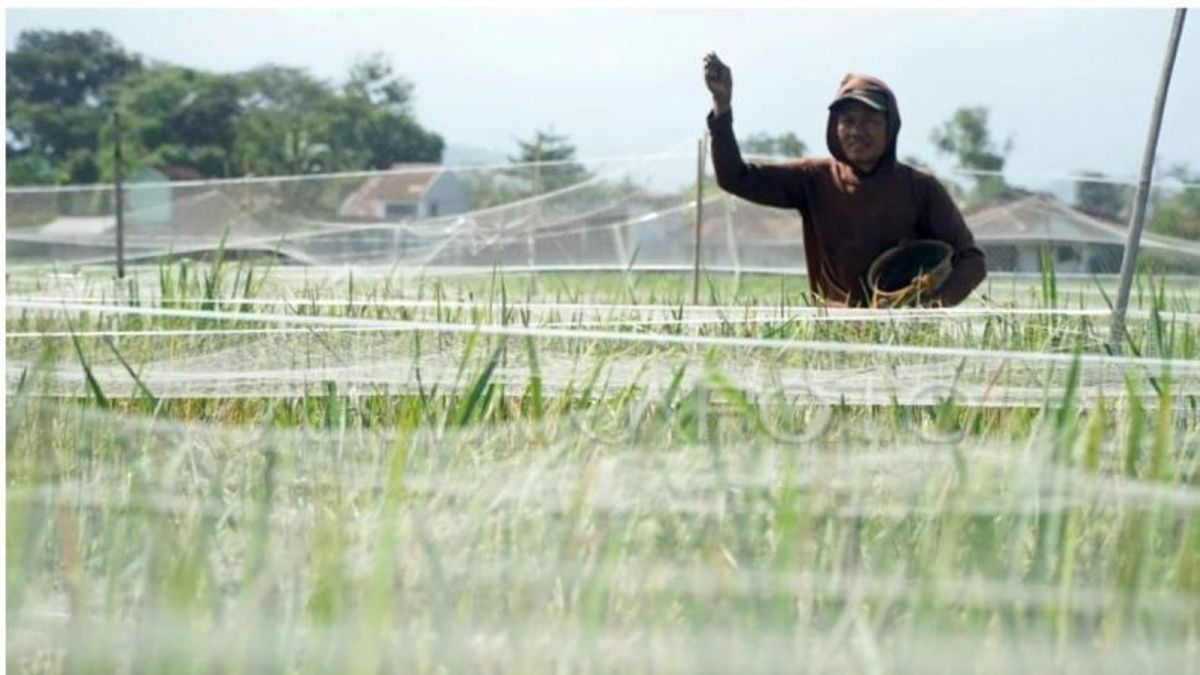


TRENGGALEK - The chocolate-wasng pest attack (Nilapavarta Lugens) that hit hundreds of hectares of rice farming land in the border area of Trenggalek and Tulungagung Regencies, East Java, has threatened many farmers with crop failure because their rice plants show symptoms of severe damage.
Hama wasng caused most of the farmers' rice crops in Durenan Trenggalek and Pakel Tulungagung sub-districts to be damaged and dried up.
Many farmers complain. They have tried to handle it by spraying pesticides or pesticides, but to no avail.
Durenan sub-district head Ahmad Zuh and revealed that the total area of the affected rice fields in his area reached 238 hectares, spread across 12 villages.
Pest attacks occur with varying intensity, ranging from mild to severe categories.
"The worst is in two villages, namely Pandesaan Village with an area of 35 hectares and Malasan Village with 30 hectares," said Zuhdan as quoted by ANTARA, Friday, August 1.
Meanwhile, 10 other villages were also affected, namely Kendalrejo Village 25 hectares, Durenan 20 hectares, Ngadiko 25 hectares, Karanganom 20 hectares, Sumberggayam 20 hectares, Baruharjo 20 hectares, Pakis 15 hectares, Panggasari 10 hectares, Kamulan 8 hectares, and Semarum 10 hectares.
Zuhdan explained that the symptoms of the wereng attack were clear. The rice plant turns yellow, the stem weakens, and the glass does not develop perfectly. A number of lands have even shown potential puso or crop failure.
SEE ALSO:
-
 | BERITA
Pakai Rompi Antipeluru, Utusan AS Witkoff Kunjungi Lokasi Operasi Bantuan di Gaza
01 Agustus 2025, 20:40 -
 | BERITA
Putin Hadapi Tenggat Waktu Trump, Isyaratkan Belum akan Akhiri Perang dengan Ukraina
01 Agustus 2025, 20:14


The condition is no less severe monitored in Kendal Village, Pakel District, Tulungagung and its surroundings.
Some rice plants look damaged and dry. Some of them are growing abnormally, thus making farmers have to work extra to carry out handling, both with insecticides and other antihama drugs.
"Wereng this season is immune to pest drugs. This has been sprayed 12 times but the wet is still there and even more. Now I try to sprinkle the sand mixed with diesel, hopefully it will be a solution (to go)," said Muali, a farmer in Kendal Village.
In addition, farmers and officers have made various control efforts, including manual spraying of insecticides and using drones.
"Sprays have been carried out some time ago, especially in the areas most affected," he said.
However, massive wasng attacks overwhelmed some farmers. Some areas of rice fields that have dried up have become difficult to handle.
"This pest spreads very quickly and is difficult to control, especially on land that is already experiencing drought," he added.
The English, Chinese, Japanese, Arabic, and French versions are automatically generated by the AI. So there may still be inaccuracies in translating, please always see Indonesian as our main language. (system supported by DigitalSiber.id)
Popular


