

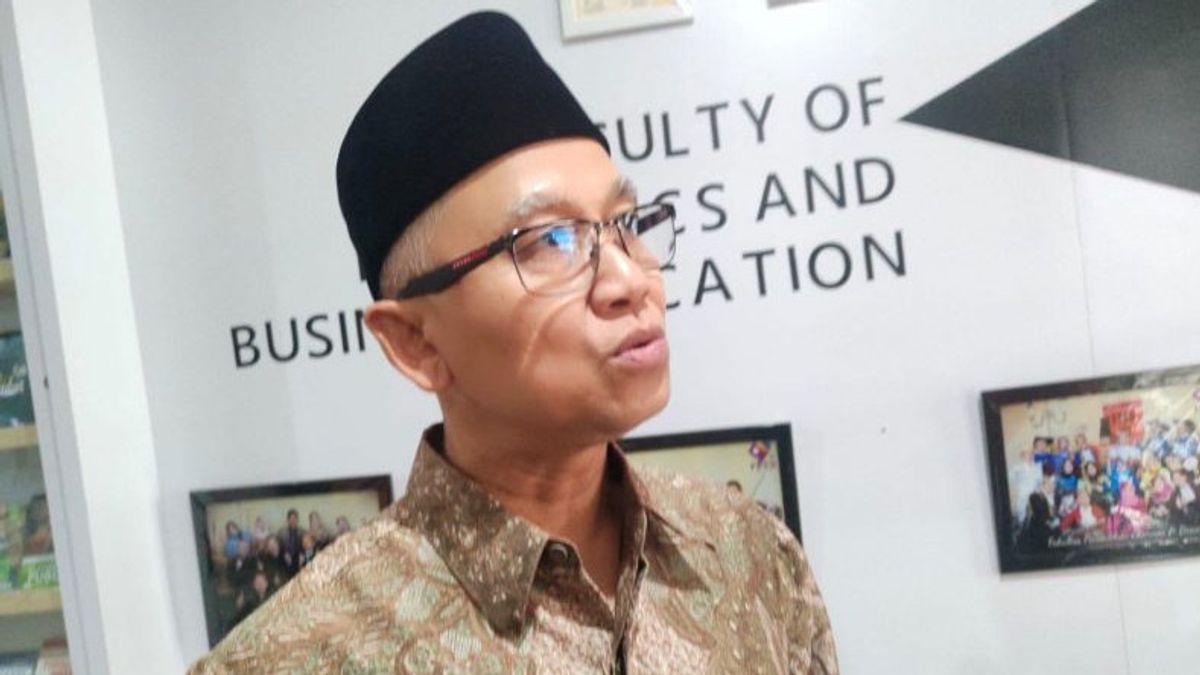


BANDUNG - Deputy Minister of Basic and Secondary Education (Wamendikdasmen) Atip Latipulhayat revealed that the exemption from education costs as mandated by the decision of the Constitutional Court (MK) may be carried out in the coming school year (2026), not this year.
"Even if it is implemented, I think it will be quite difficult if it is implemented this year, because the budget year has been running half way," said Atip at the Bandung UPI Campus, Monday, June 9.
The Constitutional Court's decision to waive the cost of education, both public and private schools, is not just a matter of making it free without considering the financing aspect, considering that everything is closely related to the budget focus carried out.
"Currently we are coordinating with the relevant ministries to see the possibility of budget allocation. The point is that it depends on the budget," he said.
Atip also said that until now there are no technical regulations or technical instructions in carrying out these policies.
"There is no technicality yet. For its implementation, we still have to do the calculations first," he added.
Previously, the Constitutional Court decided that the state, in this case the central and regional governments, must make basic education free, which is held in elementary, junior high, and madrasa or equivalent education units, both in public and private schools.
"Granted the petitioners' petition for part," said Chief Justice of the Constitutional Court Suhartoyo reading the verdict Number 3/PUU-XXII/2024 at the Indonesian Constitutional Court, Jakarta, Tuesday (27/6).
The Constitutional Court stated that the phrase "mandatory to study at the basic level of education without charge" in Article 34 paragraph (2) of Law Number 20 of 2003 concerning the National Education System (Sisdiknas) has caused multiple interpretations and discriminatory treatment so that it is contrary to the 1945 Constitution of the Republic of Indonesia.
Constitutional Justice Enny Nurbaningsih explained that the phrase "mandatory to study at the basic level without collecting fees" whose application only applies to public schools can lead to gaps in access to basic education for students attending private schools.
Moreover, under certain conditions, there are students who are forced to attend private schools due to limited capacity of public schools.
Under these conditions, according to the Constitutional Court, the state still has a constitutional obligation to ensure that no students are hampered from obtaining basic education just because of economic factors and limitations of basic educational facilities.
The English, Chinese, Japanese, Arabic, and French versions are automatically generated by the AI. So there may still be inaccuracies in translating, please always see Indonesian as our main language. (system supported by DigitalSiber.id)
Most Popular Tags
#Prabowo Subianto #donald trump #Febrie Adriansyah #8791 #giias 2026Popular


