
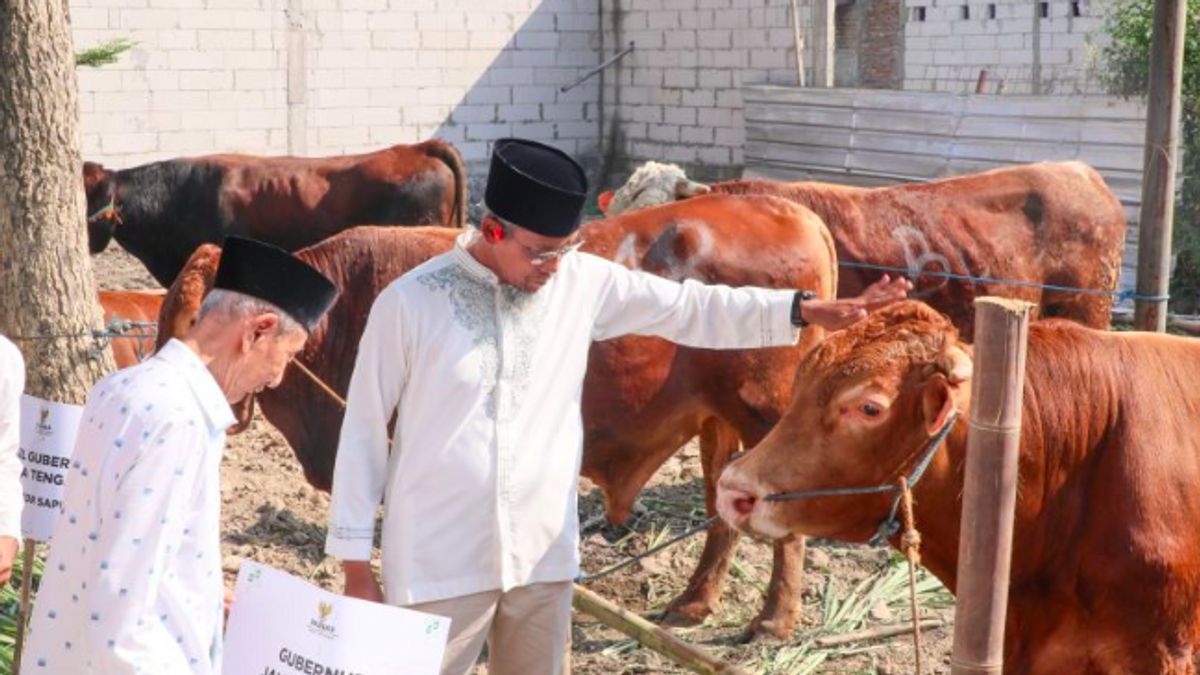


JAKARTA - In order to expand the distribution of sacrificial meat and maintain its quality and resilience, the Central Java Province National Amil Zakat Agency (Baznas) processed meat from 116 sacrificial cows into Kornet products.
This innovation is carried out to ensure that distribution is more efficient, especially to areas that are difficult to reach.
The chairman of the Central Java Baznas, Ahmad Darodji, said that the processing of meat into a cornet is not only aimed at extending the shelf life, but also as an alternative to fulfilling community nutrition in a more practical form. According to him, this processing can be stored longer than fresh or frozen meat, so it is more flexible in its distribution.
In addition to being more durable, the cornet product is considered more efficient in the logistics aspect. Compared to distributing frozen meat that requires special cooling, the cornet can be sent in large quantities at a lower transportation cost.
Darodji explained that this year the number of sacrificial animals received by Baznas Central Java increased compared to the previous year. In the previous Eid al-Adha, as many as 88 sacrificial cows were successfully processed into more than 100 thousand box cans, which were then distributed as part of the aid package to communities affected by the disaster and classified as underprivileged.
These processed products are also distributed to thousands of beneficiaries in villages that are fostered by various regional apparatus organizations (OPD) under the Central Java Provincial Government. This step is expected to contribute to increasing the nutritional intake of the community.
"Distribution in this form of processing is one of the strategic efforts to support nutritional resilience, especially among the welfare community," said Darodji, who also serves as Chairman of the Central Java Indonesian Ulema Council (MUI), as quoted by ANTARA.
SEE ALSO:
-
 | BERITA
Hari Kartini, Nihayatul Wafiroh: Perempuan Perlu Melek Literasi Digital
21 April 2025, 14:07

The chairman of the Indonesian Baznas, Noor Achmad, added that the slaughtering of sacrificial meat is also intended for 3T (disbursed, outermost, and underdeveloped) areas, which are often difficult to gain access to animal protein sources.
"In some of these areas, it could be that people rarely or even never enjoy meat. So, the existence of canned meat is very meaningful and becomes a high-value source of nutrition," he said.
Meanwhile, the Regional Secretary of Central Java Province, Sumarno, said that the sacrificial meat processing program had entered its second year of implementation. He appreciated the role of Baznas in supporting government programs, especially related to stunting and poverty alleviation.
"Thank you for Baznas' contribution. The availability of protein for children is very important to support their growth. This program is part of the solution we need," he said.
Sumarno hopes that this initiative will continue and expand its scope so that more people will receive benefits from sacrificial meat, especially in the form of processed products that have nutritional and long-lasting value.
The English, Chinese, Japanese, Arabic, and French versions are automatically generated by the AI. So there may still be inaccuracies in translating, please always see Indonesian as our main language. (system supported by DigitalSiber.id)
Popular


