

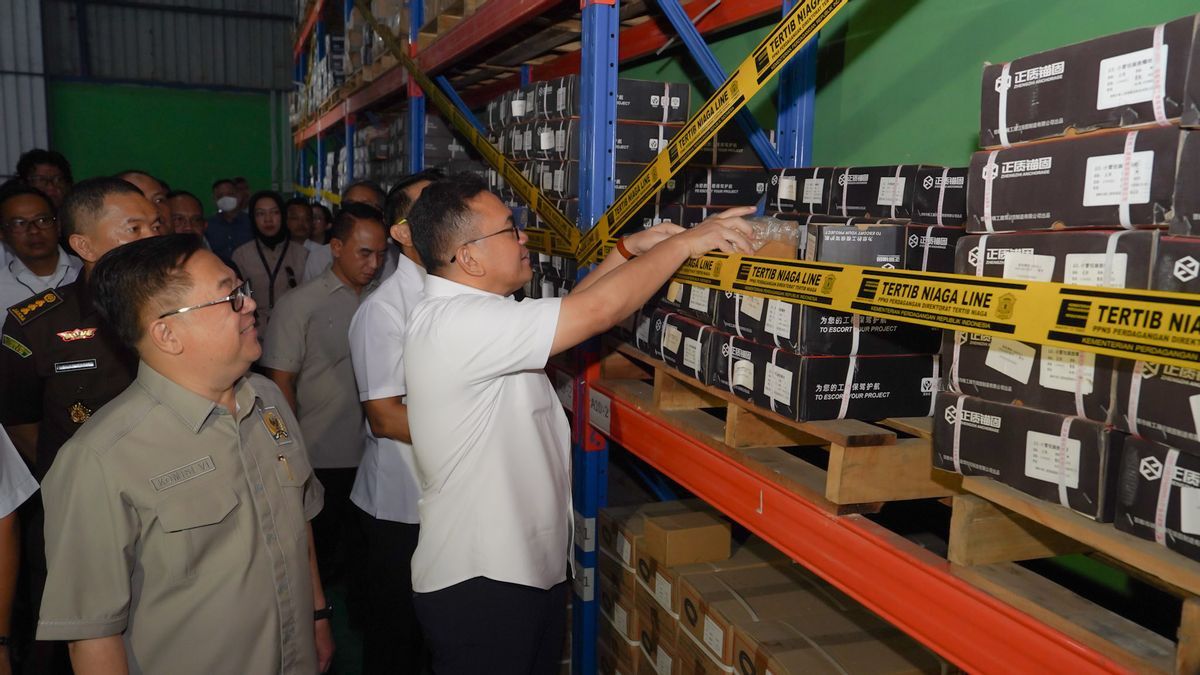


JAKARTA - Member of Commission VI of the Indonesian House of Representatives, Rivqy Abdul Halim, highlighted the findings of millions of illegal imported goods from China or China. Rivqy emphasized the urgency of the new Consumer Protection Act which can regulate product marketing through digital media, including sanctions for violators.
"The Consumer Protection Act must protect consumers from the flooding of illegal products marketed through digital media," said Rivqy Abdul Halim, Tuesday, May 27.
As is known, Commission VI of the DPR is discussing the revision of the Consumer Protection Law which will replace Law Number 8 of 1999. This change aims to adjust the regulations to current consumer challenges.
Rivqy assessed that the Consumer Protection Bill must include digital platforms in discussions to ensure protection for the community as consumers.
"This new law must have more comprehensive rules, by inviting the platform or e-commerce to sit together," he said.
As reported, the Ministry of Trade (Kemendag) secured 1,680,047 imported goods from China that did not comply with the provisions in Tangerang Regency, on Thursday, May 22. The millions of products that were secured consisted of hand tools, electrical equipment, electronics, clothing accessories, and iron or steel products and their derivatives, which amounted to Rp18.85 billion.
These products are imported by PT Asiaalum Trading Indonesia, which is a large-scale industrial group and trading of building materials. These imported goods are then stored in a warehouse in the Cikupa District area.
The company is considered to have violated a number of different provisions, including the Indonesian National Standard (SNI), the obligation to include labels in Indonesian, Security, Safety, Health, and Environment (K3L), Manual List of Cards and Guarantees (MKG), and do not have documents of origin of import.
The findings of this illegal imported goods were obtained by the Ministry of Trade through observations on social media showing the promotion and distribution of imported goods online. Currently, the Ministry of Trade is still investigating and exploring the findings of the surveillance results.
With the findings of the Ministry of Trade, Rivqy also highlighted the importance of consumer protection. Because illegal imported goods found such as dust suction, gloves, axes and other tools, electronic goods and clothing are marketed to consumers through social commerce media, TikTok.
"This means that business actors have violated the Consumer Protection Act because they do not sell or market their products to consumers honestly in accordance with applicable regulations," said Rivqy.
"In addition, the important note is that the supervision of the platform is still quite weak, because it has passed the marketing of illegal products," added the legislator from the East Java IV electoral district.
According to the man who is familiarly called Gus Rivqy, the Law on Consumer Protection has not regulated in detail related to marketing illegal products through digital media. So far, the legal umbrella used to ensnare violations committed by business actors in digital media is only the Law on Information and Electronic Transactions (ITE).
"It can be seen in Article 9 of the ITE Law which reads that business actors who offer products through an electronic system must provide complete and correct information related to the terms of the contracts, producers, and products offered," explained Gus Rivqy.
In addition to consumer protection from illegal products, members of the Commission in the DPR in charge of trade affairs and business competition also highlighted problems related to inequality in relations between business actors and consumers. Especially, said Gus Rivqy, when consumers file complaints against goods or services in digital media.
"From several existing cases, consumers often lose to the demands for defamation in digital media," he said.
On the other hand, Rivqy feels sad because consumers who are harmed by illegal products or goods and services that violate regulations are still quite rare in obtaining compensation. This is because irresponsible business actors or consumer knowledge are still lacking in relation to their rights.
SEE ALSO:
-
 | BERITA
Kremlin Sebut Pengerjaan Rancangan Nota Perdamaian Rusia Masih Berlanjut
27 Mei 2025, 05:00


In fact, added Rivqy, compensation for consumers is the breath of consumer protection itself. So the new Consumer Protection Act will have to regulate the equal position between business actors and consumers," said Rivqy.
"One of them, is that the mechanism settings for consumers to get compensation must be made relatively easier," he concluded.
The English, Chinese, Japanese, Arabic, and French versions are automatically generated by the AI. So there may still be inaccuracies in translating, please always see Indonesian as our main language. (system supported by DigitalSiber.id)
Most Popular Tags
#Prabowo Subianto #donald trump #Febrie Adriansyah #8791 #giias 2026Popular


