

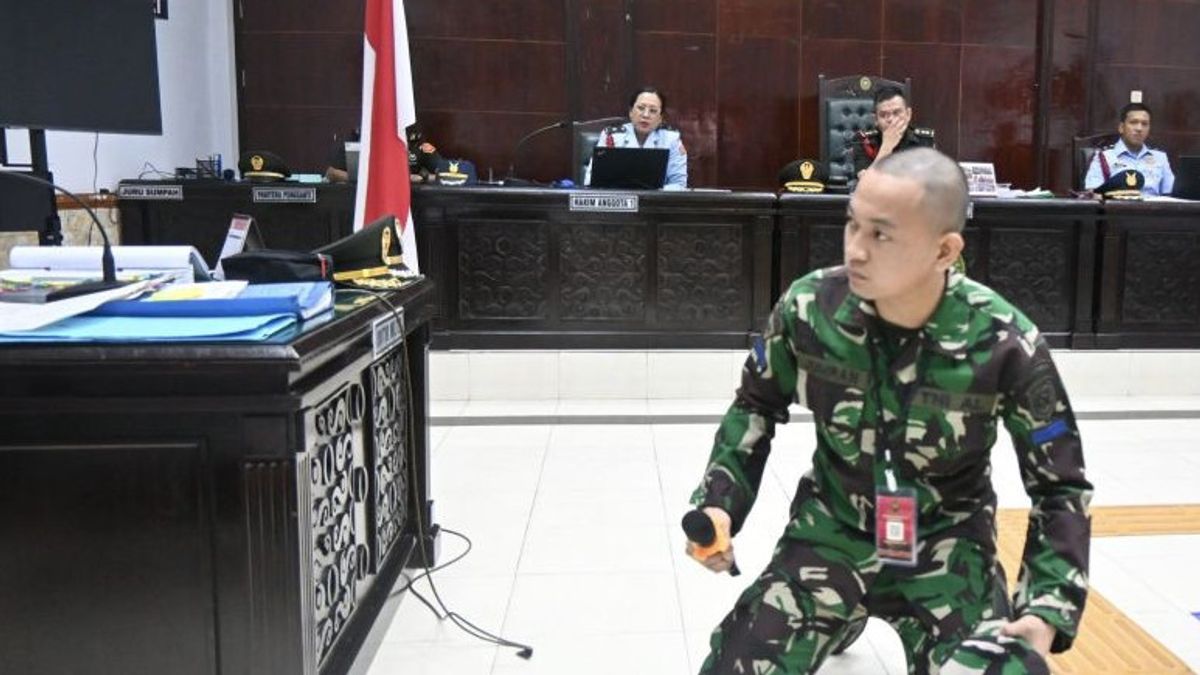


The panel of judges questioned a member of the Indonesian Navy Classi Satu Jumran, a defendant in the murder of a journalist from Banjarbaru, Juwita (23), for failing to admit to trying to eliminate evidence and traces before and after killing the victim.
The panel of judges repeated questions to the defendant based on evidence in the indictment which stated that the defendant was looking for information on Google regarding how to eliminate evidence and traces of murder.
The panel of judges chaired by Lt. Col. CK Arie Fitriansyah opened questions to explore the series of incidents ranging from the defendant who engineered the identity to purchase plane tickets using a junior ID card to return to headquarters after killing.
"Why is the defendant looking for content on how to eliminate evidence on Google?", said Lieutenant Colonel Arie, but the defendant argued that he was just looking for it without any intention.
Then the panel of judges asked the reason the defendant used another person's ID card to buy a plane ticket before the murder, and the defendant replied that the whereabouts were not easily tracked when leaving the unit.
"Buy a bus ticket from Balikpapan to Banjarbaru (the victim's address) why use a pseudonym and why engineer a night watch list in the unit," said Lieutenant Colonel Arie as quoted by ANTARA, Tuesday, May 20.
The defendant replied that the unit should consider it to be in the internal service, even though it came out without permission.
The panel of judges again questioned several statements in the investigation report (BAP) of investigators, until when the defendant had taken the bus on March 21 evening, then arrived in Banjarbaru, South Kalimantan on March 22, the defendant got off the bus to buy something.
"Why is the physical number of the cell phone entrusted to a friend in Balikpapan? And what did the defendant plan after arriving at Banjarbaru and getting off the bus? And before getting off the bus, what was the communication with the victim?," said the panel of judges.
The defendant Jumran answered cellular numbers so that his whereabouts were not tracked, and when he went down to the supermarket to buy masks, his whereabouts were not easily seen in public places.
The panel of judges seemed convinced that this was part of the defendant's instructions looking for information on how to eliminate evidence and traces of the previous murder written in the BAP that the defendant was looking for this method on Google.
Before getting off the bus, I contacted the victim to go buy shoes somewhere, I told him to get the defendant out of the house," said the defendant.
After leaving the supermarket, the defendant went to the rental to take the car that had previously been rented through the social media application, and then saw that the victim had replied to a short message on his cell phone. The panel of judges asked what the car was for, but the defendant again argued.
Then the judge searched the defendant when the defendant was driving a car to stop at a pharmacy on the side of the road to buy gloves, and asked why the defendant stopped at the pharmacy.
Despite being sidelined, the defendant finally admitted that the gloves were aimed at removing fingerprints when committing a crime, after being repeatedly questioned.
"Then what did you buy mineral water for? Buy new clothes and throw away old clothes, why?" said the panel of judges, and the defendant answered the water to wash the victim's motorbike so that his fingerprints were lost from motorcycle evidence after killing, and bought a new shirt because the old clothes were dirty.
SEE ALSO:





The judge also asked why the defendant destroyed the victim's cell phone with a small piece and threw it away randomly on the road.
"To eliminate evidence of our chat on the victim's phone," said the defendant.
The defendant in the trial confirmed that there was no intention of seeking information on how to eliminate traces of murder on Google.
"I have asked the defendant to be honest from the start, because all the statements of the defendant will be used as material for the advisor to defend the defendant," said the panel of judges.
During the examination of the defendant, the panel of judges had a dialogue with the defendant for about 3.5 hours to match whether the defendant's statement was in accordance with the information contained in the examination report (BAP).
After the trial of the defendant's examination, he then scheduled a trial on Monday (2/6) with an agenda for prosecution.
The English, Chinese, Japanese, Arabic, and French versions are automatically generated by the AI. So there may still be inaccuracies in translating, please always see Indonesian as our main language. (system supported by DigitalSiber.id)
Most Popular Tags
#Prabowo Subianto #donald trump #2026 World Cup #Febrie Adriansyah #8791Popular


