


JAKARTA - The Islamic Boarding School and Community Development Association (P3M) revealed the surprising results of its latest research: 46 out of 47 mosques within ministries, state institutions, and state-owned enterprises in Jakarta are not friendly to people with disabilities. The report entitled 'Accessibility of Public Facilities and Services for Persons with Disabilities at Government Mosques' highlights the lack of accessibility in state-owned mosques, even though Indonesia already has various regulations that support disability rights.
According to P3M research, as many as 26 mosques do not have ramps for wheelchairs, and 39 others are not equipped with standard handrails. In addition, 42 high-rise mosques do not have elevators, and 46 mosques do not have toilets with standard handles, conditions that make it difficult for people with disabilities to worship comfortably and independently.
36 mosques do not have accessible ablution sites, and 19 mosques even explicitly prohibit mobility aids, a policy that hinders basic rights to worship.
Unavailability Of The Qur'an Of Sign Language And Translators
The aspect of information and communication did not escape the spotlight. A total of 46 of the 47 mosques did not provide Al-Qur'an fire, and 45 did not have a guide block for the visually impaired. Furthermore, 46 mosques do not have sign language translators for sermons and lectures, as well as 45 mosques without a hija'iyyah sign translator. This indicates a low awareness of the spiritual rights of people with hearing and speech disabilities.
In addition to infrastructure, P3M also highlighted the readiness of mosque officials. A total of 28 mosques do not have officers who are ready to serve disability pilgrims, and 32 mosques have officers without basic training for inclusive services. Whereas according to BPS 2023 data, there are 22.97 million people with disabilities in Indonesia, equivalent to 8.5% of the national population.
Criticism Of The Government: "Mosques Must Be An Example Of Inclusion"
P3M Executive Director, KH. Sarmidi Husna, emphasized that the government mosque should be an example. "How can people be required to build disability-friendly mosques if government mosques are still left behind?" he said.
Commissioner of the National Commission for Disabilities, Fatimah Asri Mutmainnah, also emphasized that Law no. 8 of 2016 Articles 14 and 80 clearly requires the government to assist the provision of accessibility for places of worship.
Dr. KH. Maman Imanulhaq, Member of the Indonesian House of Representatives Commission VIII, stated that there is no special budget post in the 2024 State Budget for inclusive mosques, but he is committed to encouraging the affirmative budget in the 2025 State Budget.
Meanwhile, the Secretary General of the Indonesian Mosque Council (DMI), Dr. H. Rahmat Hidayat, emphasized that the principle of inclusiveness is part of the value of Islam. Prophet Muhammad SAW once appointed Ibnu Ummi Maktum who is blind as a muadzin. This is clear evidence that Islam upholds the rights of persons with disabilities," he said.
SEE ALSO:
-
 | FOTO
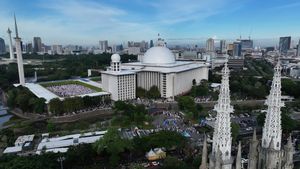
Potret Masjid Istiqlal Tempat Presiden Prabowo Salat Idul Fitri 1446 Hijriah
31 Maret 2025, 18:55

Strategic Recommendations To Create An Inclusive Mosque
P3M provides eight main recommendations for mosques in Indonesia to be more inclusive:
Transformation towards a disability-friendly mosque is not just a technical need, but a constitutional and spiritual mandate. With political commitment, policy support, and public awareness, mosques can become an inclusive worship space for all people without discrimination.
The English, Chinese, Japanese, Arabic, and French versions are automatically generated by the AI. So there may still be inaccuracies in translating, please always see Indonesian as our main language. (system supported by DigitalSiber.id)
Most Popular Tags
#Prabowo Subianto #donald trump #firearm #8791 #giias 2026Popular


